Double Star of the Month in Eridanus
-
December 2024 - Double Star of the Month
STF 430 Tauri (03 40 28.04 +05 07 33.2) is a coarse and unequal triple star found 1.5° WSW of 29 Tauri. The AB consist of stars of visual magnitude 6.8 and 9.8 separated by 26" at a PA of 57 degrees.
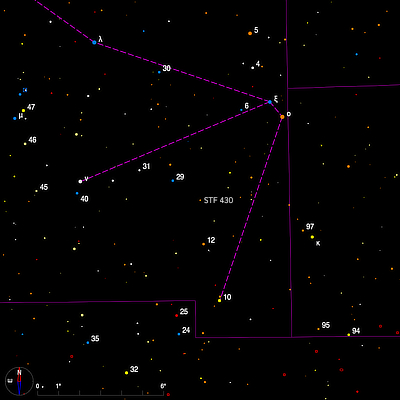
A finder chart for the double star STF 430 in Taurus created with Cartes du Ciel. The primary is a K2III and appears distinctly orange in the eyepiece. An observation made with a 10-inch mirror at x48 showed that B is blue as is the further companion, C, which is 34" away and is somewhat fainter than B.
Although A and B have similar parallaxes they are not the same within the errors quoted in the Gaia DR3 catalogue, and actually the faintest star is much closer to us than the other stars.
In southern Eridanus near the border with Caelum lies 41 Eridani (04 17 53.62 -33 47 54).

A finder chart for the double stars 41 Eridani and HJ 3642 in Eridanus created with Cartes du Ciel. This is a star which has an unusual chemical composition which contains significant amounts of mercury and manganese. Such stars are found to be common in spectroscopic binary systems and in 2012 a team using the VLTI in Chile resolved 41 Eri into two with a period of 5 days and a separation of a few milli-seconds of arc.
A century before, however, Robert Innes, using a 7-inch refractor from the Cape of Good Hope, found the star to be a close double bright (I 270) with magnitudes of 3.6 and 4.
The pair began to close in and were last seen in 1933 when the distance was 0".1. Later attempts to resolve the stars have failed - between 2017 and 2019, Dr. Andrei Tokovinin was unable to see the companion using a 4-metre telescope and it is now supposed that this is not a visual double star.
In 1836 John Herschel found a faint companion (HJ 3636 AC) about 60" distant and gave the magnitudes as 3 and 14. Today the WDS gives magnitudes of 3.9 and 11.8 with PA and separation of 8 degrees and 49".
Whilst in the area check out another HJ pair, no. 3642 just a few arc-minutes SSE - 6.6, 8.7, 157 degrees, 5".2.
Bob Argyle - Double Star Section Director
-
December 2021 - Double Star of the Month
STT 65 (03 50 18.9 +25 34 47) is close visual pair about 2 degrees north-east of the Pleiades but which does not appear to be part of the cluster. Although the compilers of Gaia EDR3 decline to pronounce on the value of its parallax, the Hipparcos mission found it to be less than half the distance to the Pleiades at 184 light-years.

A finder chart for the double star STT 65 in Taurus created with Cartes du Ciel. The pair was discovered by Otto Struve using the 15-inch refractor at Pulkova in the 1840s and it has been followed regularly ever since the orbital period was found to be relatively short (it is currently thought to be 61 years). The orbit is highly inclined and quite eccentric which means that the apparent distance between the stars ranges from 0".03 (in 1996) to almost 0".7 in 2033. At the end of 2021 the stars will be 0".59 apart and thus within range of a good 20-cm aperture, although there is a significant difference in magnitudes between A and B - 5.7 and 6.5 respectively.
Located in the narrow part of Eridanus which squeezes between Fornax and Horologium, is the K giant star y Eri (magnitude 4.6). Half a degree east is the fine pair DUN 15 (03 39 45.49 -40 21 08).
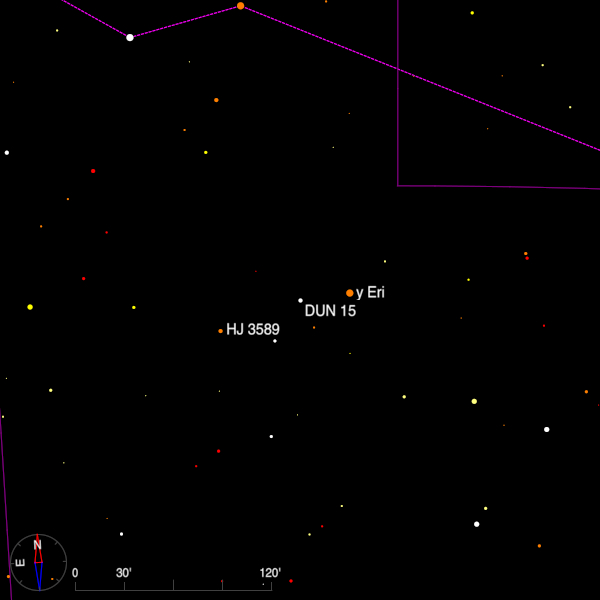
A finder chart for the double star DUN 15 in Eridanus created with Cartes du Ciel. Since John Herschel's measure in 1836, the distance has increased from 4".0 to 7".5 at the current time, whilst the position angle has reduced from 335 degrees to 327 degrees. The stars are both of spectral class A and the Washington Double Star Catalog (WDS) gives the V magnitudes as 6.9 and 7.7. This does seem to be a physical pair as the Gaia EDR3 catalogue lists a parallax for each star which is the same (mean value 4.70 mas = 694 light-years) within the errors.
Moving 1 degree ESE from DUN 15 will bring the observer upon HJ 3589, an unequal pair of magnitures 6.5 and 9.3 with position angle 350 and a current separation of 5".0 but which appears to be slowly decreasing.
Bob Argyle - Double Star Section Director
-
November 2020 - Double Star of the Month
Some 90 arc-minutes to the east of alpha Cas is the open cluster IC 1593 which is inside the nebulosity NGC 287. The cluster is dominated by a group of 9th and 10th magnitude stars which attracted the attention of S. W. Burnham soon after he obtained his 6-inch Clark refractor.
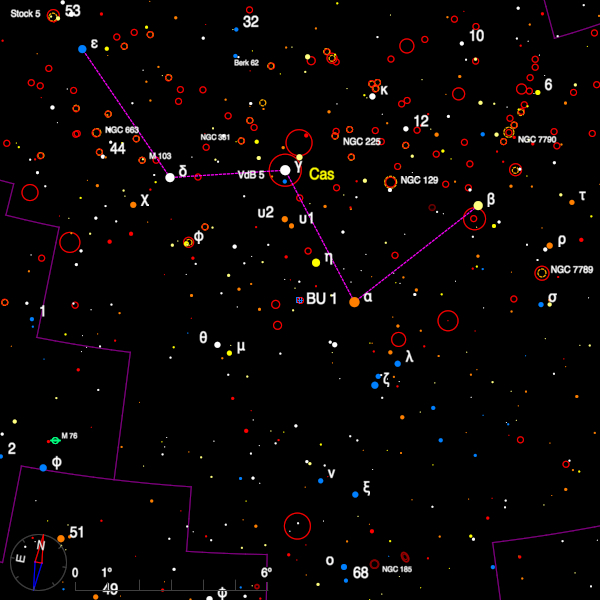
A finder chart for the double star BU 1 in Cassiopeia created with Cartes du Ciel. He found that the brightest star in the cluster (V = 8.6) is a close double. There is a magnitude 9.3 star at 1.5 arc-seconds distance, whilst star C is magnitude 8.9 is 4 arc-seconds away with another 9.7 (D) at 9 arc-seconds distance. It is not clear where this group ends and the cluster begins.
The WDS lists 16 components altogether with most of the stars lying between magnitudes 12 and 16. The accepted distance to the cluster is 2.94 ± 0.15 kiloparsecs whereas the parallax of star A in Gaia DR2 corresponds to a distance of 2.80 ± 0.38 kpc. The bright multiple is known as BU 1 (00 52 49.22 +56 37 39.5) although this was not actually the earliest Burnham discovery.
The southern part of this column in its second appearance in 2006 considered the glorious pair theta Eri or Acamar. Starting at this star and moving three degrees west you will alight upon the closer pair HJ 3527 (02 43 20.36 -40 31 38.8), also in Eridanus (as can be seen from the relevant map in the Cambridge Double Star Atlas, but the WDS catalogue mistakenly has it in Fornax - my thanks to James Whinfrey for pointing this out).
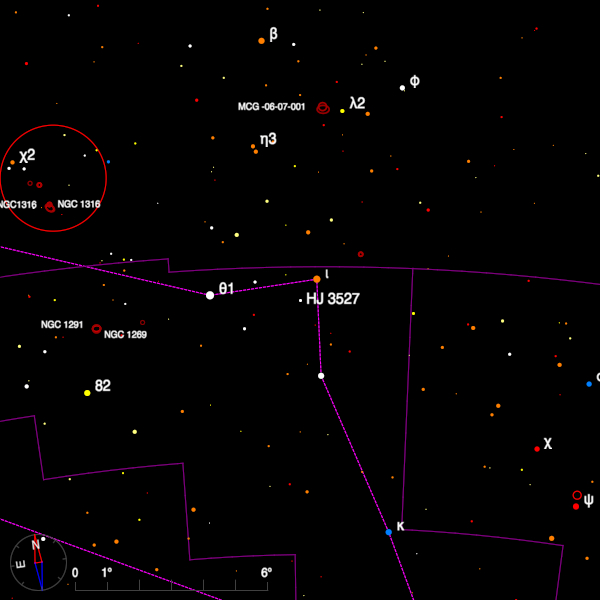
A finder chart for the double star HJ 3527 in Eridanus created with Cartes du Ciel. One of John Herschel's discoveries from Feldhausen, this is a beautiful pair, the primary of which is a late B dwarf. The magnitudes are 7.0 and 7.2 and the current separation of 2".3 appears to be increasing. Whilst observing this star in 2013 with the 67-cm refractor in Johannesburg, the writer found a faint and distant star of magnitude 11.6 at 133", unassociated with the bright pair.
Bob Argyle - Double Star Section Director
-
December 2019 - Double Star of the Month
14 Aurigae (05 15 24.39 +32 41 15.3) sits in a small cluster of naked-eye stars 5 degrees north and a little preceding beta Tauri. It was first found by William Herschel on 24 September 1780, who called it H IV 19. He gave the colours as reddish-white and dusky but by the time that F. G. W. Struve had observed the system the colours had become greenish and blue.
Struve also added a fainter companion B of magnitude 10.9 at 11 degrees and 9".8 whilst the Herschel companion was reclassified as C. There is an additional 10.8 magnitude star at 180". The writer measured AC in early 2016 at 225 degrees and 14".5.
Hubble Space Telescope (HST) observations of star C have shown the existence of a white dwarf companion 2" away but 7 magnitudes fainter than C in the V band. There are no confirming observations to attest that the white dwarf is a physical member of the system, but if it is then 14 Aur is quintuple as both A and C are spectroscopic binaries and C is attached to A.
A low power field also includes 16 Aurigae, a considerably more difficult pair found by Otto Struve in 1848. The Washington Double Star Catalog (WDS) gives magnitudes of 4.8 and 10.6 whilst the position of B has changed little relative to A. In 2009 it was at 55 degrees and 4".1. This implies a physical relation as the primary star, a K3 giant has a proper motion well in excess of 0".1 per year. Gaia DR2 shows the B star but is coy about it's parallax and proper motion.
BU 311 (04 26 56.93 -24 04 52.8) lies in an extensive sparse area of Eridanus about 10 degrees west of Lepus. It was found by S. W. Burnham with his 6-inch refractor on 24 October 1874, who estimated the distance at 1". Burnham noted that there was
uncertain change
by the time he compiled his General Catalogue (1906).Since then the companion has passed through periastron and is now on the opposite side of the apparent orbit at half the discovery distance. The period is 596 years and the stars will remain close for some years to come. The ephemeris for 2020.0 gives 162 degrees and 0".4. The magnitudes are 6.7 and 7.1, so about 30-cm will be needed to divide these stars.
Bob Argyle - Double Star Section Director
-
December 2018 - Double Star of the Month
Both pairs in this month's columns are long period binaries accompanied by distant and faint, but co-moving companions.
STF 326 (02 55 39.06 +26 52 23.6) was unknown to me until recently. Observations of it on the web indicate that the stars are yellow-orange and reddish. It is 1.5 degrees ESE of 41 Arietis, itself a wide pair found by Herschel (3.6, 8.8, 237 degrees, 123"), but also a more complex system according to the Washington Double Star catalogue (WDS).
Despite having moved just 5 degrees in position angle (PA) since 1831, STF 326 was allocated a hyperbolic orbit in the 1960s - suggesting that the stars make one close approach and then fly off into different directions in space. The existing astrometry hardly supports this theory but the stars have certainly closed since discovery and are now at 221 degrees and 5".5 with the K2 primary at magnitude 7.7 and the M0V secondary at V = 10. They are thus rather faint but the fine colours make this a system worth looking out for.
There is a background star (C) at 171 degrees and 41" (magnitude 11.9), but the 13.9 magnitude comes at 266 degrees and 44" is LDS 883 D. It is at the same distance as the AB pair, and moving with the same substantial proper motion- 0".3 per year.
Gaia DR2 puts them all at 73.5 light years.
BU 1004 is in the constellation of Eridanus (04 02 03.44 -34 28 55.7) and located about 3.5 degrees west of 41 Eri. It was found by Burnham in 1881 and with magnitudes of 7.3 and 7.9 it must have been an easy object in the Mount Hamilton 12-inch.
Since then the position angle has reduced by 100 degrees and the separation has changed from 1".7 to the current value of 1".2 at PA 50 degrees, making it a rather tricky object from the UK due to the very low altitude.
J. Docobo finds an orbital period of 410 years and predicts that the stars are now close to minimum separation and may reach a maximum of 1".8 by around 2280.
In the last century W. J. Luyten found a faint star, probably a white dwarf, moving through space with a similar proper motion to AB. LDS 3551 B is visual magnitude 18 and lies 64" distant in PA 313 degrees.
DR2 pins all three stars down to 151 light years give or take 0.1 or 0.2 light years so this is a physical triple star.
Bob Argyle - Double Star Section Director
-
December 2016 - Double Star of the Month
pi Arietis (02 49 17.55 +17 27 51.5), also known as STF 311, is a very unequal triple and as such probably needs 10-cm to see all three well. The stars are magnitudes 5.3, 8.0 and 10.7, and the separations of AB and AC are 3".2 and 24".1.
AB first came to the attention of the elder Herschel in 178x and is listed as H I 64. Sissy Haas notes that this pair was not seen in 12.5-cm, but Admiral Smyth is enthusiastic about this
superb trio
.Pale yellow
,flushed
anddusky
is his conclusion on the star hues.The proximity of pi Ari to the ecliptic has resulted in lunar occultations occurring and it was during one of these events that a close companion to A was found. A also appears to be an SB1 but it seems unlikely that this is the occultation pair so A would appear to be a group of 4 stars.
Looking much further out David Arnold finds a mag 10.5 star at 220" whilst Tofol Tobal has imaged stars of mags 14 and 15, at respectively 14".2 and 17".5 from A.
DUN 16 = f Eri (03 48 35.88 -37 37 12.6) is a member of the Tucana/Horologium + Columba moving group - a cadre of bright stars with similar space motions which are between 37 and 65 light years away from the Sun.
The pair consists of a magnitude 4.7 B8 dwarf paired with a 5.3 magnitude A1 dwarf. The separation has increased from 7" in 1826 to 8".4 in 2009 whilst the position angle has changed from 202° to 216° in the same interval.
The significant proper motion of star A would have moved it further away from B had B been a field star, rather than a binary companion, as seems to be the case.
One star is possibly a beta Lyrae-type eclipsing binary. The revised Hipparcos parallax gives a distance of 50.8 parcsecs. Ernst Hartung says that
This beautiful pale yellow pair dominates a field of scattered stars and is a fine sight with 7.5 cm
. Sissy Haas calls it aShowcase pair
.Bob Argyle - Double Star Section Director
-
December 2015 - Double Star of the Month
Epsilon Arietis = STF 333 (02 59 12.73 +21 20 25.6) can be found 17 degrees following beta Arietis. It is in a rather sparse area of sky and for those without setting circles this is probably the easiest way to find it.
It is a splendid binary star with both components of mags 5.2 and 5.6 being white to most eyes although W. H. Smyth fancied that he saw a pale yellow hue to the primary star and the secondary was 'whitish'. Smyth also noted that the Reverend Dawes first saw this pair at his observatory at Bedford.
Struve noted is as being amongst the closest of his discoveries (0".5) and subsequent observations showed it widening with a small increase in position angle. Over the last century there has been little motion of note except that the companion now seems to have reached greatest elongation and is slowly heading back towards the primary star.
In Webb Society Double Star Circular No 17 (2009) Ian Coster produced an orbit for STF 333 with a period of 313 years and three years ago Francisco Rica published one with a period of over 1200 years, so the future motion is almost entirely indeterminate. The pair will certainly remain an excellent test for 10-cm aperture for a few years yet, and the current separation is 1".34. A faint field star of mag 12.7 is 146" distant.
John Herschel swept up the coarse triple HJ 3644 (04 21 31.29 -25 43 42.4) in 1836. It is located in an empty region in Eridanus and can be found by firstly locating the bright pair nu3 and nu4 Eri and moving about 9 degrees due north.
Herschel noted the stars had magnitudes 6, 8 and 14 and only estimated angles and separations. Modern catalogues give the brighnesses as 6.2, 8.2(C) and 13.0(D) and the distances between AC and AD are now 41" and 44". Burnham found the A star to be a close double in 1879 when using his 6-inch refractor on Mount Hamilton in California, fortuitously as it turns out because the pair was then at its widest separation of 0".65.
For a few years after discovery motion appeared rather slow but accelerated considerably in the second decade of the last century and the pair closed up to 0".2 by 1920. Modern computations give orbital period as 81 years and at the present time the stars are slowly widening. The position for 2016.0 is 222°, 0".40 so at least 25-cm is necessary to see the pair divided. The WDS lists the magnitudes of AB as 6.6 and 7.3.
Bob Argyle - Double Star Section Director
-
Double Star of the Month - December 2013
In this series of short articles, a double star in both the northern and southern hemispheres will be highlighted for observation with small telescopes, with new objects being selected for each month.
88 Tau (04 35 39.23 +10 09 39.3) is a binocular pair whose visual magnitudes are 4.3 and 7.8, which can be easily found 6 degrees due south of Aldebaran. Smyth referred to it as a `star with comes' and blithely asserted that after the year 2000 the stars would start to approach each other in the southern part of their orbit. He based this on a difference of position angle of 4.5 degrees between 1800 and 1822 when perhaps the most obvious inference is that the two stars are unconnected. In fact, Piazzi's position for 1800 is not very accurate and there has been little change since 1822. The two stars actually have similar proper motions and may have been co-eval. Smyth noted that the colours were bluish-white and cerulean blue whereas T. W. Webb (yellow-white and yellow-red) and, more recently, Sissy Haas (vivid lemon yellow and silvery cherry) seem to differ from this. In fact 88 Tau is a sextuple system. The A star was resolved by speckle into two components separated by 0".12 and mags of 4.4 and 6.6. The period is 18 years. Both of these stars are spectroscopic binaries with periods of 3.57 and 7.59 days. Distant B is also an SB with a period of 1349 days.
BU 391 (04 26 56.93 -24 04 52.8) can be found in a very sparse part of Eridanus, about 8 degrees N of nu3 and nu4 Eri. It is one of Burnhams's earlier discoveries - made with the 6-inch Clark. Burnham was not convinced that there was much change in the system when he compiled his Catalogue in 1900 but subsequently the stars began to close and periastron was passed around 1980. The pair is currently at 151° and 0".4 which makes it a challenge for a medium aperture from the UK. The magnitudes are 6.7 and 7.1 so it should be divided on a good night with 30-cm. The orbital period is 596 years (Scardia 2003) but note that the WDS catalogue notes give a much shorter and incorrect value.
Bob Argyle - Double Star Section Director
-
Double Star of the Month - December 2012
In this series of short articles, a double star in both the northern and southern hemispheres will be highlighted for observation with small telescopes, with new objects being selected for each month.
The conventional long-focus refractor user is at a disadvantage when it comes to examining that part of the sky near the celestial poles. This is a pity since there are a number of systems north of +75 which are worth looking out - amongst the binaries are STF2 and pi Cep and the beautiful optical pairs 19 Cam, STF1694 and kappa Cephei, not to mention the Pole Star itself.
The writer measured STF460 in Cepheus (04 10 02.74 +80 41 55.2) on three nights in 1994 but has not examined this slow moving binary since. The period appears to be about 415 years so it has moved almost half an orbital revolution since discovery in 1828. The position angle is increasing and anyone observing it in late 2012 should see the companion at about 149° and 0".69. Having reached a maximum apparent separation in the 1920s the pair is now closing and should reach 0".65 in around 2030. The stars are visual mags 5.6 and 6.3, and Webb gives colours of yellowish and bluish whilst Sissy Haas notes only that the primary is straw yellow.
32 Eri (93 54 17.49 -02 57 13.0) is another of William Herschel's discoveries, but being close to the equator is comfortably within reach of many latitudes and the smallest telescopes. The stars are mags 4.8 and 5.9 and the colours ascribed to stars by Hartung deep yellow and white seem to chime perfectly with the given spectral types of G8III and A2V. Only the earliest measures of the elder Herschel seem to disagree with the general finding that the separation is around 6".5. Is this an error by WH or evidence of rather swifter orbital motion which has not manifested itself since? Between the measures of Struve in 1822 and today there seems to have been no significant movement in separation or position angle but as the stars have similar proper motions there seems no doubt that they form a binary pair. At 165" there is a 10.5 magnitude third star - it too shows no apparent motion over 150 years, so is it also a member of the system?
Bob Argyle - Double Star Section Director
-
Double Star of the Month - December 2011
In this series of short articles, a double star in both the northern and southern hemispheres will be highlighted for observation with small telescopes, with new objects being selected for each month.
With the Pleiades now high in the sky there is the opportunity to get a good look at this young star cluster some 420 light years distant.
James Mullaney and Wil Tirion in their Atlas note nine double stars within a radius of 3 degrees of the cluster centre. Most western of these is 7 Tau (033426.62 +242752.1) and although it lies at the same distance as the cluster its proper motion indicates that it does not belong. William Herschel noted the wide companion of V = 9.9 at a distance of 22" and it resides in the WDS as H 4 88. Thomas Lewis considered it was an optical companion but the WDS says that it is physically connected. It was Freidrich Struve who resolved the primary into a close pair of stars of mags 6.6 and 6.9 at a distance of 0".6. The pair closed to 0".2 about 90 years ago and has now widened again to 0".7 and PA 353 (2012). In a 20-cm OG it is usually a difficult pair and requires a steady air for a good view. The period appears to be around 520 years and both stars appear white to the writer; Smyth made them white and yellowish.
Some 20 degrees below the tip of the `V' of Taurus can be found the naked-eye pair omicron 1 and omicron 2 Eri. Omicron 2 is the nearby triple star STF518 which contains two dwarf stars but this month the spotlight falls on 39 Eri (041423.69 -101521.2) which is 3 degrees south of omicron 2. Another discovery by William Herschel this beautiful pair is a slow binary having moved some 10 degrees retrograde since discovery and is now somewhat closer than then also (2009, 6".7). The significant proper motion in declination of 0".16 per year would have separated the stars by more than 30" since discovery if the pair were not connected. Modern catalogue values for the magnitudes are 5.03 and 8.53 although Smyth noted star B as mag 11 in the `Celestial Cycle'. The primary is a K3 giant so both Hartung and Gould, observing from the southern hemisphere where the star is high in the sky, noted an orange hue whilst the faint secondary appeared white in both cases. Webb, observing from the Welsh border made them yellow and blue.
Bob Argyle - Double Star Section Director
-
Double Star of the Month - December 2008
In this series of short articles, a double star in both the northern and southern hemispheres will be highlighted for observation with small telescopes, with new objects being selected for each month.
zeta Per = STF 464 (03 54 07.92 +31 53 01.2) is a rare animal - a supergiant in a visual binary system. The star was thought to be a member of the Perseus OB2 association but the recently revised Hipparcos parallax puts it around 230 parsecs away, significantly closer than the association. The WDS notes 3 other companions two of which appear by dint of differing proper motions, to be optical but Kaler thinks that both B and E are physical stars. The early type of the primary (B1Ib) and star B (B8V) result in the system appearing white to the small telescope user but Smyth says `flushed white and small blue' whilst Webb says `green white and ash' and Haas has `banana-yellow and blue'. The position of B has changed little since it was measured by Struve in 1824 and is currently near 209 degrees and 12".9. The magnitudes of A and B are 2.85 and 9.16 making it not particularly easy for a small aperture. The WDS notes that A is a spectroscopic binary but no orbit appears to have been calculated for it and a paper in 2003 shows no variation in radial velocity. Both stars appear white to the writer.
f Eri = Dun 16 (03 48 35.82 -37 37 12.5) `Superb double star but ill defined' wrote John Herschel in 1847 commenting on his observations made 11 years earlier. Hartung gives both stars as pale yellow whilst the WDS spectral types of B9V and A1V seem at odds with this assessment. The stars are magnitudes 4.72 and 5.25 and the separation has increased from 7".0 in 1826 to 8".4 in 2002 with the angle increasing from 202 to 218 degrees in the same period. This system is some 185 light years distant and the proper motion is sufficiently large that over 200 years the stars would have separated by about 15 arc seconds if they were not binary in nature. `Showcase pair' says Sissie Haas in her book.
Bob Argyle - Double Star Section Director
-
Double Star of the Month - October 2008
In this series of short articles, a double star in both the northern and southern hemispheres will be highlighted for observation with small telescopes, with new objects being selected for each month.
This month's pairs ar both bright, well-observed binaries and well seen in small to medium apertures.
36 And (00 54 58.02 +23 37 42.4) is a beautiful pair following the Square of Pegasus, some 3 degrees south following zeta Andromedae. The two stars are strong yellow (Webb) or golden (Smyth) and form a binary system whose period is 167.7 years so it has passed the position it occupied when discovered by F G W Struve in 1827. The current PA and separation are 322 degrees and 1".1 making it a fine sight in a 15-cm telescope. It is strangely absent from Hartung's book, which includes more northerly objects of less distinction such as AC 1. This system is almost 38 pc distant and the primary is a K1 subgiant. The star itself is just visible to the naked-eye with the components being magnitudes 6.1 and 6.5.
p Eri (01 39 47.24 -56 11 47.2) is one of Dunlop's discoveries (Dun 5) and is probably the nearest equivalent to 61 Cygni in the southern hemisphere. It is close (5.3 parsecs according to Hipparcos), it contains two K dwarfs (in this case K0 and K5) which have visual magnitudes 5.8 and 5.9 respectively, has a similarly long period (483 years) and is also well-separated - reaching a maximum distance of 11.8 arc seconds in 2040. The Chambers edition of Smyth's Celestial Objects which contains a southern extension, also identifies the star as 6 Eri but does not mention colours, neither does John Herschel in his Cape observations. Hartung records both as deep yellow.
Bob Argyle - Double Star Section Director
-
Double Star of the Month - December 2007
In this series of short articles, a double star in both the northern and southern hemispheres will be highlighted for observation with small telescopes, with new objects being selected for each month.
Epsilon Per (03 57 51.2 +40 00 36) With the newly invigorated Comet Holmes causing a stir in observational circles, this month's northern double star is in Perseus where the comet has spent much of the last few months. Epsilon is located in the east of the constellation about 15 degrees following Algol. Coincidentally, its primary star - a hot B dwarf is also an eclipsing system in the Algol class. Almost due north, about 9 arc seconds distant is the companion, an A2 dwarf and so it might be expected that both stars would appear white in a small telescope. Hartung, however, notes star B to be slate gray whilst Smyth in 'Celestial Cycle' records that it is lilac. The latter also informs the reader that John Herschel suggested putting a piece of paper at the centre of the objective, (Smyth used a 2-inch stop on his 5.9-inch refractor), in order better to see the faint companion which is 6 magnitudes fainter than A. This is a relatively distant system - the revised Hipparcos catalogue, produced recently by Dr. Floor van Leeuwen gives a parallax of 5.12 +/- 0.22 mas corresponding to 630 light years.
Jc 8 (03 12 25.7 -44 25 11) In 1835 John Herschel found a close double star at this position and gave it his catalogue number 3556. He had trouble in making out that it was wedge-shaped and estimated the position as 230 degrees+/- and 1.5 arc seconds. In March 1856 Captain W. S. Jacob in Madras, whilst making measures of southern pairs with his 6.3-inch refractor made by Lerebours and Secretan, suspected the A component of being double in the S direction. This has turned out to be a rapid visual binary with a period of 45.2 years with the separation varying from 0.04 to 0.75 arc seconds. Currently the separation of AB is 0".70 and the pair is beginning to close again, whilst that of AB-C has widened to 3".7 making the whole group an attractive sight in a 20-cm telescope or bigger.
Bob Argyle - Double Star Section Director
-
Double Star of the Month - December 2006
In this new series of short articles, a double star in both the northern and southern hemispheres will be highlighted for observation with small telescopes, with new objects being selected for each month.
gamma And (02 03 53.9 +42 19 48) is one of the most impressive double stars in the northern hemisphere. It first appears in the list of pairs found by Christian Mayer and published in the Astronomische Jahrbuch in 1784. William Herschel first measured it in the late 1770's when he found 70.4 degs and 9".25 `a mean of two years observation'. The colours are striking - yellow and blue green, the latter a contrast effect - reflecting the spectral types of K3 and B8. The relative positions of the two bright stars has changed little since then - the modern values being 63 and 9.5 In 1842, Otto Struve, using the new 15-inch refractor at Pulkova found the companion to be a close pair. Subsequent observations show that BC is a 61 year binary with a highly inclined and eccentric orbit, closing from 0".4 at discovery to become single in all telescopes by 1892. It is currently closing again (the latest orbit showing 0".33 for 2007.0); between 2014 and 2016 it will swing through 280 degrees of position angle and then start to widen again, having reached a minimum distance of just over 0.01 arc seconds in late 2015. This may be the last opportunity for some time for owners of 25-cm telescopes to see the pair elongated.
theta Eri (Acamar - 2 58 15.7 -40 18 17) is a brilliant white A star some 20 degrees north following Achernar (alpha Eridani). The parallax as determined by Hipparcos is 20.72 mas yielding a distance of 157 light years. The small proper motion of about 0.06 arc seconds per year of star A would have changed the separation of the pair by some 10 arc seconds over the last 200 years. No such change appears in the relative measures so the pair is clearly a long period binary. The WDS shows that the PA has changed by 8 degrees between 1835 and now whilst the separation has edged closer from 8".7 to 8".4. The notes to that catalogue also indicate that the primary star is a spectroscopic binary but it does not appear in the 9th Spectroscopic Binary Catalogue. The WDS has it under the catalogue name PZ 2 and in Piazzi's Praecipuarum Stellarum Inerrantium Positiones Mediae of 1814 the stars are given magnitudes 4.5 and 5.6. The modern magnitudes are 2.9 and 4.0. The fainter star of this beautiful pair is also an A star so both components appear white. It is visible in small telescopes and possibly larger stabilized binoculars. It reminds the writer of the pair theta Aql.
Bob Argyle - Double Star Section Director


