Double Star of the Month in Cygnus
-
August 2024 - Double Star of the Month
33 Cygni lies in northern Cygnus, near the border with both Cepheus and Draco. It forms one apex of a triangle whose sides are 1.5 degrees long with two other stars, both of which are visual doubles. The star which is directly east of 33 is STF 2687 (20 26 23.47 +56 38 19.3). This is an easy pair for the small aperture with the stars of magnitudes 6.3 and 8.1, separated by 25".

A finder chart for the double star STF 2687 in Cygnus created with Cartes du Ciel. The other member of the triangle is STF 2671 (H I 95). This is a brighter but closer pair than STF2687. The main components have magnitudes 6.1 and 7.5 and the current position of the fainter component is 337 degrees and 3".8, coordinates which have changed very little over 200 years. There is a 12.4 magnitude star at 53 degrees and 90" and two further 13th magnitude field stars.
The second edition of The Cambridge Double Star Atlas shows the pair HJ 2975 in Capricornus about 5 degrees south of, and slightly following, the bright triangle of visual double stars formed by omicron (ο) Cap, rho (ρ) Cap, and pi (π) Cap (see this column for August 2015, 2016 and 2017 respectively). It is a fairly difficult pair for small telescopes as the Washington Double Star catalog (WDS) gives magnitudes of 7.5 and 11.6 and a separation of 11".
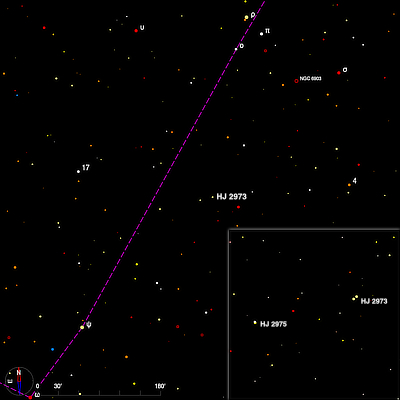
A finder chart for the double star HJ 2973 in Capricornus created with Cartes du Ciel. The Atlas also shows that the star immediately north preceding by about 30 minutes is also double. This is a brighter and easier object (magnitudes 7.8 and 8.1) which does not warrant a label because the stars are 39" apart, but it is HJ 2973 (20 32 13.27 -22 09 17.6), a pair of yellowish F stars, one of which was found to be a close double at a lunar occultation in 1983.
These Herschel pairs were discovered using the 20-foot reflector from Slough in 1830/1, and John Herschel allocated magnitudes of 8 and 14 to HJ 2975 and 8.9, 8.9 to HJ 2973.
Bob Argyle - Double Star Section Director
-
August 2022 - Double Star of the Month
In the column for August 2019, I described 16 Cygni, a bright and easy double foundabout 6 degrees north of delta Cygni. Starting with 16 Cygni, and moving west about 5 degrees a coarse triple of 6th magnitude stars will appear in the finder field. The easternmost of these is STF 2486 (19 12 05.03 +49 51 20.7) which consists of stars with V = 6.5 and 6.7 which are currently 7".1 apart in position angle 202 degrees.
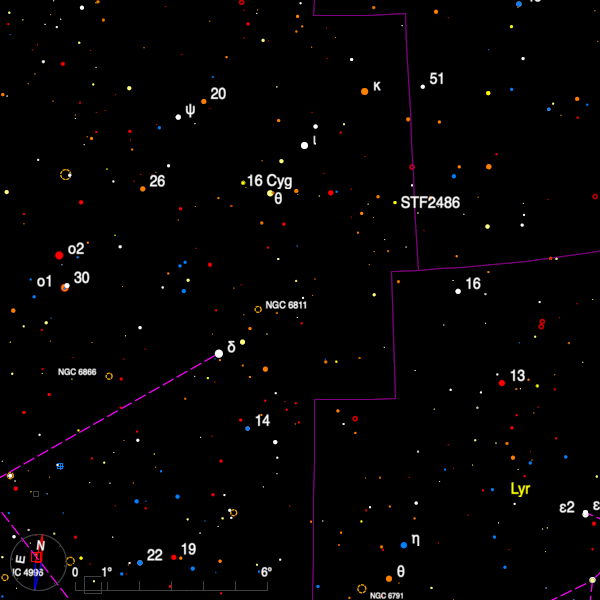
A finder chart for the double star STF 2486 created with Cartes du Ciel. This is a relatively nearby (82.5 light-years) binary pair whose period has been found to be 1459 years but clearly this is a preliminary value, since the position angle has decreased but 21 degrees since 1819. The proper motion of the stars is more than 0".6 per year, so they are rapidly leaving behind star D (V = 11.1) at 196", but rapidly approaching star C which is V = 13.2 at 27".
Sir William Herschel's third and last catalogue of double star discoveries includes many pairs which are low in the sky from the UK, and two of them were found close to omicron Sagittarii.
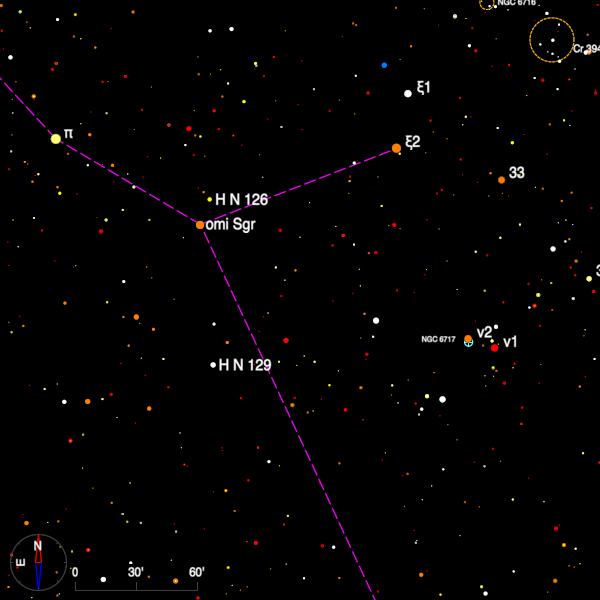
A finder chart for the double star double stars H N 126 and H N 129 created with Cartes du Ciel. The first of these, H N 126 (19 04 20.28 -21 31 53.7), is the more difficult of the two. It is about 15 arc-minutes NW of omicron and consists of stars with magnitudes 7.9 and 8.1 which are currently 1".3 apart in PA 183 degrees. This binary has almost completed 270 degrees of its apparent orbit since discovery, has an orbit of about 502 years, and lies 168 light-years distant.
About 1.25 degrees due south of omicron is H N 129 (19 04 14.20 -22 53 47.5), significantly easier at 309 degrees and 8".3, but with two components which are considerably unequal (V = 6.9 and 9.2).
Bob Argyle - Double Star Section Director
-
August 2019 - Double Star of the Month
16 Cyg (19 41 49.1 +50 31 32) is a beautiful, wide double star easily found by heading due north from delta Cygni, itself a bright although unequal and much closer pair (see the column for Aug 2011).
16 Cyg is a much measured pair and the Washington Double Star (WDS) observations catalogue has almost 600 entries.
It is clear from the astrometry of both stars given by the Gaia DR2 mission that they at the same distance from Earth (A is 68.8 light years away whilst B is 69.2). It seems certain that they form a binary system of long period where here long is taken to mean anywhere from 18 centuries to 485 centuries. This is the range of possible solutions from three different research groups.
In 1998 a star of visual magnitude 13, thought to be a M dwarf was found just 3 arc seconds from A and it is clear that it shares the large space motion of the bright stars and is therefore physically associated with A. In 1996 a planet associated with A was independently found at Lick and McDonald observatories which has a period of 2.19 years.
16 Cygni is a binocular pair but best seen in telescopic apertures. The components are spectral types G1 and G3, so slightly larger and more luminous than the Sun, and they shine with magnitudes 6.0 and 6.2. Smyth calls them pale fawn colour, whilst Webb just notes that they are yellow.
AC11 (18 24 57.2 -01 34 46) is in Serpens, about 2 degrees north-west of the 3.3 mag eta Serpentis. It was found by Alvan Clark on 30th July 1854, and reported by W. R. Dawes to the Monthly Notices of the RAS. "A very difficult object", he reported, "though decidedly elongated with a 7.5-inch aperture".
The stars are of magnitudes 6.7 and 7.2 and at present this 248 year binary is just closing from maximum separation. The orbital position in late 2019 is 354 degrees and 0".8 and it is well seen in the Cambridge 20-cm refractor. It remains above 0".6 for another 20 years or so and then dives down to about 0".03 towards the end of this century.
Continue another 2 degrees NW to find 59 Ser, a pretty pair separated by just under 4".
Bob Argyle - Double Star Section Director
-
August 2018 - Double Star of the Month
Embedded in the Milky Way in Cygnus, about 2 degrees East and slightly south of 22 Cyg, is HJ 1470 (20 03 39.5 +38 19 38.3) a deep-red star which lies at a distance of 1630 light years (with an error of about 30 light years) according to the latest results from the Gaia mission (DR2). Simbad gives the spectral type as M0III and the star is about 225 times as bright as the Sun.
John Herschel noted a distant companion of magnitude 9.3. The Cloudy Nights website contains drawings of HJ 1470 and three nearby pairs which together form an arc of stars about 22' across and known as Chaple's Arc or the Fairy Ring. The other pairs are considerably less impressive.
An observer in the US using an 8-inch at x53 noted that the primary was strong yellow-orange/reddish and greyish-blue. At the beginning of 2005, I measured the pair with the Cambridge 8-inch. The result was 340 degrees and 28".6.
Browsing though Sissy Haas' excellent descriptive guide to visual double stars, I came across the pairs S 715 (19 17 39.96 -15 58 01.7) and S 716 (19 18 05.55 -15 57 13.4) which can be found in Sagittarius.
The brighter pair is S 715 where the two components have magnitudes of 7.1 and 7.9 and they are currently at 17 degrees and 8".4. Just 6 arc minutes preceding and 1 arc minute north is S 716 with magnitudes 8.4 and 8.6 at 194 degrees and 5".0.
Gaia has observed both pairs; each appears physically connected but the components of S715 are 480 light-years away whilst the stars in S 716 are both 1030 light-years distant.
S 716 is also known as Stone 46. Ormond Stone (1847-1933) was Director of Cincinnati Observatory where he found a number of pairs using the 11-inch refractor, in this case about 40 years after South first noted it.
I measured S 715 in 2016 with the Johannesburg telescope, but S 716 was not noticed, although it should have been clear in the 6-inch finder.
Bob Argyle - Double Star Section Director
-
August 2015 - Double Star of the Month
Lambda Cygni (20 47 24.563 +36 29 26.7) is easily found. Just move 3 degrees due north from epsilon Cygni, the left-hand star in the cross. One of Otto Struve's discoveries from Pulkova the seeing needs to be good to get a measure of the companion. The stars are magnitudes 4.7 and 6.3 but have always been separated by less than 1" although the angular distance between the stars is now roughly double that at discovery. Since 1990 the writer has observed the pair in 12 seasons and in that time the position angle has decreased by about 10 degrees. The current orbit has a period of 391 years but this is complicated by the fact that Hal McAlister and colleagues found the primary to be an interferometric binary with a period of 11 years and maximum separation of 0".05. There is some evidence that one of the three stars is also a single-lined spectroscopic binary. Lambda Cyg has a spectral type of B5Ve and is a rapid rotator surrounded by a circumstellar disk. Sir James South adds a faint companion, mag 9.7, at 106° and 83".
The sprawling constellation of Capricornus sits near the meridian on a northern summer night but locating stars in it apart from the third magnitude alpha and beta needs the help of a star atlas. However, starting with the brightest star of all, beta, by moving 3 degrees south and slightly east a trio of stars is encountered, all enclosed by a 1 degree field. Each of these is a visual double star and the subject of this column is omicron Cap = SHJ 324 (20 29 53.91 -18 34 59.4) the most southerly of the three. Smyth calls it omicron2 and notes that both components are to be found in Piazzi's catalogue. The WDS gives magnitudes of 5.9 and 6.7 and the separation is currently 21".9, down from 25" when found by William Herschel with a small decrease in the position angle, currently 238°. The Hipparcos catalogue gives the distance as 216 light years but with a formal error of 27% this is an indicator that there could possibly be another star nestling in the system.
Smyth calls both stars bluish, and whilst Sissy Haas regards them as almost equal, the report by Hartung notes that they are an 'unequal white pair'.
Bob Argyle - Double Star Section Director
-
Double Star of the Month - September 2013
In this series of short articles, a double star in both the northern and southern hemispheres will be highlighted for observation with small telescopes, with new objects being selected for each month.
As telescope makers of renown the Clarks (Alvan and his son Alvin George) were able to point large new telescopes at bright stars in order to test them and, if lucky, they discovered new companions. Such was the case of Sirius but here there was already significant evidence that the star was double based on Bessel's discovery of variable proper motion.
In the case of tau Cygni (21 24 47.35 +38 02 39.6), however, the discovery of duplicity was entirely serendipitous. Discovered by A. G. Clark using a 26-inch refractor, it has turned out to be a system of considerable interest. The period is 49.8 years and the separation varies from about 0".5 to 1".1 but the difficulty for the observer is the significant difference in brightness between the two stars. The WDS gives V mags of 3.8 and 6.6. The writer has seen the comes with the 8-inch OG at Cambridge and the system is widening again at present - in the autumn of 2013 the position will be 213° and 0".9 and so should be seen in 20-cm on a night of good seeing. The pair is easy to find as the southernmost of a trio of brightish stars 10 degrees following gamma Cygni and it is 1.5 degrees south following 61 Cygni. Recent investigations by the astrometric-based Palomar High-precision Astrometric Search for Exoplanet Systems (PHASES) have pointed out the possibility of a sub-stellar companion to one of the stars. The period may be 826 days and the mass may be 12.3 Jupiters but this is very much preliminary work.
About 10 degrees preceding the 3rd magnitude star beta Aquarii is 3 Aqr. Just south following is a pair of stars the preceding of which is 4 Aqr and the following 5 Aqr. William Herschel noted that 4 Aqr (20 51 25.69 -05 37 35.9) was double on Sept 3 1782 and listed it as number 44 is his Class I stars. Wilhelm Struve measured it at Dorpat in 1825 and at present the stars are in almost exactly in the same place having undergone a whole orbital revolution since then. This 187-year-period binary is not particularly easy from the UK due to its low declination and it is now closing again. For 2014.0 it will be at 30° and 0".7 making it a target for a superior night. The stars are mags 6.4 and 7.4.There are two distant and unconnected comites - C is 13.3 at 74" from AB and D is 9.7 at 136". In each case the separation is increasing.
Bob Argyle - Double Star Section Director
-
Double Star of the Month - August 2011
In this series of short articles, a double star in both the northern and southern hemispheres will be highlighted for observation with small telescopes, with new objects being selected for each month.
Delta Cygni (19 44 58.4 +45 07 51), like Alpha Pav, is a B subgiant, if a little later in the spectral class. Its duplicity was discovered by the elder Herschel when the separation was around 2".3. Over the next half century or so, the mag 6.3 companion moved closer to A (mag 2.9) thus making the pair more difficult for early micrometrists. Indeed Webb reports that in the mid C19 the separation was such that the B star sat on the first diffraction ring of A making it difficult to spot and some reported that it was much easier to see in the twilight sky before sunset. Reports came in of brightness variation of up to 2 magnitudes in the companion but it may well be that this was due to the large difference in magnitude and close separation. At present the distance has increased slightly since Herschel's time and the companion has traced out about 150 degrees. An orbit of 780 years period currently occupies the USNO 6th orbit catalogue and predicts 219°, 2".70 for 2012.0. Its not an easy pair for the small aperture and can occasionally evade the 20-cm user if the seeing is not at least reasonably steady. Recently, Jim Daley in the US has added four faint field stars, arranged as two 3" pairs on either side of delta and distant 42" and 148" from it.
Alpha Pavonis (20 25 38.9 -56 44 06) sits in an empty part of the southern sky but at mag 1.9 it is unmistakeable. From Feldhausen in South Africa, John Herschel examined the star and noted a distant wide pair - both stars of which are much fainter than alpha. It entered the catalogue as HJ 5193 and although there is probably no physical connection between any of the stars the system, caught the attention of the writer last year whilst using the 26-inch refractor in Johannesburg. The primary is a brilliant white, star B is reddish (John Herschel thought it `very red' and its closer companion C appeared blue - an unusual and rather patriotic combination of hues. The distance AB is 245" whilst C is 17" from B, and the magnitudes of BC are given as 9.14 and 9.17 in the WDS. It would be interesting to know if these colours are apparent in smaller apertures.
Bob Argyle - Double Star Section Director
-
Double Star of the Month - August 2010
In this series of short articles, a double star in both the northern and southern hemispheres will be highlighted for observation with small telescopes, with new objects being selected for each month.
mu Cyg (21 44 08.57 +28 44 33.4) is a fine binary, currently well-seen in 10-cm aperture. It is number 72 in Christian Mayer's 1780 catalogue of double stars and since that time has been well followed by double star observers with the WDS listing more than 700 measurements. The apparent orbit is quite eccentric (0.66) and the companion spends about one-third of the orbital period of 789 years near periastron and the remaining two-thirds near apastron. A close approach occurred in 1936 when the distance dropped to about 0".5 and so the pair having reached an elongation will now start to close slowly, reaching around 1".2 in 40 years time and then widening to 7".2 in the 24th century.
According to the WDS the stars are both F dwarfs with the companion somewhat earlier than the primary. This is an unequal pair with the stars being magnitudes 4.8 and 6.2. The primary is a double-line spectroscopic binary and both the distant companions are field stars.
One of the finest sights in a small telescope in the southern hemisphere is gamma CrA (19 06 25.14 -37 03 48.5) whose binary nature was discovered by John Herschel from South Africa in 1834. With the separation ranging between 1".3 and 2".5 and a period of 122 years this is a good system to follow over a period of a few years. At the moment the companion is at 9 + and 1".35 with the position angle reducing at the rate of about 4 degrees per year. Like mu Cyg (above) it is an unequal pair of magnitudes 4.5 and 6.4. Hartung does not give any colours but Sissy Haas mentions that Gould finds pale yellow.
gamma CrA is 56 light years distant according to Hipparcos and located near the border with Sagittarius. The bright globular NGC 6723 appears in the same wide-field finder view when acquiring the star.
Bob Argyle - Double Star Section Director
-
Double Star of the Month - September 2007
In this series of short articles, a double star in both the northern and southern hemispheres will be highlighted for observation with small telescopes, with new objects being selected for each month.
61 Cygni (21 06 50.84 +38 44 29.4) Although observed by Flamsteed in 1690, the duplicity of this star seems to have been first noted by Bradley in 1753. A recent orbit by Kiseleva indicates that the separation of the two stars would have been around 10 arc seconds for 1690 - certainly within Flamsteed's resolving power. He did, for instance, see the third star in the zeta Cancri system in1680 when it was 6 arc seconds from AB.
Piazzi discovered the large common proper motion in 1806, and Bessel then made his pioneering measurement of the parallax of 61 Cyg A indicating that it was nearby. Even so, as late as 1891, Burnham was not convinced that the pair was a binary one, being discouraged by the large separation which amounted to 21 arc secs at that time. At present this has widened to almost 31 seconds and, according to Kiseleva, reaches 34.3 secs in 2106 before closing to a minimum of 9 arc seconds around 2350. Long series of astrometric plates taken during the last century led to speculation that star A was accompanied by a planetary mass companion in a short period but this has not yet been confirmed.
The pair is a very attractive one for the small telescope user. The stars are both late K dwarf stars and hence orange in hue, although Hartung gives colours of orange and red. Hipparcos finds parallaxes 287.1 and 285.4 milliarcsecond for A and B with errors of 1.5 and 0.7 mas respectively.
theta Indi (HJ 5258) (21 19 51.9 -53 26 57.4) John Herschel remarked `Beautiful' as he recorded this pair found with the 20-foot reflector at Feldhausen on sweep 468 dated 1834 Jul 8. He gives the magnitudes as 6 and 10 and notes that it is number 7003 in the Brisbane catalogue. He later made four measures of position angle and two of separation to give a weighted mean measure for 1834.51 of 307°.0, 3".67. Modern catalogues such as the WDS list the magnitude as 4.5 and 6.9, a significant difference in the brightness of star B, but the distance has now almost doubled and it may be this is why the companion looks brighter in recent years.
There is no doubt that this is a physical system as the proper motion, common to both stars is 0.13 arc seconds per year and the parallax is 33.58+/- 0.76 mas equivalent to a distance of 97 light years. Hartung found the stars were pale yellow and distinctly reddish.
Bob Argyle - Double Star Section Director
-
Double Star of the Month - August 2007
In this series of short articles, a double star in both the northern and southern hemispheres will be highlighted for observation with small telescopes, with new objects being selected for each month.
beta Cygni (19 30 40.29 +27 57 34.9) One of the most famous and beautiful pairs in the sky has been a favourite for small telescopes for many years but the use of modern imaging techniques has confirmed that this is a multiple system, possibly quintuple. The bright pair was certainly noted by Flamsteed in June 1691. Spectroscopy showed the primary to have a composite spectrum, a K giant combined with a late B star, whilst the wide visual companion is a B8 dwarf. This difference in spectral type explains the marked contrast in colours between the stars. Exact shades depend upon the individual but the Victorians called them topaz and sapphire whilst modern descriptions tend towards yellow and blue. Whichever applies, the pair is a magnificent sight in binoculars. The primary component was resolved in 1976 by Harold McAlister using speckle interferometry, and subsequently seen visually by Charles Worley with the 26-inch refractor at Washington. Aa is a difficult pair, since the visual magnitude difference is about 2. A recent orbit by Marco Scardia and colleagues gives a period of 213 years and the current separation is 0".37. This pair has been resolved from the UK by Christopher Taylor with a 12.5-inch Calver reflector.
In 1980 another component, closer in than a was reported by Bonneau and Foy and confirmed about a decade later but has not been seen since. There is little doubt that A and B form a very long period binary system. The Hipparcos parallaxes agree within the errors of both, placing the stars about 118 parsecs away, whilst the proper motions are similar. In 2007 February, a paper published by Roberts et al reports the presence of a faint companion to B some 4 magnitudes fainter in the I band which may be a G dwarf.
Gale 3 (19 17 12.22 - 61 39 39.7) is a bright, relatively close naked-eye star in the constellation of Pavo. It consists of two white stars of spectral types A5 and A8. The period of the pair is 156.7 years and in mid-2007 the position angle is 340 degrees and the separation 0".51 making it a good test for a 10-inch telescope. The separation increases slowly to 0".56 over the next 50 years and then closes down to 0".15 one hundred years from now.
This is one of five pairs that Walter F. Gale (1865-1945) found with an 8.5-inch With reflector from New South Wales. Gale noted the pairs in 1894 and this list appears in Astronomische Nachrichten (AN 143, 293, 1897). However, R. T. A. Innes also found two of the stars independently but somewhat later in 1894, and acknowledges Gale's contribution in his paper - `detected by Mr. Gale on his 8.5-inch, previously to my seeing them '. Since Innes published his list first (in MN 55, 312, 1895) the pairs are given the catalogue letter I rather than GLE. Ironically, Innes was using a 6.25-inch Cooke refractor of 1851 which he had borrowed from Gale!
Bob Argyle - Double Star Section Director


