Double Star of the Month in Canis Major
-
January 2026 - Double Star of the Month
The Hyades moving group contains stars which are not immediately proximate to the open cluster on the sky. The most famous is perhaps Capella, a bright spectroscopic binary with a 104 day period which is orbited by a binary pair of red dwarfs. Another member is ENG 22 (05 41 20.33 +53 28 52.7) which can be found 2.5 degrees WSW of delta Aurigae (V = 3.7).

A finder chart for the double star ENG 22 in Auriga created with Cartes du Ciel. It was catalogued by Rudolf Engelmann but recent measures by the Gaia satellite have revealed the parallax and proper motion of both components. The pair consists of stars of V magnitudes 6.0 and 8.9 which lie at a mean distance of 40.0 light-years and which are moving across the sky at 0".5 per year. The separation and position angle have remained fixed at 98" and 72 degrees so this is probably a binary system. The primary is a K dwarf and the companion has spectral type M0.
Adhara = epsilon CMa (06 58 37.55 -28 58 19.5), at V = 1.5, is the second brightest star in the constellation, but 4 million years ago, it was the brightest star in the sky reaching magnitude -4.

A finder chart for the double star eps CMa in Canis Major created with Cartes du Ciel. In the nineteenth century a visual companion was seen at the Cape Observatory, some six magnitudes fainter and 7".5 distant in position angle 167 degrees. Ernst Hartung noted that the the pair can be seen in 75-mm aperture, and that the primary is brilliant white whilst the companion is deep yellow.
The brightness of the primary is probably the reason why the error in the parallax found by Hipparcos is significantly larger than usual. Gaia has no results for this star but it is possible that the brightest stars in the sky will be investigated towards the end of the project. The satellite was switched off on March 27, 2025 and work on the Gaia DR4 catalogue is now in progress and the results are expected towards the end of next year.
Bob Argyle - Double Star Section Director
-
January 2025 - Double Star of the Month
About five degrees east of the line joining the two stars which form the 'horns' of the constellation of Taurus, the Bull is a right-angled triangle of 5th magnitude stars. These are 132, 136 and 139 Tauri. If you acquire 132 Tau in the field then about 20 arc-minutes north-east is the wide pair STTA66 (05 47 56.13 +24 41 12). This is an entry in the catalogue of wide pairs which Otto Struve compiled during his survey at Pulkovo in the 1840s.

A finder chart for the double star STTA 66 in Taurus created with Cartes du Ciel. The stars, which are relatively bright - 7.0 and 7.7 - and are separated by 94" in position angle 166 degrees. Rather surprisingly, they appear to be at the same distance as determined by the Gaia satellite and a search around them reveals a star of magnitude 19 also at that distance although the quoted error is substantial.
132 Tauri itself is recorded in the Washington Double Star catalog (WDS) as a very close visual binary, although only observed on one occasion in 1979. During the Hipparcos survey another component was recorded. The two stars were given as 5.0 and 9.1 at 230 degrees and 3".8. And again the only observation appears to be the first one and such a pair should be visible in 25-cm (the WDS gives magnitudes 5.0, 9.1, 230 degrees, 3".8). It certainly it should have been detected in the recent Gaia observations and does not appear there.
Looking through the earlier entries in this column which occupy the southern sky I find that I have been remiss in not including one of the finest of John Herschel's pairs - HJ 3945 or 145 CMa (07 16 36.84 -23 18 56) known quite widely, especially in the United States, as the 'Winter Albireo'. The stars are not quite bright as those in beta Cygni but form a spectacular pair for the small telescope.

A finder chart for the double star HJ 3945 in Canis Major created with Cartes du Ciel. The primary is a K3 supergiant and its companion an F0 dwarf. John Herschel notes
Orange and green. Fine contrast of colours
. Modern observers also attest to the strong contrast of colours.This is certainly an optical pair - star B is 346 light years away whilst star A is 2,600. The stars can be found 3 degrees east of the magnitude 3.0 blue supergiant omicron 2 CMa. The 6th magnitude star HIP 35578 which is more than 3 degrees to the south and has almost identical proper motion to B has been formally identified as a physical companion (C). However Gaia DR3 gives its distance as 296 light-years - about 50 light-years closer than B.
Bob Argyle - Double Star Section Director
-
January 2024 - Double Star of the Month
Admiral Smyth's Bedford Catalogue contains an entry for 124 Tauri, and from his description of it as a coarse quadruple star of which components B and C are 6".2 apart in PA 318 degrees this appears to agree with Struve's catalogue entry of STF 755 (05 39 09.17 +23 17 17.7).
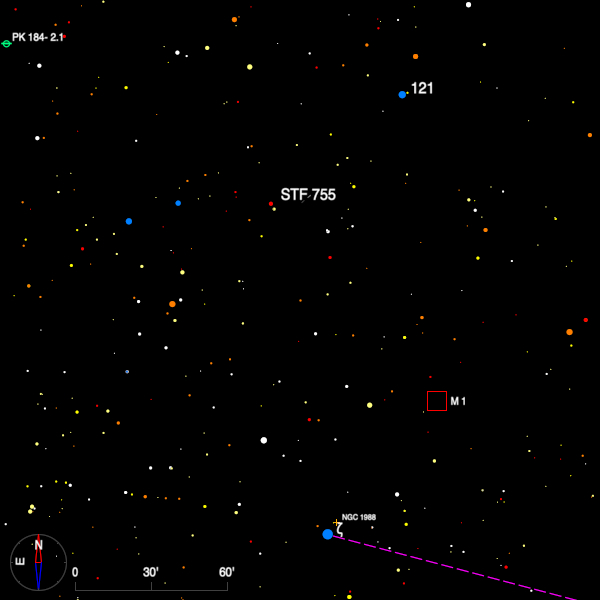
A finder chart for the double star STF 755 in Taurus created with Cartes du Ciel. According to the Washington Double Star catalog (WDS) A is magnitude 7.8 at 31 degrees and 149". This is HD 37387, a K2 giant star which appears close to the reflection nebula GN 05.36.2.The fourth star, D, is 50 degrees and 95" from A and has V = 11.1.
There is no label for 124 Tauri in the the Cambridge Double Star Atlas (2nd edition) but the star appears about 30' W of a small right-angled triangle of 6th magnitude stars which in turn sits 2 degrees NNE of zeta Tauri. Smyth happened upon it in 1835 whilst looking for Comet Halley. He gives the colours as garnet (A), pale blue-white (B,C) and bluish (D).
Some 3.5 degrees WSW of epsilon CMa is a triangle of 5th and 6th magnitude stars, the brightest of which is 10 CMa. In the same field, north following is HJ 3891 (06 45 31.20, -30 56 56.3), a double star discovered by John Herschel from the Cape of Good Hope.
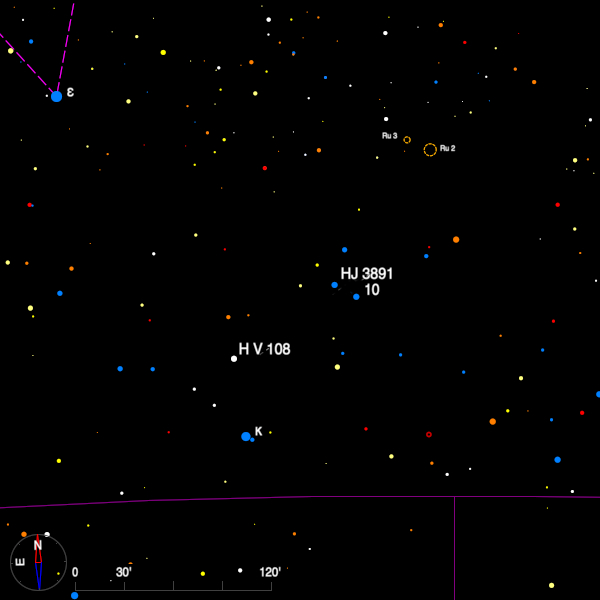
A finder chart for the double star HJ 3891 in Canis Major created with Cartes du Ciel. The primary is a B2III star of V = 5.7, and is accompanied by a 8.2 magnitude star at 223 degrees and 5".0. There has been little change since 1838. The stars have similar parallaxes and the mean distance to the system is 1968 light-years. The primary star is also called HP CMa.
Just 90 arc-minutes to the SE is a wide pair swept up by the elder Herschel in 1782. H V 108 has stars of similar brightness (5.8 and 7.7) but they are separated by 43" in PA 66 degrees. The A component has a particularly close and faint companion just 0".6 away which was discovered from Robert Rossiter in South Africa, whilst the WDS notes that the B star has a variable radial velocity. Andrei Tokovinin regards this as a physical quadruple - the brighter stars appear in Gaia DR3 with respective distances of 634 and 623 light-years.
Bob Argyle - Double Star Section Director
-
February 2022 - Double Star of the Month
To the naked eye, Canis Minor is essentially two stars - Procyon and beta (or Gomeisa). In the field with Procyon is STF 1126 which has already been described in this column (Feb 2014). Starting at Gomeisa, move 1.5 degrees due south and slightly east and you will alight on eta CMi (07 28 02.1 +06 56 32), a magnitude 5.3 star. It is also known as BU 21, the low number indicating it was in the first list of discoveries, made with the famous 6-inch Clark refractor, which S W Burnham published in 1870.
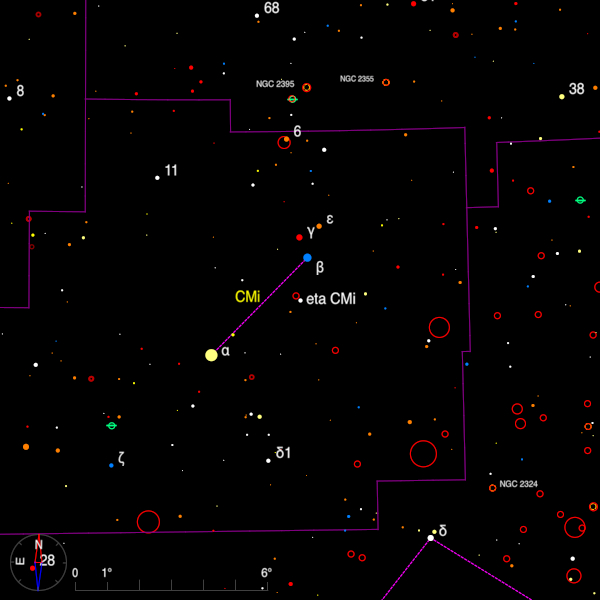
A finder chart for the double star eta Canis Minoris created with Cartes du Ciel. The Washington Double Star Catalog (WDS) gives the magnitude of B as 11.1 and the latest measures places it 4".3 from the bright primary. Gaia EDR3 tells us that the stars are at the same distance from us, within the errors of measurement i.e. 319 light-years, and that the proper motions are almost identical.
Two and a half degrees south of eta CMa (Aludra) is an equilateral triangle of 5th magnitude stars, the north-easterly of which is a fine triple for medium apertures and a difficult quadruple for 30-cm upwards.
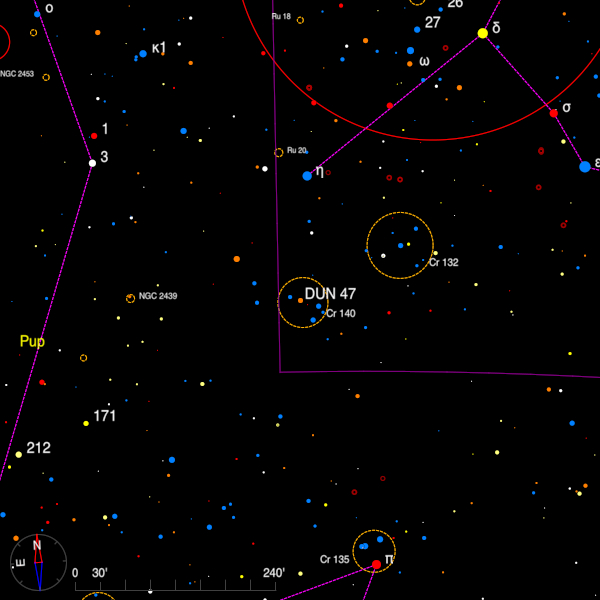
A finder chart for the double star double star DUN 47 created with Cartes du Ciel. The region was noted by James Dunlop at Paramatta when he saw a very wide and unequal pair of stars which he catalogued as DUN 47 (07 24 43.9 -31 48 32), and which is now given as AC in the WDS. These are 5.4 and 7.6 at 344 degrees and 97". A third star (B) was added by Bernhard Dawson observing with a 15-inch refractor at La Plata in Argentina. He noted a magnitude 9.7 just 2".2 from the primary and some years later Willem van den Bos added D, a magnitude 10.8 at 0".9 from C, a star which has not been measured since 1965.
Stars A and B have parallaxes close to 5.2 milli-arcseconds (630 light-years), whilst C and D are considerably more distant (mean parallax of 2.4 mas = 1360 light-years) and thus placing them at about the same distance as the nearby cluster Collinder 140. (This is a revised version - I'm grateful to John Greaves for pointing out an error in the original text).
Bob Argyle - Double Star Section Director
-
January 2022 - Double Star of the Month
phi Tauri (04 20 21.2 +27 21 03) can be found about 10 degrees north of the Hyades. Found by William Herschel, it is an attractive double star for small apertures, offering as it does, a beautiful colour contrast between the two components. The primary is a K1 giant which W. H. Smyth found to be pale red but I noted as golden yellow with a 21-cm mirror in 1968. The companion is blue and the stars are magnitudes 5.0 and 7.4.
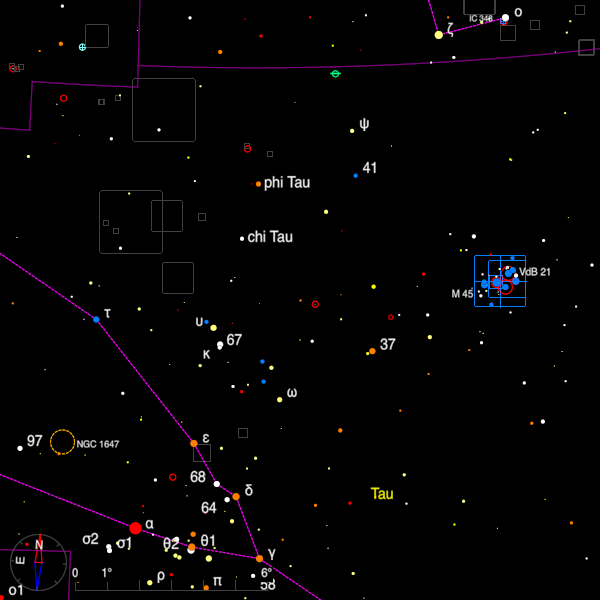
A finder chart for the double stars tau and chi Tauri created with Cartes du Ciel. I found the position angle (PA) and separation to be 258 degrees and 48".4 in 2015 and whilst this is significantly different to the first measures of this pair, the differences are due entirely to differences in proper motion due to the differing distances to each star; 284 light-years for the primary, and 346 light-years for the secondary.
Just 2 degrees south, and slightly east of phi is chi (04 22 34.9 +25 37 45), another probably optical pair, but with magnitudes of 5.4 and 8.5, it is also well-seen in small telescopes. The stars are separated by 19" in position angle 25 degrees.
The 4.4 magnitude tau (or 30) Canis Majoris (07 18 42.49 -24 57 15.8) is at the centre of the open cluster NGC 2362. Like many stars in this region it is young, hot and very luminous and has a spectral type of 09II.
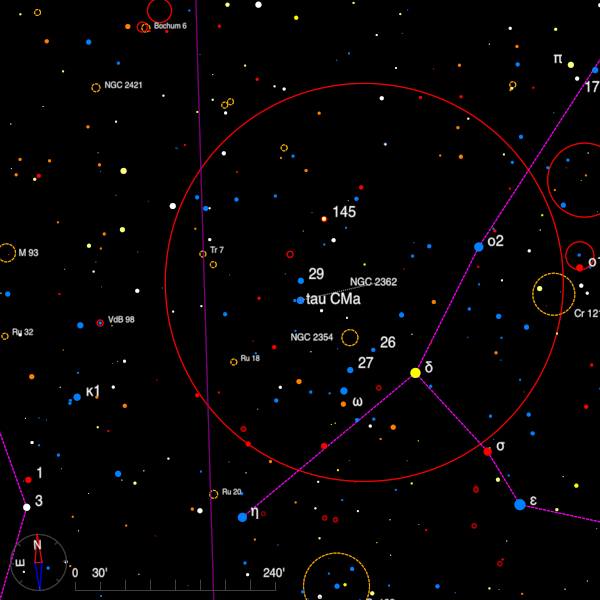
A finder chart for the double star double star tau Canis Majoris created with Cartes du Ciel. It attracts the interest of the double star observer because it appears in the catalogue of John Herschel as HJ 3948. The nomenclature applies to companions of 10.2, 11.2 and 8.2 at distances of 8".3, 14".2 and 83".5 respectively and it is of interest to the binocular observer as well as the small aperture telescope.
Tau itself, has 5 components all within 1 arc-second. Quite recently, Dr. Andrei Tokovinin found a magnitude 9.7 star nestling 0".9 away whilst in 1951, the great interferometric observer William Finsen noted another star 0".2 distant. Tau is also a tight triple star with a fainter eclipsing binary, orbiting tau itself as a spectroscopic binary with a period of 154 days.
Bob Argyle - Double Star Section Director
-
February 2019 - Double Star of the Month
Epsilon Hya (08 46 46.51 +06 25 07.7) is one of the most observed double stars in the catalogue. According to the Washington Double Star Catalog (WDS) it has been measured 432 times since it was discovered by Wilhelm Struve in 1825. It seems to have escaped the attention of William Herschel although it would have been within the capability of his telescope.
Since 1825 the companion, known as C, has moved 120 degrees in position angle with little change in separation. A measurement at Cambridge in 2017 showed it at 309 degrees and 2".93. It should be resolvable in 10-cm; the stars have visual magnitudes of 3.8 and 7.8.
In 1860 Otto Struve, using the 15-inch refractor at Pulkovo suspected that the primary star was elongated, an impression he received again in 1864. In April 1888 Giovanni Schiaparelli, observing with the 15-inch refractor at Milan, noted a clear elongation and subsequent follow-up observations allowed him to say that the primary star was a close binary of short period.
Eight revolutions have been traced out since discovery and the period of AB is close to 15.05 years. The stars are never wider than 0".27 and at the start of 2019 they are 0".22 apart and closing.
A more distant star D (V = 12.5) at 210 degrees, 18" is also physical, and C is a spectroscopic binary of period 9.9 days meaning this is a quintuple system.
The Struve pair is a fine sight on a good night - the stars are given as yellow and purple by Smyth but I saw them more as yellow and light blue.
In the visually barren but telescopically interesting area between Sirius and Procyon there are a number of fine double stars and clusters.
About 5 degrees west and a little north of 5 Pup (see the column for February 2018) is STF 1097 (07 27 56.66 -11 33 24.7), an easy 6.3 and 8.2 magnitude pair with colours of yellow and bluish.
I came across it in Spring of last year and obtained 311 degrees and 20".8. I did not see the close companion to A that Dembowski had suspected in 1865, and Burnham confirmed nine years later with his 6-inch Clark. It should be visible in 20-cm although the low altitude of the star would have been a factor.
BU 332, as it is known, is currently at 0".7 and may be closing; the stars are magnitudes 6.2 and 7.4. There are two faint comites. D is 9.7 at 157 degrees 23" (distance decreasing) and E is 12.4 at 43 degrees and 32".
Espin noted that A varied between 6 and 6.8 with a period of 14 days, whilst Otero, more recently, suggests that it is the Burnham component which is likely varying by around 0.6 magnitude to produce the small observed variation in AB (0.13 magnitude) found by Hipparcos.
Bob Argyle - Double Star Section Director
-
January 2018 - Double Star of the Month
7 Cam (04 57 17.2 +53 45 07.5) is a fairly unprepossessing system in the F G. W. Struve Dorpat catalogue and appears as number 610 in that list.
The stars are magnitudes 4.9 and 11.3 with the current position 242° and 26 arc-seconds, and there is no evidence that the stars are in anyway connected. It is 7 degrees north of Capella and about 4 degrees preceding, and is part of a group of 4th and 5th mag stars which also contain the splendid pairs 1 and 2 Cam.
In 1864, Baron Ercole Dembowski discovered that A was an unequal, close pair, the new component being magnitude 7.9 at 307° and 1".2. Since then the stars have closed in, but are now slowly widening, although by 2020 the separation will still only be 0".62 in PA 196°.
A recent orbit with a period of 2733 years has since been replaced in 2014 by a linear ephemeris by Drummond, although this has now, in turn, been updated by Hartkopf in 2017.
The two recent linear solutions give 315° 0".88 and 196° 0".62 respectively for epoch 2020 but it is difficult to understand why there is such confusion about the quadrant in which the companion is located as there is such a large difference in magnitude. Suffice to say it will take sustantial aperture to see Dembowksi's companion but visual observations will help to confirm which of the two predictions is right.
With Canis Major skimming along the southern horizon at present there is a brief window of opportunity to delve into its treasures.
Mu (μ) CMa (06 56 06.59 -14 02 34) is a pretty pair but rather close and unequal and tends to be more difficult than it really is due to its low altitude from the UK.
The stars are magnitudes 5.3 and 7.1 with a current separation of 3".1, showing a very slow closing since discovery almost 200 years ago. Struve gave colours of orange and reddish although the Washington Double Star Catalog (WDS) gives spectral types of G5III and A2.
By the way, don't forget to take a look at Sirius, just 3.5 degrees south-west of μ CMa - the companion is now fully 10 arc-seconds distant.
Bob Argyle - Double Star Section Director
-
Double Star of the Month - February 2007
In this new series of short articles, a double star in both the northern and southern hemispheres will be highlighted for observation with small telescopes, with new objects being selected for each month.
The constellation of Gemini is well up in the northern sky during the middle of the month with the famous pair of stars Castor and Pollux at the eastern end of the group. The two stars are well contrasted with Castor showing pure white, as befits its membership of the class of A stars. Pollux, on the other hand, is orange, in reality a cool giant star and is actually the brighter of the two visually, prompting suggestions that one of the stars has changed in output in recent times.
For the small telescope user, Castor (7 34 35.9 +31 53 18) is of real interest. The star is a brilliant binary with two white components of magnitudes 2.0 and 2.9 currently separated by 4.4 arc seconds in position angle 59 degrees, making it easily visible in a 60-cm telescope. It may have been first resolved by Cassini in 1678 but it was certainly noted by Bradley in 1718. Since then the position angle has decreased by almost 300 degrees, with closest approach around 1965 when the separation was 1.8 arc seconds. Some 72 arc seconds to the south-east is a star of magnitude 9, known as Castor C. This star revolves around Castor AB in a period of many thousands of years. The remarkable fact about the Castor system is that all three visible stars are spectroscopic binaries, making the Castor system a rare example of a sextuple star.
Sirius (06 45 08.9 -16 42 58, mags -1.5, 8.5). The brightest star in the sky is also one of the nearest, located 8.7 light years away. The details of the discovery of the white dwarf companion are well-established. Bessel first noted that the proper motion of Sirius was not linear but the predicted companion was not seen until January 1862 when Alvan Clark was testing the 18.5-inch objective for Dearborn Observatory. Uniquely, Peters calculated an orbit for the Sirius system 11 years before the star was first seen. His value for the period, 50.01 years is very close to the currently accepted value.
There is much speculation about the smallest aperture required to see the Pup. It depends crucially on several factors - the separation of B from A, the quality of the atmosphere and the quality of the telescope optics. When B is near periastron it cannot be seen in any telescope. Between 1890 and 1897 when the separation was less than 4 arc seconds, there were no sightings recorded.
A recent observation of Sirius B was reported by Ralph Aguirre of the Sacramento Valleys Active Astronomers in March 2006. At a separation of 7.3 arc seconds B was seen with a 130-mm Takahashi refractor at x140 but he found it was better seen at x220, a point which earlier observers seem to agree about. This year the writer plans to use a hexagonal diaphragm on the 8-inch refractor at Cambridge in an attempt to get his first glance of this elusive object.
Bob Argyle - Double Star Section Director


