Double Star of the Month in Ara
-
June 2025 - Double Star of the Month
Two degrees of tau Her (V = 3.9) is STF 2063 (16 31 47.73 +45 35 53.8). This is a rather wide but also rather unequal pair with the two stars shining at magnitudes 5.7 and 8.7 respectively.
There has been very little motion since William Herschel noted them on 1782 Nov 8. and the pair entered his catalogue as H 4 62 and which he called very or extremely unequal noting colours of white and 'br' although it is unclear what this actually is. Bright red? Bluish-red? Brown?
I checked with Bruce MacEvoy's excellent complete catalogue of the Herschel double stars and he does not comment on the colours. I observed the pair with a 21-cm reflector at x96 and found colours of white and blue.
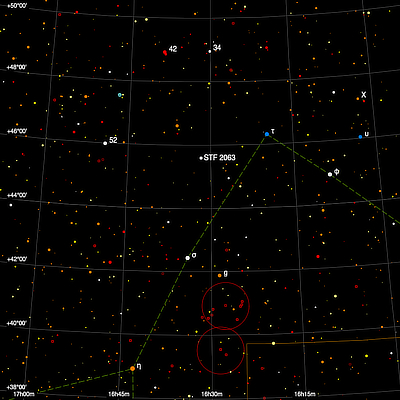
A finder chart for the double star STF 2063 in Hercules created with Cartes du Ciel. The primary has a spectral type of A1V, and the Gaia DR3 catalogue reveals the stars are at the same distance (230 light-years) and have very similar proper motions. The companion lie at PA 195 degrees and the stars are currently separated by 16".3.
A rather similar pair can be found in the southern hemisphere in the constellation of Ara. HJ 4978 (17 50 28.40 -53 36 44.7) is a little more unequal (5.7 and 9.2) and somewhat closer (12".3 and PA 268 degrees). The system, noted as nu1 Arae by John Herschel, lies 1.5 degrees due east of the globular cluster NGC 6397.
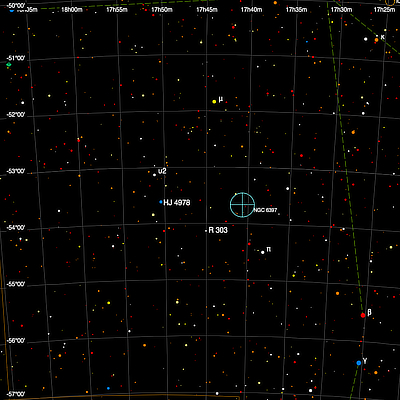
A finder chart for the double star HJ 4978 in Ara created with Cartes du Ciel. The SIMBAD catalogue notes that the primary star is an Algol variable called V539 Ara, it has a period of 3.17 days and the eclipse depth is 0.53 magnitude, but SIMBAD gives no reference to the star as a wide visual double.
Whilst in the area, check out the pair R 303 which is one degree SW of HJ 4978. The stars are magnitudes 7.8 and 9.0 with a separation of 3".6 and a PA of 108 degrees.
Bob Argyle - Double Star Section Director
-
July 2024 - Double Star of the Month
The constellation of Draco is draped across 11 hours of Right Ascension and perhaps the most distinctive part of it are the four stars which form the head of the beast. The faintest of these, and the most north-westerly is nu Dra (17 32 16.04 +55 10 22.5). Even a small pair of binoculars will show that it is really two equally bright, white gems, both of visual magnitude 4.9. Discovered in 1690 (by Flamsteed) this beautiful pair is worth seeking out in any aperture.

A finder chart for the double star ν Draconis in Draco created with Cartes du Ciel. The separation is slowly decreasing with time but at the time of writing is still a generous 62". Gaia EDR3 indicates that the stars are essentially at the same distance (98 light-years) and have very similar proper motions. This object forms one of the calibrating standard pairs which I use to convert the settings of the micrometer on the 8-inch Cooke telescope at Cambridge to position angles in degrees and separation in arc-seconds on the sky.
Meanwhile, the stars of Ara sit south of Scorpius and the brighter members resemble a `butterfly' shape. Beta and gamma Ara, at the head of the butterfly, sit a degree apart and have distinctly different hues, thus creating a fine view in binoculars. Beta is red and gamma is blue whilst 4 degrees due south is 3.6 magnitude delta Ara (17 31 05.96 -60 41 01.8).
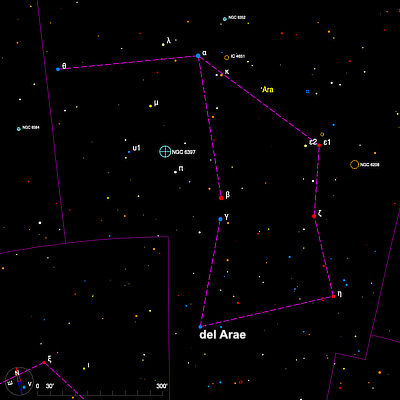
A finder chart for the double star δ Arae in Ara created with Cartes du Ciel. John Herschel noted a distant and faint companion (V = 11) some 40" away and entered the pair as number 4951 in his catalogue. The companion should be visible in 10 or 15-cm and is now somewhat better placed having eased out to a distance of 50".4 in 2016. In 2010 a project involving deep infra-red imaging of stars which may have sub-stellar companions revealed 3 images within 12" whose K magnitudes were between 12 and 14.
Bob Argyle - Double Star Section Director
-
July 2020 - Double Star of the Month
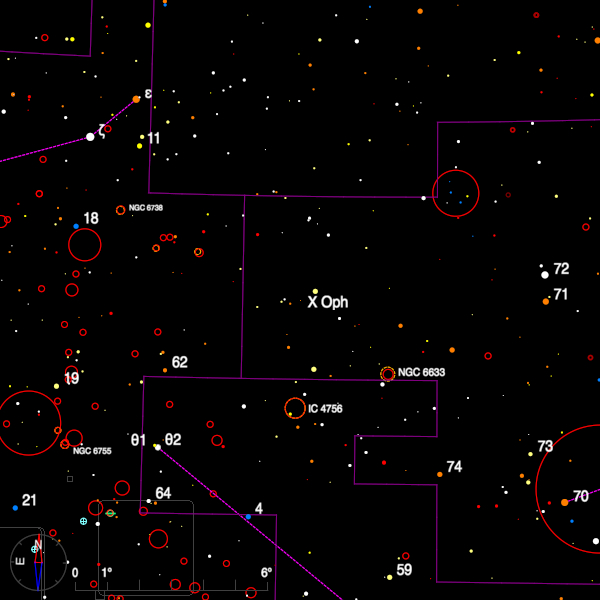
A finder chart for the double star X Oph in Ophichus created with Cartes du Ciel Mira was not the first Long Period Variable to be shown to be a visual binary. T. H. E. C. Espin found X Oph (18 38 21.13 +08 50 02.6) in 1886 and in 1900 William Hussey, observing at Lick Observatory, noted that the star was a close pair and catalogued it as HU 198. On several nights with the 36-inch refractor he saw two equally bright stars at a separation of 0".2. Later spectroscopic observation showed that the star spectrum was composite with a K giant combined with an M6 giant. George van Biesbroeck, when observing X Oph visually noted its very deep orange colour.
Since then the stars have separated somewhat and in 2018 the companion was found to be at 126 degrees and 0".5. This fact, and also that X Oph has only a 3.3 magnitude amplitude, and the companion is significantly brighter than Mira B makes this star easier to resolve than Mira, although at least 30-cm would be needed, preferably.
An ephemeris for X Oph gives a maximum brightness on Feb 5, 2020 and Jan 8, 2021 so during July 2020 the variable should be near minimum and therefore helps visual resolution. It is also 10 degrees higher in the sky than Mira. X Oph can be found 4 degrees due north of the open cluster IC 4756 or 18 degrees due west of Altair. According to David Boyd of the BAA Variable Star Section, the primary ranges from V = 6.5 to 9.8 whilst the B star is magnitude 9.0. Gaia DR2 gives a parallax for the variable of 4.66 ± 0.30 mas or 700 ± 45 light-years but there is no entry for the companion.
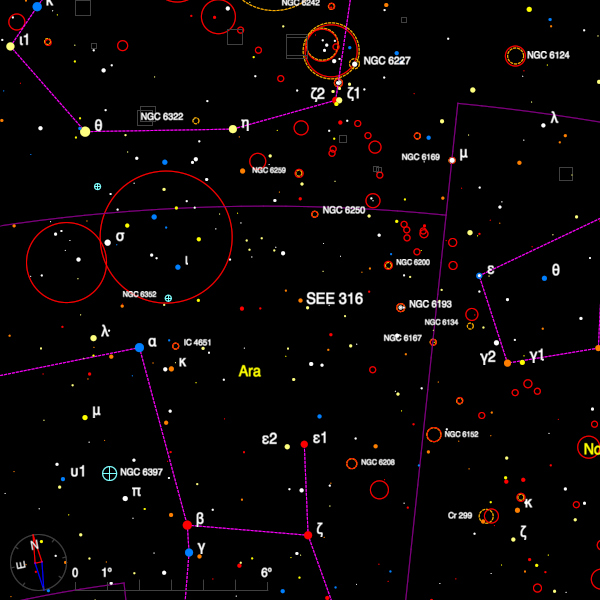
A finder chart for the double star SEE 316 in Ara created with Cartes du Ciel SEE 316 (17 00 26.96 -48 38 52.2) is in northern Ara and lies 2.5 degrees due east of DUN 211 which was described in May's column.
A discovery of T. J. J. See, this fine pair can be well resolved in 15-cm. The stars are magnitudes 6.3 and 7.7 according to the Washington Double Star Catalog (WDS) and when the writer last measured them in 2016 the position angle and separation were 173 degrees and 1 arc-second. This represents a small increase in angle and a doubling of separation since the first observation in 1897.
Hipparcos gives a distance of about 350 light-years but with a significant error. Surprisingly, the stars do not appear in the Gaia DR2 catalogue even though significantly closer pairs are included. E. J. Hartung noted that the field is rich in faint stars.
Bob Argyle - Double Star Section Director
-
May 2020 - Double Star of the Month
Epsilon Boötis (14 44 55.44 +27 04 29.9) is one of the best-loved and most well-known of visual double stars - and one of the brightest - its components are 1.9 and 4.8 in the Gaia G band - the equivalent of Johnson V.
Its spectacular colours prompted F. G. W. Struve to call it Pulcherrima (most beautiful). It was found by William Herschel and was catalogued by him as H I 1. W. H. Smyth calls it pale orange and sea green but leaves any discussion of it out of his book Sidereal Chromatics. Apertures of 15-cm will show it well, especially if a higher magnification is used.
Gaia DR2 includes both components but does not give a parallax for the bright star. The quoted error in the parallax for B is significantly larger than normal, which may be due to the proximity of A or the fact that B is a spectroscopic binary, although it does not appear in the Ninth Spectroscopic Binary catalogue. DR2 makes the distance of B to be 219 ± 6 light-years. The pair appear to be physical with the position angle having increased about 45 degrees to 347 degrees in 2018. The distance at that epoch is 2".8 which has changed little since 1777. Assuming the orbit is circular then the period will be about 2,000 years.
The galactic equator passes through the north-east corner of Ara and close to the very young cluster NGC 6193, which in turn is just east of the HII region NGC 6188. About 1 degree ENE of NGC 6193 is the wide binocular triple star DUN 211 (16 47 28,13 -48 19 10.1).
The brightest pairing (AB) is stars of magnitude 6.5 and 8.1 in the G band of Gaia. The primary is clearly a red star and is a bright M giant whereas the companion 106" distant in PA 125 degrees is early F. The third obvious component can be found at 144 degrees and 130" and has G = 8.1. However, 10-cm aperture should be sufficient to show the close companion to C found by John Herschel at the Cape (HJ 4885). D is 3".8 away in PA 239 degrees, and both C and D have similar parallaxes and proper motions. Gaia DR2 puts them at around 440 light-years. Star B is unconnected and star A is much more distant than its companions.
Bob Argyle - Double Star Section Director
-
June 2017 - Double Star of the Month
beta Serpentis (15 46 11.21 +15 25 28.9) is a magnitude 3.7 star of spectral type A2IV some 155 light years away.
About 30" west of it is a magnitude 10 companion which is unrelated. This pairing was seen by William Herschel in 1781. The companion should be visible in 7.5-cm on a fair night as it is not too close to the glare of the bright primary.
About 25 arcminutes further west is an 8th magnitude star which is moving through space with the same motion as beta and it is almost certainly physically associated. This star, in turn, has a companion and the system is known as ROE 75.
E. D. Roe was an American astronomer who had access to the 12 and 40-inch refractors of Yerkes Observatory for double star measurement, but in this case he discovered number 75 on 1911 May 20 with his own 6.5-inch Clark refractor.The secondary is magnitude 10.7 at only 6" distance so a larger aperture may be needed to see this unequal pairing.
Ara lies below Scorpius in the southern sky and the north-east of the constellation is rich in open clusters.
NGC 6193 is part of the Ara OB1 association and is thought to be 4200 light years away. Buried in the cluster is the bright and wide pair DUN 206 (16 41 20.42 -48 45 46.7).
This is an easy pair for the small aperture with the white components of magnitudes 5.7 and 6.7 being 10" apart.
The brighter component is itself quadruple. Owners of 10-cm or more may be able to see the mag 8.4 star at 1".7 from A, but A itself is a massive triple consisting of three O stars, two of which form a close SB of 2,67 days period and they are in turn circled by a third star every 8.1 years. The total mass of these three stars is thought to be about 140 solar.
The whole region is spectacular for the small telescope and there are fainter and more distant stars to be seen with small apertures.
Bob Argyle - Double Star Section Director
-
Double Star of the Month - July 2011
In this series of short articles, a double star in both the northern and southern hemispheres will be highlighted for observation with small telescopes, with new objects being selected for each month.
Alpha Herculis or Rasalgethi (17 14 38.86 +14 23 24.9) is a red supergiant star (M5Ib/II) and the leader of Hercules. It has long been known as a visual binary and is particular attractive to small telescope users because of the contrast offered between the primary and its G5 giant companion some 4".6 distant. The primary is usually seen as orange/red but the companion has variously been reported as white (Hartung), bluish-turquoise (Haas) and sage green (Perez). The primary is a semi-regular pulsating variable whose brightness varies from about magnitude 3.1 to 3.9, and the main period of oscillation appears to be 1343 days. The companion is about 5.4. The motion is orbital but extremely slow and the period is thought to be about 3600 years, but this is complicated by the fact that each component is double again. The primary has been resolved occasionally by speckle interferometry at the 0".02 level whilst the secondary has been known as a spectroscopic binary for many years; the period is 51.6 days. There is also another companion to A with a period of 10 years which does not appear to be the speckle companion so alpha is at least quintuple. For the larger telescope user two faint companions mag. 11.1 at 79", and mag. 15.5 at 19" appear to be merely optical.
Located in Ara, just on the border with Scorpius, HJ 4949 AB (17 26 51.98 -45 50 34.7) is the primary, of the wide pair DUN 216 (5.6, 7.1) which was found by Dunlop in 1826 at 30O and 33".1. By 1999 the pair had widened to 102" thanks to the proper motion of C. AB is a beautiful pair barely 2" apart which has moved about 20 degrees retrograde since being found by John Herschel in 1834. The stars, of magnitudes 5.6 and 6.3, are both late B in spectral type and hence appear white and afford "a beautiful contrast with the surrounding starry field" according to Hartung. Hipparcos places them at distance of 613 light years.
Bob Argyle - Double Star Section Director
-
Double Star of the Month - June 2011
In this series of short articles, a double star in both the northern and southern hemispheres will be highlighted for observation with small telescopes, with new objects being selected for each month.
Beta Serpentis (15 46 11.21 +15 25 18.9) lies about 11 degrees south of the crown of Corona Borealis. The primary is a mag 3.7 star of spectral type A2IV and many observers find it to be yellowish. The faint (mag 10.0) companion was found by the elder Herschel on 1781 Aug 13, and he did not allocate it a colour, noting it only as `extremely faint'. Today 15-cm aperture will show it clearly enough - a slighter harder test is the 10.7 mag star some 200" away in PA 212°. A very recent study has been using Hipparcos data to physically link apparently unrelated pairs of stars and in Beta's case the study found that there is a very high probability that the faint wide pair ROE 75 (mags 8.2, 10.7, PA 327°, separation 6".2) which can be found some 20 arc mins south preceding beta Ser is physically connected to Beta by dint of having a very similar parallax and proper motion.
The small constellation of Ara is seen against the Milky Way near the tail of the Scorpion, and Hartung lists numerous objects of interest within its borders. The coarse cluster NGC 6193 is involved with the emission nebula NGC 6188 and in addition the brightest star MLO 8 (16 41 20.42 -48 45 46.7) is a multiple system of some interest. In 1878 observers at Melbourne divided A (mag 5.1) and found a mag 8.4 companion at 2".1 distance. The distance between the two has been closing since and the last recorded measure in 1938 placed the companion 1".6 from the primary, although Hartung reports seeing the star clearly resolved with 10.5-cm in 1963. It is not clear if B is a background star or an orbital companion - the next positive observation will help to decide this question. For the small telescope user there is star C (mag 6.8) some 10" away and medium apertures should easily find two fainter (mags 10.5 and 11.4) and more distant comites found by Herschel and another of mag 12.5 discovered by Innes.
Bob Argyle - Double Star Section Director
-
Double Star of the Month - July 2009
In this series of short articles, a double star in both the northern and southern hemispheres will be highlighted for observation with small telescopes, with new objects being selected for each month.
Both systems featured in this month's column are close to the Sun but vary considerably in difficulty of observation. One is a real test for a medium aperture whilst the other can be seen in a small telescope.
Mu Herculis = STF2220 (17 46 27.72 +27 43 21.0) was found by William Herschel in 1781 and is a wide and very unequal pair of magnitudes 3.42 and 9.78. The current position angle and separation is 248 degrees and 34".9 values which have increased only marginally since Struve measured the pair in 1831. The large proper motion of A and the small change between A and B over time mean that the two stars form a physical system. In 1854 Alvan Clark found that the companion was double. It turns out to have a period of 43.2 years and is a severe test of resolution and light gathering power. The components are mags 10.2 and 10.7 and the separation varies between 0".5 and 1".5. At the time of writing the stars are 1".1 apart and will close until 2018 when a separation of about 0".6 is reached. This is a good opportunity to see this system as a triple star. The revised parallax from Hipparcos is 120.33 mas putting the group at a distance of about 27 light years. The spectral type of A is G5IV and that of the close pair appears to be dwarf M, not withstanding the fact that Chambers in his revision of Smyth's Bedford Catalogue, assigns to it a colour of cerulean blue.
As a nearby solar-like star, mu Her A is a good candidate for hosting a planetary system and in 1994 two independent series of radial velocities were taken. What they showed was a slow drift which indicated a possible period of 30 years. In 1998, a star of V magnitude 12.7 was seen 1.4 arc seconds from A using adaptive optics on the 100-inch reflector at Mount Wilson. This object is close to the sub-stellar mass limit and further observations will be needed to establish its physical connection to A. The WDS lists another star, mag 11.5 at 256", but it far from clear that this also belongs to the system.
About 4 degrees north preceding the 3rd magnitude star alpha Arae is BSO 13 (17 19 02.95 -46 38 11.4). Picked up as early as 1824 in the mural circle at Paramatta (Sydney) it is a similar system to eta Cas - a nearby, long period, unequal pair with a G-type primary and M secondary, in this case G8V and M0V. The stars, which are only 28.7 light years distant, are now moving slowly apart in their 693 year orbit and are currently at 257 degrees and 9".9 so they are visible in 75-mm aperture with ease, although larger apertures will show the colours to greater effect. Hartung notes deep yellow and orange. The WDS gives magnitudes of 5.61 and 8.88 but van den Bos in a series of measures in Johannesburg in the 1920s consistently estimated the magnitude differences as 2.5 or so, so there may be some real variation in the brightness of the companion.
Bob Argyle - Double Star Section Director


