-
July 2025 - Double Star of the Month
Zeta Lyrae (18 44 46.36 +37 36 18.4) is the third star in the tight, naked-eye triangle that includes Vega and the Double-Double (epsilon). It appears in many double star catalogues, including those of Herschel, the Struves and South and Herschel but according to the Washington Double Star catalog (WDS) it was found by Francesco Bianchini (1662—1729) with the date 1737 which presumably refers to a book published posthumously called Astronomicae et geographicae observationes selectas... written in Latin, but available in full on the internet.
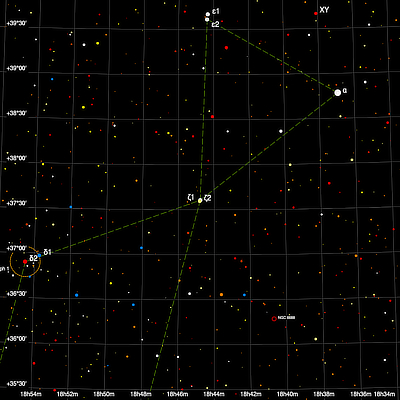
A finder chart for the double star zeta Lyrae in Lyra created with Cartes du Ciel. The brightest component, zeta1 is magnitude 4.34, and is a spectroscopic binary, whilst the fainter component, zeta2, is 5.62. The stars lie 157.9±0.2 light-years away according to Gaia DR3. An observation with the Cambridge 8-inch in 2010 gave 149 and 45".4 but there is very little relative motion between the two stars.
Zeta Lyrae is resolvable in binoculars and both stars appear white. There are four faint field stars ranging from mags 13.3 to 15.7 which lie between 22" and 78", two of which were found by Burnham with the 18.5-inch at Dearborn and the faintest was detected in the Lick 36-inch.
WNO 6 (18 28 57.36 -26 34 55.5) lies 1.5 degrees south of the 2.8 magnitude lambda Sagittarii, the orange-hued K1 giant star at the top of the 'Teapot' lid of Sagittarius. It is a fine pair for the small aperture with stars of magnitudes 6.7 and 8.0 separated by 42" with a position angle of 182 degrees. Gaia DR3 places them at significantly different distances, the A component has a distance of 639 light-years away but it has a large formal error of 24 light-years. B is 472 light-years away.
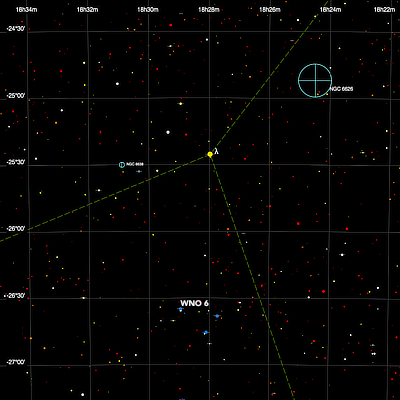
A finder chart for the double star WNO 6 in Sagittarius created with Cartes du Ciel. It makes a tight triangle with two other stars the most north-westerly of which is BU 133, a rather difficult pair requiring at least 25-cm as the stars have passed 0".6 and are still closing, having been 1".8 apart when discovered by Burnham using his 6-inch Clark refractor. The magnitudes of 6.6 and 8.5 add to the difficulty of resolution.
Bob Argyle - Double Star Section Director
-
Double Star of the Month - August 2012
In this series of short articles, a double star in both the northern and southern hemispheres will be highlighted for observation with small telescopes, with new objects being selected for each month.
The two pairs selected this month are almost copies of one another. They have the same separation, and position angle, similar magnitudes and even the colours are close.
Eta Lyrae (19 13 45.49 +39 08 45.5) appears as H 4 2 in the great astronomer's first list of double stars published in 1782, but it was first listed by Christian Mayer in 1779. The primary is a luminous object more than 1,000 light years away. The companion appears to be an F star and with the primary being an early B subgiant, one might have expected colours to be white and yellow when in fact Hartung records yellow and ashy. The WDS gives magnitudes of 4.38 and 8.58 with current distance and PA being 28".5 and 79°. A fainter and more distant star (mag 11.4) can be seen at a distance of 161". Along with theta, also a wide, unequal pair, it follows Vega by about 7 degrees.
Beta1 Sgr (19 22 38.29 -44 27 32.1) is not only not the second brightest star in Sagittarius but it is actually about 12th in the list. The naked eye can make out both beta 1 and its close neighbour beta 2 (mag 4.27) some 20 arc mins away. Dunlop listed beta 1 as a telescopic double in 1826 and and since that time the position angle has increased slowly to 76° and the separation decreased slightly to 28".7. Hartung gives the colours as pale yellow and ashy white - the spectral types are actually B8V and F0V perhaps reversing what one might expect from the colours. However, Ross Gould using a 175-mm refractor disagrees with this judgement and gives the colours as white and yellowish. The stars are magnitudes 3.98 and 7.21 and again this is an optical system. Beta1 lies in the far south-western part of Sagittarius, close to the border with Corona Australis and Telescopium.
Bob Argyle - Double Star Section Director


-
Deep-Sky Objects and Observations
