The Webb Deep-Sky Society

An international society of amateur and professional astronomers specialising in the observation of double stars and 'deep sky' objects founded in 1967. Membership is open to anyone who shares the interests of the Society.

  • About Us
  • Membership
  • Deep-Sky News
  • Galaxies
  • Nebulae and Clusters
  • Double Stars
  • Publications
  • The DSO
  • September 2024 - Double Star of the Month

    Just two and a bit degrees north of the Saturn Nebula (NGC 7008) is the long period binary STF 2751 (21 02 09.00 +56 40 11.1). This pair of white stars should be divided easily in 10-cm and may be split in a good 7.5-cm aperture.
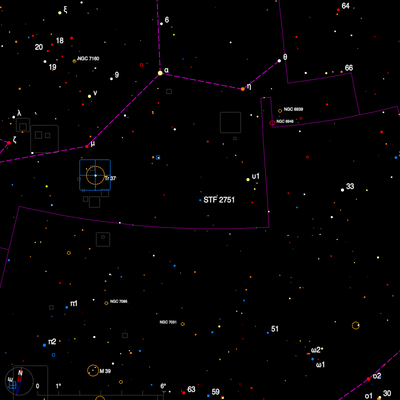
    Finder chart for the double star STF 2751 in Cepheus
    A finder chart for the double star STF 2751 in Cepheus created with Cartes du Ciel.

    Since 1828 when an early measure by the discoverer F G W Struve gave 343 degrees and 1".5 the stars have now moved on to 356 degrees and 1".6. Gaia DR3 indicates that the stars are at the same distance from us at least within the formal quoted errors. They lie 1,100 light-years away and are moving across the sky at close to 0".1 per year.

    Three degrees due south of the first magnitude Achernar in Piscis Austrinus is delta PsA (22 55 56.89 -32 32 22.9) which was found to be double by Herbert Howe in Cincinnati in 1876 and is number 91 in his catalogue, although the Washington Double Star catalog (WDS) also call this system BU 772 which reflects an independent, but later, discovery by S. W. Burnham.

    Finder chart for the double star delta PsA in Piscis Austrinus
    A finder chart for the double star delta PsA in Piscis Austrinus created with Cartes du Ciel.

    The WDS gives magnitudes of 4.3 and 9.3 whilst the Gaia DR3 catalogue records G magnitudes (similar to visual) of 3.9 and 9.8. As the current separation is 4".7 this is a pair which needs a night of steady seeing and, given its very low declination from the UK, probably 15-cm aperture. The stars appear to form a physical system and are 171 light-years away. Both beta PsA and gamma PsA are pairs with bright primaries and considerably fainter comites (see this column for Oct 2016 and Oct 2012 respectively).

    Bob Argyle - Double Star Section Director

  • About the Webb Society

    • Back top of this page
    • Go to our home page
    • About us
    • News
    • Our Annual Meeting
    • Galaxy Section
    • Nebulae and Clusters Section
    • Double Star Section
    • Join the Webb Deep-Sky Society
    • Links to members' websites
    • Useful astronomy links
    • Contact Us
  • Deep-Sky Objects and Observations

    • Observations home page
    • Object of the Season
    • Double Star Circulars
    • Double Star of the Month archive
    • Double Star of the Month RSSRSS feed icon
    • Galaxy of the Month archive
    • Galaxy of the Month RSSRSS feed icon
    • Picture of the Month archive
    • Picture of the Month RSSRSS feed icon
    • Nebula and Cluster of the Month archive
  • The Deep-Sky Observer

    • DSO digital subscriber login
    • Webb Society Journal archive
  • Publications

    • Handbooks, Guides and Atlases
    • Alvin Huey's Observer's Guides
    • Willman-Bell Publications
    • Free Observing Guide Downloads
  • Featured Articles

    • Where to get reliable NGC/IC data
    • Rediscovering the Bedford Catalogue
    • An Averted Vision Scale

If you have any comments or problems with this page or any other Webb Deep-Sky webpage then please contact the Website Administrator

The Webb Society is registered under The Charities Act 1960 - Registered Charity No. 288384 © 2025 Webb Society except where stated.

The information contained in this website is for general information purposes only. The information is provided by The Webb Deep-Sky Society and while we endeavour to keep the information up to date and correct, we make no representations or warranties of any kind, express or implied, about the completeness, accuracy, reliability, suitability or availability with respect to the website or the information, products, services, or related graphics contained on the website for any purpose. Any reliance you place on such information is therefore strictly at your own risk. In no event will we be liable for any loss or damage including without limitation, indirect or consequential loss or damage, or any loss or damage whatsoever arising from loss of data or profits arising out of, or in connection with, the use of this website. Through this website you are able to link to other websites which are not under the control of The Webb Deep-Sky Society. We have no control over the nature, content and availability of those sites. The inclusion of any links does not necessarily imply a recommendation or endorse the views expressed within them. Every effort is made to keep the website up and running smoothly. However, The Webb Deep-Sky Society takes no responsibility for, and will not be liable for, the website being temporarily unavailable due to technical issues beyond our control.