Double Star of the Month Archive before 2014
-
Double Star of the Month - December 2013
In this series of short articles, a double star in both the northern and southern hemispheres will be highlighted for observation with small telescopes, with new objects being selected for each month.
88 Tau (04 35 39.23 +10 09 39.3) is a binocular pair whose visual magnitudes are 4.3 and 7.8, which can be easily found 6 degrees due south of Aldebaran. Smyth referred to it as a `star with comes' and blithely asserted that after the year 2000 the stars would start to approach each other in the southern part of their orbit. He based this on a difference of position angle of 4.5 degrees between 1800 and 1822 when perhaps the most obvious inference is that the two stars are unconnected. In fact, Piazzi's position for 1800 is not very accurate and there has been little change since 1822. The two stars actually have similar proper motions and may have been co-eval. Smyth noted that the colours were bluish-white and cerulean blue whereas T. W. Webb (yellow-white and yellow-red) and, more recently, Sissy Haas (vivid lemon yellow and silvery cherry) seem to differ from this. In fact 88 Tau is a sextuple system. The A star was resolved by speckle into two components separated by 0".12 and mags of 4.4 and 6.6. The period is 18 years. Both of these stars are spectroscopic binaries with periods of 3.57 and 7.59 days. Distant B is also an SB with a period of 1349 days.
BU 391 (04 26 56.93 -24 04 52.8) can be found in a very sparse part of Eridanus, about 8 degrees N of nu3 and nu4 Eri. It is one of Burnhams's earlier discoveries - made with the 6-inch Clark. Burnham was not convinced that there was much change in the system when he compiled his Catalogue in 1900 but subsequently the stars began to close and periastron was passed around 1980. The pair is currently at 151° and 0".4 which makes it a challenge for a medium aperture from the UK. The magnitudes are 6.7 and 7.1 so it should be divided on a good night with 30-cm. The orbital period is 596 years (Scardia 2003) but note that the WDS catalogue notes give a much shorter and incorrect value.
Bob Argyle - Double Star Section Director
-
Double Star of the Month - November 2013
In this series of short articles, a double star in both the northern and southern hemispheres will be highlighted for observation with small telescopes, with new objects being selected for each month.
Three degrees north of alpha Ari is a line of four stars of marginal naked-eye visibility. The most westerly of these stars is 10 Arietis, a close visual binary. The third star is 14 Ari - a coarse triple. 10 Ari (02 03 39.26 +35 56 07.6) was found by Wilhelm Struve at Dorpat and during the remainder of the nineteenth century the star closed slowly, leading Burnham to comment (in 1906) 'Probably orbital motion, although the measures are well represented on the hypothesis of rectilinear motion'. From a distance of 1".98 in 1833, the companion passed by the primary around 1920 at a distance of about 0".3 and has been widening since. The current catalogue period is 325 years and gives a position of for 2014.0 of 346° and 1".48. It is a nice pair in the Cambridge 8-inch but needs a night of good seeing to see the companion of magnitude 7.9 close against the mag 5.8 primary.
omega Fornacis (02 33 50.71 -28 13 56.4) was swept up by John Herschel at Feldhausen in 1834 and is catalogued as HJ 3506. He noted that it was a 'very fine star but ill-defined'. The stars are magnitudes 5.0 and 7.5 and there has been little motion since discovery, the latest position in the WDS gives 10".8 and 245°. Sissy Haas calls this a 'showcase pair' and gives colours of goldish-white and smoke-grey whilst Magda Streicher with a larger aperture notes yellow-white and light grey-blue. Hartung does not pronounce on colours but notes a similar pair about 2' west. It seems likely that the two stars are physically connected. Hipparcos gives a distance of 484 light years and the primary is a subgiant of spectral type B9.5.
Bob Argyle - Double Star Section Director
-
Double Star of the Month - October 2013
In this series of short articles, a double star in both the northern and southern hemispheres will be highlighted for observation with small telescopes, with new objects being selected for each month.
Delta Cephei (22 29 10.25 +58 24 54.7) is the prototype pulsating variable the period of which holds the key to its distance. Thanks to Hipparcos this distance has also been determined geometrically and it comes out at 865 light years with a formal error of 37 light years. Regrettably few Cepheids were in range of the satellite during its operation between 1989 and 1993 but its successor, GAIA, will sweep up many more when it launches later this year. Delta is also a most attractive double star and its mag 6.1 companion is probably visible in regular binoculars. It can be found 41" distant from delta in PA 191°. This is formally star C in the system as S. W. Burnham found a much fainter (mag 13) and somewhat closer star (B) using the 18.5-inch refractor at Dearborn. Matt Heijen using a 30-cm Orion records the colours on his StarObserver.eu website and notes 'yellow, almost orange and bluish white'. There are three more distant comites between mag 13.5 and 14. C was noted as a spectroscopic binary by Belopolsky more than 100 years ago but little seems to be known about it now and it does not appear in the Ninth Catalogue of Spectroscopic Binary Orbits. Recent radio observations of delta reveal an extended nebula of ionized hydrogen surrounding the star which infers that mass loss is taking place at a level of around 10-6 solar masses per year. This may go some way to explaining the discrepancy between the mass derived from stellar evolutionary models and that obtained from stellar pulsation and dynamical techniques.
STF2944 in Aquarius (22 47 50.19 -04 13 44.8) is a nice triple star which contains a visual binary system. It is 2.5 degrees following the pretty, coarse pair kappa Aqr which has an orange primary star. The closer AB pair consists of stars with magnitudes 7.3 and 7.7 which have closed up considerably since discovery in 1782. In the same time the position angle has increased by almost 60°. For the end of 2013 the stars can be found at 303° and 1".86. C which is mag 8.6 is 60" away in position angle 86°. This is not physically connected to AB and is being left behind by the rather considerable proper motion of the close pair, some 0".4 per year. It is large enough to have attracted the attention of Willem Luyten and both components are in the NLTT (Not Less than Two-Tenths) Catalogue. The colours in these stars are not too obvious given that they are rather faint, but at low power Sissy Haas gets beige white and arctic blue for AB combined and C. Hipparcos confirms the proximity of the system to the Sun - the parallax yields a distance of 105 light years.
Bob Argyle - Double Star Section Director
-
Double Star of the Month - September 2013
In this series of short articles, a double star in both the northern and southern hemispheres will be highlighted for observation with small telescopes, with new objects being selected for each month.
As telescope makers of renown the Clarks (Alvan and his son Alvin George) were able to point large new telescopes at bright stars in order to test them and, if lucky, they discovered new companions. Such was the case of Sirius but here there was already significant evidence that the star was double based on Bessel's discovery of variable proper motion.
In the case of tau Cygni (21 24 47.35 +38 02 39.6), however, the discovery of duplicity was entirely serendipitous. Discovered by A. G. Clark using a 26-inch refractor, it has turned out to be a system of considerable interest. The period is 49.8 years and the separation varies from about 0".5 to 1".1 but the difficulty for the observer is the significant difference in brightness between the two stars. The WDS gives V mags of 3.8 and 6.6. The writer has seen the comes with the 8-inch OG at Cambridge and the system is widening again at present - in the autumn of 2013 the position will be 213° and 0".9 and so should be seen in 20-cm on a night of good seeing. The pair is easy to find as the southernmost of a trio of brightish stars 10 degrees following gamma Cygni and it is 1.5 degrees south following 61 Cygni. Recent investigations by the astrometric-based Palomar High-precision Astrometric Search for Exoplanet Systems (PHASES) have pointed out the possibility of a sub-stellar companion to one of the stars. The period may be 826 days and the mass may be 12.3 Jupiters but this is very much preliminary work.
About 10 degrees preceding the 3rd magnitude star beta Aquarii is 3 Aqr. Just south following is a pair of stars the preceding of which is 4 Aqr and the following 5 Aqr. William Herschel noted that 4 Aqr (20 51 25.69 -05 37 35.9) was double on Sept 3 1782 and listed it as number 44 is his Class I stars. Wilhelm Struve measured it at Dorpat in 1825 and at present the stars are in almost exactly in the same place having undergone a whole orbital revolution since then. This 187-year-period binary is not particularly easy from the UK due to its low declination and it is now closing again. For 2014.0 it will be at 30° and 0".7 making it a target for a superior night. The stars are mags 6.4 and 7.4.There are two distant and unconnected comites - C is 13.3 at 74" from AB and D is 9.7 at 136". In each case the separation is increasing.
Bob Argyle - Double Star Section Director
-
Double Star of the Month - August 2013
In this series of short articles, a double star in both the northern and southern hemispheres will be highlighted for observation with small telescopes, with new objects being selected for each month.
Those who have read last month's version of this column will have noted that the northern object was 26 Dra, one of Burnham's very unequal pairs. This month's selection is another from that stable, BU 648 (18 58 01.47 +32 54 05.8) can be found in Lyra, in the same low power field as gamma, and 20 minutes or so north-west of the bright star. Burnham assigned magnitudes of 6 and 9.5 to this discovery which was only separated by 0".6 at the time. The WDS gives magnitudes of 5.3 and 8.0 and it can certainly be seen with 20-cm on a good night. At the time of writing, the separation is 1".23 and the position angle 247° at mid-2013. This star has also recently been in the news because it is accompanied by a planetary object whose mass depends on which of the two stars it is orbiting. This is not known at present but if, for instance, it accompanies star B, then the mass is estimated at 1.5 Jupiters. This discovery is unusual because it was made astrometrically, rather than by radial velocity measurement, using the PHASES (Palomar High-precision Astrometric Search for Exoplanet Systems) part of the Palomar Testbed Interferometer instrument. There are 4 distant comites ranging between magnitudes 11.0 and 12.6.
H N 126 (19 04 21.53 -21 31 53.7) belongs to William Herschel's last double star catalogue which was published in 1823, a year after his death. In this case the N stands for 'New'. This 'small yellow binary' says E. J. Hartung, can be found in a 'field profusely sown with stars' and it is very close to omicron Sagittarii. Burnham's Celestial Handbook also attributes the label HU 261 to the system but it has now reverted back to its original discoverer. This is a pretty pair of long period and the two components are moving slowly retrograde. At this time the position is 186°, 1".25. The writer has not observed this pair from the UK but it should be well seen in 20-cm provided the seeing and transparency are sufficiently good at this low declination.
Bob Argyle - Double Star Section Director
-
Double Star of the Month - July 2013
In this series of short articles, a double star in both the northern and southern hemispheres will be highlighted for observation with small telescopes, with new objects being selected for each month.
S W Burnham discovered 26 Dra (17 34 59.58 +61 52 28.4) using the 18.5-inch refractor at Dearborn Observatory in 1879. It was soon apparent that this was a binary system because the large proper motion of the primary star (almost 0".6 per year) was clearly shared by the faint and close companion. Along with many of the other similar pairs he discovered, Burnham substantially underestimated the brightness of the companion, and gave the magnitude of the stars as 5.5 and 10.1 is his General Catalogue of 1906. The WDS gives 5.28 and 8.54 and I saw the comes perfectly well with the 8-inch Cooke refractor at Cambridge in summer 1999. At that time the separation was 1".6 but the pair is now closing quickly and it will take a larger aperture to see them in 2013 when the separation is 0".65. The large proper motion is a consequence of the proximity of this star system. The Hipparcos catalogue gives a revised parallax of 70.47 mas which corresponds to 46.3 light years with a quoted error of 0.24 light years. To find it, draw a line between beta and nu Draconis in the head of the Dragon and extend the line twice as far again.
See 342 (17 53 23.47 -34 53 42.5) is also a close pair requiring a reasonable aperture to resolve, but it does have the additional attraction of being embedded in the open galactic cluster M7, close to the tail of Scorpius. Since discovery in 1897, the pair has moved in retrograde fashion by 80 degrees whilst the separation has remained close to 0".4. A provisional orbit by Andreas Alzner puts the period at 700 years and its parallax places it at the distance of M7. A good chart for identifying See 342 is given in Burnham's Celestial Objects Volume 3, page 1712. It is #1 and is located at the SW corner of the cluster. Robert Burnham quotes magnitudes of 6.5 for each star whilst the WDS lists 5.85 and 7.89 which also seems too unequal. Recent measures by Tokovinin give a delta m of 0.3 to 0.4. The primary star is a K giant and a spectroscopic binary.
Bob Argyle - Double Star Section Director
-
Double Star of the Month - June 2013
In this series of short articles, a double star in both the northern and southern hemispheres will be highlighted for observation with small telescopes, with new objects being selected for each month.
Situated in the north of Boötes, STT 298 (15 36 02.59 +39 48 08.7) is one of the more rapid binary systems found by Otto Struve at Pulkovo and it now embarking on its fourth orbit since discovery. Look for the naked-eye pair nu1 and nu2 Boötis some 6° following beta Boötis and STT 298 can be found just south preceding phi Boötis. The star is nearby (the distance is 73 light years) so the orbit is relatively large in angular terms. The stars are almost near peristron and at 182°, 1".18 in mid-2013 they offer a good opportunity to see a pair with a period of only 55.6 years. The system moves across the sky at almost 0".5 per year and is accompanied at a distance of 121" by star C which is mag 7.8 and also a K dwarf. For the telescopic observer there are two fainter but unrelated stars of mags 12.1 and 13.9.
DUN 178 (15 11 34.82 -45 16 39.0) is an orange KOIII giant star of mag 6.3 accompanied at a distance of 30".6 by a mag 7.3 white star according to Richard Jaworski using a 100-mm aperture in Australia. Both these stars appear in the Hipparcos catalogue but do not appear to be connected in any way. A is 510 light years away whilst B is 400 light years distant. At discovery in 1826 the pair were separated by 40" so the change is purely due to different proper motions. This pair is located in the heart of Lupus, a constellation rich in visual double stars, and can be found in the same low-power field as lambda Lupi. In 1929 Willem van den Bos, using the 26.5-inch refractor in Johannesburg, found a companion of mag 9.6 some 1".1 distant from A. There has been little change in the position of this star in the intervening 80 years and it offers a challenge to a 30-cm telescope in a good location.
Bob Argyle - Double Star Section Director
-
Double Star of the Month - May 2013
In this series of short articles, a double star in both the northern and southern hemispheres will be highlighted for observation with small telescopes, with new objects being selected for each month.
There are two pairs for the price on one in the northern half of this month's column. In the extreme north-west of Boötes following eta UMa is a coarse group of bright stars. The two closest together are kappa and iota and both are worth seeking out with telescopic aperture. Kappa Boötis (14 13 29.00 +51 47 23.8) is a long period visual binary with both stars possessing the same proper motion and at a similar distance from us (162 light years). There has been little motion over the past 200 years beyond a slight widening of the separation to 13".6 and a small diminution in the position angle. In 1850 T. W. Webb made the stars pale yellow and bluish whilst in 1915 William Franks recorded yellow and purple. B is a spectroscopic binary with a period of about 5 years. More recently Tokovinin has recorded a 16.9 mag comes at 108" to A which appears to have shared proper motion with AB. Some 25 arc mins south following is iota Boötis (STFA 26 - 14 16 10.07 +51 22 01.3) which is a binocular pair which will benefit from telescopic aperture. The stars are mags 4.8 and 7.4 and are 38" apart. The Irish amateur, Isaac Ward, who used a 4.3-inch Wray refractor, found a comes of mag 12.6 at 92". The spectral types are A7 and K0 and Webb found whitish yellow and lilac.
When William Herschel was accumulating his catalogue of double stars he searched every part of the sky and he must have had a good southern horizon. One of the lowest of his finds is Y Cen (13 53 32.75 -35 39 51.2) which at -35 degs could only have been a mere 5 degrees above his horizon even at culmination. He acknowledges that the pair is `too low for accuracy' giving a distance of 54" (currently 68"). The stars are mags 5.5 and 8.7 and it’s not surprising that Herschel missed the duplicity of the primary, later found by Howe. Currently at 1".0 it was nearer 0".7 in the 1780's but as the two components are almost equal it is a fine object for 15-cm at a suitable latitude. The period appears to be 258 years and the position angle is increasing. Burnham and Innes respectively added fainter companions - 12.3 at 28" and 14.8 at 38". Hipparcos puts the system at 167 light years.
Bob Argyle - Double Star Section Director
-
Double Star of the Month - April 2013
In this series of short articles, a double star in both the northern and southern hemispheres will be highlighted for observation with small telescopes, with new objects being selected for each month.
Near the centre of the coarse Coma star cluster is STF1639 (12 24 26.81 +25 34 56.7) which forms an equilateral triangle with 12 and 13 Com and is the faintest of the three. It is a binary with a highly eccentric orbit (e = 0.93) and which is now resolvable in 10-cm aperture given a night of reasonable seeing. The stars are magnitudes 6.7 and 7.8 and appear to be dwarfs of spectral types A7 and F4. It was discovered by Struve and in 1827 the separation was 1".2. This decreased steadily until the 1890s when the pair was unresolvable in even the largest apertures. By the end of that decade it was again measureable and since then has increased in separation to 1".8 at the time of writing. The orbit currently in the USNO 6th Orbital Catalogue gives a period of 575 years which gives a distance of 0".09 for 1892 and the maximum is reached around 2175 when the stars will be 2".35 apart. The 10-cm telescope might also make out a distant third star of mag 11.5, 92" away in PA 160.
Modern star atlases show the star N Hya (11 32 16.90 -29 15 39.7) firmly in Hydra and some 3 degrees north of the mag 3.5 xi Hya - itself a very unequal and wide double star with a 10.7 mag companion at 68", the distance of which is increasing. The WDS shows no measures of this pair since 1928. William Herschel found N Hya on 1783 Jan 10 and it is number 96 in his third category. He called it 17 Crateris and noted that both stars were reddish white. A few years later it appeared in Piazzi's Catalogue as 17 Hya. Modern telescopes tend to yellow tints - Hartung gives both yellow and Sissy Haas called them grapefruit colour. The stars are almost identical - both are spectral type F8V - and have changed little in separation and position angle over the last 200 years. The current position is 210° and 9".4. This is a nearby system which is certainly binary - the proper motion is significant.
Bob Argyle - Double Star Section Director
-
Double Star of the Month - March 2013
In this series of short articles, a double star in both the northern and southern hemispheres will be highlighted for observation with small telescopes, with new objects being selected for each month.
6 Leo (09 31 57.58 +09 42 56.8) can be found about 2 degrees preceding omicron Leo, and is in the same low power field as omega Leo - a splendid binary (see the column for March 2008). Not unsurprisingly it was first catalogued by Sir William Herschel on 1781 Feb 21 when he noted that the `Large' star was red and the `Small' star `dusky'. It then seems to have appeared in everyone else's catalogue (SHJ 107, STTA 101).The primary is a K giant star and has visual magnitude 5.22. It is accompanied at 75° and 37".5 by a magnitude 9.3 star whose relative position has changed little over 200 years. T. W. Webb noted colours of deep orange and green with his 3.7-inch Tulley refractor and again, in 1882, presumably with the 9.3-inch where he notes pale orange and blue. Hipparcos places the primary star at just over 500 light years away.
J Velorum (10 20 54.81 -56 02 35.6) is near the southern border of Vela with Carina and is located almost on the galactic equator. It is 2 degrees north of the Smile nebula (NGC 3199), a cloud of gas some 75 light years in diameter and 12000 light years distant formed by the interaction of a hot Wolf-Rayet stellar wind and the surrounding interstellar medium. On sweep 435 with his 18-inch reflector at Feldhausen, Herschel described it as `A very large and very remarkable nebula, which is brighter to the S.f. part, and dies off to the N.p., having a curved form and forked tail. In the head of it is a double star. The nebula is pretty bright, very large, figure irregular, 8' long 4' broad'. The double star mentioned is HJ 4302 (10.9, 12.1, 116°, 22".7). Whilst J Velorum was first observed as a double by Rumker (it is RMK13) he missed the brighter but closer B component and recorded only A and C. It was John Herschel who noted the star as triple and referred to it as T Velorum. AB has mags of 4.5 and 7.2 which are currently at 102° and 7".1. C, which is V= 9.2, is 36" away in PA 191° and the distance is slowly widening. Andrew James calls it a spectacular triple. The colours are blue, white and yellow.
Bob Argyle - Double Star Section Director
-
Double Star of the Month - February 2013
In this series of short articles, a double star in both the northern and southern hemispheres will be highlighted for observation with small telescopes, with new objects being selected for each month.
It was near delta Gem (07 20 07.39 +21 58 56.4) that Pluto was first seen on a plate taken by Clyde Tombaugh at Lowell Observatory in February 1930. By a strange coincidence, Herschel found the mag 8.2 companion to delta on March 13 1781, the very same night that he discovered Uranus and later recorded the system as H 2 27. The primary star is a late A9 giant, of visual magnitude 3.55, and at a distance of 60 light years according to Hipparcos. To see the companion comfortably requires 15-cm and a night of reasonable seeing. Some disagreement attaches to the colour of the secondary. It is given as K3V in the WDS and E. Hartung noted it as reddish, as it did T W Webb but some years before he had recorded the hue of the star as purplish. The primary is also a single-lined spectroscopic binary and has also been seen double at lunar occultation’s but attempts to resolve it directly using speckle methods have so far failed.
BU 332 (07 27 51.66 -11 33 24.7) is a multiple star which appears coincident with NGC2396 on Map 8 in Norton, close to the point where Monoceros, Canis Major and Puppis meet. Just after completing the notes on this system I read the Sky and Telescope for February 2013 and found that it featured in Sue French's column (page 57) under the name STF 1097. AC has mags 6.2, 8.7 and the components seem relatively fixed at 313° and 20". In 1865 Baron Dembowski suspected that A was double and it was later confirmed by Burnham using his 6-inch Clark refractor. Star B is magnitude 7.35 and there has been very little motion - amounting to 7° retrograde in PA, and the stars are possibly closing up. Small telescope users should be able to see the more distant D (V = 9.7) at 157o, 23". A 12.7 mag star at 32" will need at least 10-cm. Hartung notes that it is a beautiful field and that the close pair is deep yellow and white.
Bob Argyle - Double Star Section Director
-
Double Star of the Month - January 2013
In this series of short articles, a double star in both the northern and southern hemispheres will be highlighted for observation with small telescopes, with new objects being selected for each month.
26 Aurigae (STF 753 - 05 38 38.10 +30 29 32.8) is one of William Herschel's class III double stars, and can be found about 3 degrees north-following beta Aurigae. It is a bright and easy pair - the two main stars being visual magnitude 5.4 and 8.4 and the companion 12".2 distant from A. Smyth found the stars to be pale white and violet whilst Sissy Haas notes straw yellow and atlantic blue. It seems likely that this is a physical pair but the same cannot be said of the unassociated star of V = 11.5 which is slowly increasing its distance from A and can be found at 113 degrees and 35". Burnham found it independently in 1872 but noted that it had already been found by Morton using the 7.75-inch refractor at Lord Wrottesley's observatory some 10 km north-west of Wolverhampton. In 1892 Burnham found that the primary was an almost equally bright close pair and indeed it turns out to be a binary with a period of 53 years (BU 1240). At present it is just beginning to close and at 0".2 will require considerable aperture and excellent seeing.
Five degrees following epsilon Col is a wide (13 arc min) pair of stars which make up an easy binocular double and may just be visible to the naked eye. This is gamma1 (V = 4.7) and gamma2 Caeli (V = 6.3). There is much more here for the telescopic observer to note, because both these stars are again double. Gamma1 (05 04 24.40 -35 28 58.7) somehow missed the attention of John Herschel and was swept up by Captain Jacob in 1847. The companion at magnitude 8.2 is currently 3".2 distant in position angle 305 degrees. There is slow retrograde motion and the distance is gradually increasing. The primary is a K3 giant and indeed Hartung notes the colour to be orange, with the companion white. Gamma2 was discovered to be a close unequal pair by the Hipparcos satellite and is now called HDS658. The companion (mag 9.7) is 0".9 away in position angle 195 degrees - there has been about 12 degrees of motion since discovery. This star should be visible in 30-cm on a good night. Both gamma1 and gamma2 are in Hipparcos but gamma1 has a parallax of 17.90 mas whereas that of gamma2 is 10.15 mas.
Bob Argyle - Double Star Section Director
-
Double Star of the Month - December 2012
In this series of short articles, a double star in both the northern and southern hemispheres will be highlighted for observation with small telescopes, with new objects being selected for each month.
The conventional long-focus refractor user is at a disadvantage when it comes to examining that part of the sky near the celestial poles. This is a pity since there are a number of systems north of +75 which are worth looking out - amongst the binaries are STF2 and pi Cep and the beautiful optical pairs 19 Cam, STF1694 and kappa Cephei, not to mention the Pole Star itself.
The writer measured STF460 in Cepheus (04 10 02.74 +80 41 55.2) on three nights in 1994 but has not examined this slow moving binary since. The period appears to be about 415 years so it has moved almost half an orbital revolution since discovery in 1828. The position angle is increasing and anyone observing it in late 2012 should see the companion at about 149° and 0".69. Having reached a maximum apparent separation in the 1920s the pair is now closing and should reach 0".65 in around 2030. The stars are visual mags 5.6 and 6.3, and Webb gives colours of yellowish and bluish whilst Sissy Haas notes only that the primary is straw yellow.
32 Eri (93 54 17.49 -02 57 13.0) is another of William Herschel's discoveries, but being close to the equator is comfortably within reach of many latitudes and the smallest telescopes. The stars are mags 4.8 and 5.9 and the colours ascribed to stars by Hartung deep yellow and white seem to chime perfectly with the given spectral types of G8III and A2V. Only the earliest measures of the elder Herschel seem to disagree with the general finding that the separation is around 6".5. Is this an error by WH or evidence of rather swifter orbital motion which has not manifested itself since? Between the measures of Struve in 1822 and today there seems to have been no significant movement in separation or position angle but as the stars have similar proper motions there seems no doubt that they form a binary pair. At 165" there is a 10.5 magnitude third star - it too shows no apparent motion over 150 years, so is it also a member of the system?
Bob Argyle - Double Star Section Director
-
Double Star of the Month - November 2012
In this series of short articles, a double star in both the northern and southern hemispheres will be highlighted for observation with small telescopes, with new objects being selected for each month.
STF 162 (01 49 15.54 +47 53 49.0) sits in an obscure corner of Perseus about 6 degrees north and 2 degrees preceding gamma And. It is also about 1.5 degrees south following 51 And. It is a multiple star, four components of which can be seen in 7.5-cm. The closer pair, which consists of components of magnitudes 6.5 and 7.2, was found by Struve in 1828 when the separation was 2".2 and the position angle 227 degrees. At the current epoch these have both decreased to 1".9 and 298 degrees. A third star which remains fixed with respect to A can be found 20" away almost due south, and another at mag 10.1 is 139" distant. The WDS reveals that either A or B is itself an interferometric binary with a separation less than 0".2 and B is also a spectroscopic binary.
Epsilon Sculptoris (01 45 38.65 -25 03 08.8) is a fine pair located in the extreme north-east corner of Sculptor and which can be seen from the UK but which first caught the attention of John Herschel at Feldhausen when he noted 'large * w(hite) small star dull red' an gave the magnitudes as 6 and 10(modern values 5.4 and 8.5). Since then the companion has moved slowly retrograde from the discovery position of 72 degrees to its current value of 20 degrees. In 1969 de Freitas Mourao looked at the observations and decided that they could be fitted by a face-on circular orbit with a separation fixed at 4".65 and a period of almost 1200 years. In recent years, however, the companion has begun to stray ever further from the primary and the separation is now over 5". More observations are needed but the real orbit will not be obvious any time soon, and in fact the apparent motion to date looks more linear than curved. However, epsilon Scl is relatively nearby (92 light years) and the annual proper motion of 0".16 would take it almost 30" from B since discovery if the latter was optical. Hartung called it an easy, bright yellow pair whilst Gould with 175-mm called the primary pale yellow.
Bob Argyle - Double Star Section Director
-
Double Star of the Month - October 2012
In this series of short articles, a double star in both the northern and southern hemispheres will be highlighted for observation with small telescopes, with new objects being selected for each month.
This month's targets are a coarse but interesting multiple star in Cassiopeia and an unequal pair in Piscis Austrinus. In both cases the primary stars are brighter than 5th magnitude.
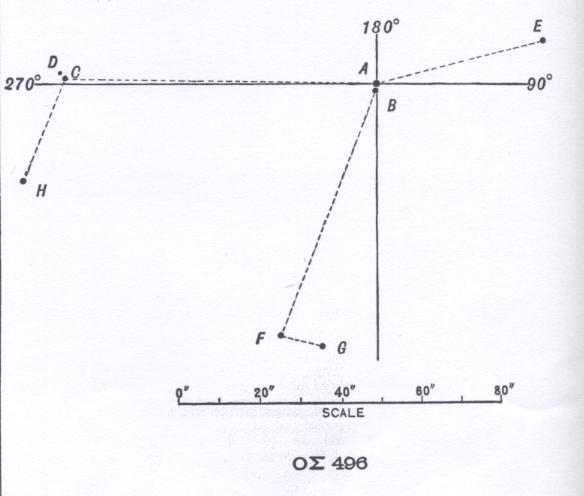
1H Cas - STT 496 (23 50 01.92 +58 32 56.1) challenges the writer's ability to describe a picture in less than a thousand words so for the first time in this series he has resorted to an image to help out. (See Fig 1). The field diagram comes from Burnham's General Catalogue of Double Stars, Part 2, page 1030. 1H Cas - so called because there is no Bayer or Flamsteed letter assigned to this mag. 4.9 star, first came to be catalogued by William Herschel - and it is number H VI 25 in his catalogue, but appears as SHJ 355 in the Cambridge Double Star Atlas and the book by Sissy Haas. It is located by extending the line from gamma Cas through beta Cas by the same distance again. Herschel also noted stars F, G and H which are given magnitudes of 10.6, 11.1 and 13.0 in the WDS. For the moderate aperture there are two close binaries in the group. The first is A itself which was divided by Otto Struve. The companion B, of magnitude 9.3, is only 0".8 distant and appears to be in direct motion. Somewhat earlier, Dawes doubled C which is a little wider (1".4) and less unequal, the magnitude of the companion, D, being 9.1. Again there is slow retrograde motion. Finally, a magnitude 10 companion at 207 degrees and 231" called I in the WDS was observed by Burnham with the 36-inch Lick refractor, and also turns out to be a close binary currently separated by 0".3.
gamma PsA (22 52 31.53 -32 52 32) is about one degree south-west of delta PsA which, in turn, is 3 degrees south of Fomalhaut. Delta is a fine, unequal pair found by Howe which is almost a perfect copy of gamma which was thought to have been first seen as double by John Herschel whilst at the Cape of Good Hope in 1835. In fact, Brian Warner, writing in the Monthly Notices of the Astronomical Society of Southern Africa in 1977 (Vol 36, page 134) makes a case for the duplicity of gamma PsA having been found by Fearon Fallows, the first Astronomer Royal at the Cape, a few years before. Fallows used a Mural Circle and a Transit instrument and made a couple of lists of double stars which he had happened across during the course of routine observations. Gamma is a very unequal system, magnitudes 4.5 and 8.2, with a companion which is slowly widening and is currently 4" distant. The primary is an AO giant some 217 light years away although Hartung (using a 30-cm reflector) saw the colours as pale and deep yellow whilst Gould with 175-mm also from Australia called the primary `off-white'.
Bob Argyle - Double Star Section Director
-
Double Star of the Month - September 2012
In this series of short articles, a double star in both the northern and southern hemispheres will be highlighted for observation with small telescopes, with new objects being selected for each month.
beta Cep (21 28 39.58 +70 33 38.5) was observed as a double star by both William Herschel and Piazzi. The mag 3.2 primary is accompanied by a companion of magnitude 8.6 some 14" distant in position angle 251 and there has been little change in this relative position in more than 200 years. Beta Cep is a distant star - Hipparcos puts it at almost 700 light years. It is clearly also a very luminous star, the WDS catalogue marks it out as a giant of spectral class B3. Interest in beta was reawakened in the 1970s when Antoine Labeyrie, the father of speckle interferometry, found the brighter star to be a close but unequal binary. Paul Couteau the famed visual observer tried to resolve it with the telescope at Nice but failed and subsequent observations have shown the magnitude difference in the visual to be more than 3. The orbit of Aa is very highly inclined and motion is almost all in distance - ranging from 0".33 at greatest separation (to be reached in 2035) to less than 0".01 near periastron. AB is noted as a showcase pair by Sissy Haas and she gives the colours as brilliant white and green. Smyth notes white and blue and also that there is a coarse but very minute double star preceding. Beta Cephei is probably more well-known as the prototype of a class of pulsating variable stars similar to Cepheids but with lower amplitude and range of magnitude. In this case the period is about 4 hours and the star varies by about 0.03 in V.
MLO 6 (21 27 01.62 -42 32 52.5) is located in Microscopium - close with the border with Grus and sadly too far south to be seen from the UK. Hartung gives colours of deep yellow and white which is surprising given that the primary is an A star but with metallic lines in its spectrum. The distance is 184 light years and the small change in relative position (146°, 4".2 in 1879, to 150°, 2".9 in 2008) suggest that this is a long period physical system. The magnitudes of 5.63 and 8.15 means that a good view of both stars would be gained with apertures of 15-cm or more.
Bob Argyle - Double Star Section Director
-
Double Star of the Month - August 2012
In this series of short articles, a double star in both the northern and southern hemispheres will be highlighted for observation with small telescopes, with new objects being selected for each month.
The two pairs selected this month are almost copies of one another. They have the same separation, and position angle, similar magnitudes and even the colours are close.
Eta Lyrae (19 13 45.49 +39 08 45.5) appears as H 4 2 in the great astronomer's first list of double stars published in 1782, but it was first listed by Christian Mayer in 1779. The primary is a luminous object more than 1,000 light years away. The companion appears to be an F star and with the primary being an early B subgiant, one might have expected colours to be white and yellow when in fact Hartung records yellow and ashy. The WDS gives magnitudes of 4.38 and 8.58 with current distance and PA being 28".5 and 79°. A fainter and more distant star (mag 11.4) can be seen at a distance of 161". Along with theta, also a wide, unequal pair, it follows Vega by about 7 degrees.
Beta1 Sgr (19 22 38.29 -44 27 32.1) is not only not the second brightest star in Sagittarius but it is actually about 12th in the list. The naked eye can make out both beta 1 and its close neighbour beta 2 (mag 4.27) some 20 arc mins away. Dunlop listed beta 1 as a telescopic double in 1826 and and since that time the position angle has increased slowly to 76° and the separation decreased slightly to 28".7. Hartung gives the colours as pale yellow and ashy white - the spectral types are actually B8V and F0V perhaps reversing what one might expect from the colours. However, Ross Gould using a 175-mm refractor disagrees with this judgement and gives the colours as white and yellowish. The stars are magnitudes 3.98 and 7.21 and again this is an optical system. Beta1 lies in the far south-western part of Sagittarius, close to the border with Corona Australis and Telescopium.
Bob Argyle - Double Star Section Director
-
Double Star of the Month - July 2012
In this series of short articles, a double star in both the northern and southern hemispheres will be highlighted for observation with small telescopes, with new objects being selected for each month.
With the summer constellations now becoming dominant, the two pairs selected this month are to be found in the constellations of Hercules and Ophiuchus.
STF2194 (17 41 05.50 +24 30 43.2) sits in the preceding edge of a glorious 1 degree field which includes the bright stars 83 and 84 Herculis. The pretty pair itself is an optical system and since 1783 it has widened gradually from 14".3 to 16".3. The main stars are magnitudes 6.5 and 9.3 and the current position angle is near 7°. Webb noted them as orange and blue in 1850, using his 3.7-inch refractor whilst Franks early in the last century found them to be yellow and lilac. The primary star is a K0 giant which is also a spectroscopic binary. About 169" away in PA 163° is a third star, nominally the same brightness in the visual as B.
STF2173 (17 30 23.78 -01 03 46.2) is a visual binary with a period of 46.4 years. Its highly inclined apparent orbit means there are two opportunities for small apertures to see the two stars before orbital motion takes them beyond the range of most amateur telescopes. The writer measured this pair in 1992 and 1997 with the Cambridge 8-inch Cooke telescope when the separation was respectively 1".1 and 0".7. The two stars are now separating reaching a separation of 0".8 in the south-eastern quadrant in 2012, they then close rapidly and open out again, reaching 1".1 in the north-west in 2037. Both stars are yellow and close to V = 6.0 so this pair forms a beautiful test object at present for 15-cm aperture. Whilst in this area, check out another target some 4 degrees slightly preceding this pair - 41 Oph, a close unequal binary which is one of R. G. Aitken's last discoveries. It needs at least 15-cm on a good night.
Bob Argyle - Double Star Section Director
-
Double Star of the Month - June 2012
In this series of short articles, a double star in both the northern and southern hemispheres will be highlighted for observation with small telescopes, with new objects being selected for each month.
The two systems featured this month are both unequal and difficult pairs which need at least 30-cm to see well. Both stars are also at the same distance from us - about 140 light years.
gamma CrB (15 42 44.57 +27 17 44.3) is number 1967 in F. G. W. Struve's catalogue of 1837. This has always been a hard object to see in the 8-inch OG at Cambridge but on nights of good seeing the companion can be measured, most recently in the summer of 2010 when the separation was found to be 0".7. The stars are in a very elongated and inclined 91 year orbit so that most of the motion is in distance. At the time of writing the pair is closing again and the separation has reached 0".56 at PA 111° but the stars are magnitude 4.0 and 5.6 which makes resolving the pair more difficult. Check the nearby eta CrB first before attempting this pair. It is slightly wider and more equally bright. If this does not jump out as a clear double then its unlikely that gamma will!
See 258 (16 03 32.22 -57 46 29.5) is also known as iota 1 Normae and it sits half way between zeta Arae and beta Circini. It has a short period for a visual binary - 26.9 years and at the middle of 2012 can be found at 213° and 0".33 but after this the stars close further. The two components are relatively bright (5.2 and 5.8), even so a night of good seeing will be necessary to see any sign that this is a double star. For the smaller telescope user there is a third star which forms HJ 4825 and which is currently at 241° and 11".2 having slowly decreased from 251° and 15" at discovery in South Africa in 1835. John Herschel measured this system again in 1837 and on the latter date the close pair would have been 0".42 apart but Herschel made no mention of it. Hartung notes that C is reddish compared with AB which are probably a pair of late A stars.
Bob Argyle - Double Star Section Director
-
Double Star of the Month - May 2012
In this series of short articles, a double star in both the northern and southern hemispheres will be highlighted for observation with small telescopes, with new objects being selected for each month.
Nine degrees south of Arcturus is 15 Boo - a naked eye star which is a difficult double star for the small aperture but which can be well seen in a 20-cm OG on a good night. Track another 3 degrees south-east and the eye alights on a crooked line of 3 stars with the brightest of them being the most northerly. This star is STF1835 (14 23 22.74 +08 26 47.8) and because it is almost half a magnitude brighter than 15 Boo it is unusual in that it has no Bayer number or Flamsteed letter. For the small telescope the pair offers a very pleasing sight with an AO primary being accompanied by an F2 secondary some 6" away to the south. Hartung makes the colours white and deep yellow, Sissy Haas has goldish-white and powder blue whilst W. S. Franks in 1916 made them white and lilac. Angular change has amounted to 7 degrees in the last 230 years but it seems certain that the two stars are physically connected. In 1889 Burnham found that B was a close double (BU 1111) and indeed it turns out to have a binary period of 40 years. The separation ranges from 0".15 to 0".3 so could be seen in 30-cm or more when at its widest in 2022. For 2012.0 the distance is 0".2.
About 3 degrees following beta Crucis, although actually in Centaurus, is a group of bright double stars - R 213, I 424 and CorO 152 - the latter two of which are in the same field. I 424 (13 12 187.63 -59 55 13.9) is a very unequal and rather close pair which needs 20-cm on a good night to see well, but which Hartung could just catch with 10.5-cm. The magnitudes are 4.8 and 8.4 and a recent measure in 2008 by the writer put the fainter star at 13° and 2".0. For the larger aperture, the primary is the binary See 170 - discovered by Thomas Jefferson See and which is only 0".22 apart in mid-2012. This 27 year pair has components of 5.3 and 6.0. Hartung notes that the primary star is yellowish but it has the spectrum of a B5 dwarf. Some distance from AB-C are two faint companions of magnitudes 12.6 and 14.9. About 8' NE is CorO152 - a 25" pair with colours of orange and reddish according to Hartung. R213 is a pair of white stars of magnitude 6.6 and 7.0 which has moved little in PA since discovery by Russell but the separation has tripled to 0".9 and this makes it an excellent test object for a 12-cm aperture.
Bob Argyle - Double Star Section Director
-
Double Star of the Month - April 2012
In this series of short articles, a double star in both the northern and southern hemispheres will be highlighted for observation with small telescopes, with new objects being selected for each month.
2 CVn = STF1622 (12 16 07.55 +40 39 36.6) is a beautiful pair with components of contrasting hues which sits near the western border of Canes Venatici with Ursa Major and about 5 degrees following beta CVn. The primary star, an early M giant is accompanied by a late F dwarf and many writers have commented upon the colours to be seen here: - Webb called them very gold and blue, Dembowski thought them yellow and azure, Franks made them orange and blue and more recently Sissy Haas recalled brick red and silvery sapphire. The stars are magnitudes 5.9 and 8.7 and are currently separated by about 11".4 which makes them an easy target even for the small telescope.
mu Crucis (12 54 35.66 -57 10 40.4) is simply one of the most beautiful doubles in the sky. A pair whose components of visual magnitude 3.9 and 5.0 share common proper motion and distance, this system belongs with the Scorpio OB2 association of young hot stars, and Hipparcos places both stars about 412 light years away. Shatsky and Tokovinin used the ADONIS near infrared adaptive optics system on the ESO 3.6-metre reflector to search for faint, close companions and they found two objects within 5" of component B. No magnitudes or proper motions are available so it is too early to say if these are physically connected but the two bright stars certainly form a very long period binary. Mu Crucis was found by Dunlop in 1826. The spectral types are both B and Hartung record them as both white whereas Richard Jaworski sees a tinge of yellow in the fainter star. The current separation of 35" and the brightness of the stars almost makes this a southern equivalent of Albireo but without the colours.
Bob Argyle - Double Star Section Director
-
Double Star of the Month - March 2012
In this series of short articles, a double star in both the northern and southern hemispheres will be highlighted for observation with small telescopes, with new objects being selected for each month.
STT 215 (10 16 16.05 +17 44 24.6) is one of Otto Struve's discoveries at Pulkova and is a slow moving binary. In 1844 the stars were just 0".47 apart in position angle 256°. Since then, slow retrograde motion has brought them to 177° and 1".5, sufficiently wide to be well-seen in a small telescope although the relative faintness of the two stars does require a night of good seeing and transparency to get a good view - it is not the easiest of pairs to measure with the Cambridge 8-inch OG. Surprisingly, the star is not in the Dover edition of Webb's `Celestial Objects' but it is described in Hartung and Haas. The current orbit projects a period of 670 years with the separation continuing to increase slowly. Hipparcos puts this star at a distance of 375 light years and the WDS gives the spectral type of the primary as A9IV.
I11 (09 15 14.64 -45 33 19.8) is in Vela, currently prominent from southern latitudes, and which is full of interesting double stars. It is located about 2 degrees south following λ Vel and was one of Robert Innes' first discoveries with a borrowed 6-inch refractor from Sydney in the last decade of the 19th century. Set in a fine field Hartung found both stars to be yellow, although the spectral type of the primary is B8V. This is undoubtedly a binary, albeit of very long period. Having closed slightly since discovery with increasing position angle, it was found at 290° and 0".8 in 1997 when last measured. It is a very distant system, only just giving a significant parallax form the observations made by Hipparcos which place it at a distance of almost 1900 light years.
Bob Argyle - Double Star Section Director
-
Double Star of the Month - February 2012
In this series of short articles, a double star in both the northern and southern hemispheres will be highlighted for observation with small telescopes, with new objects being selected for each month.
15 Lyn (06 57 16.60 +58 25 23.0) is on the western edge of a coarse cluster of double stars which also includes the close binaries 4 and 14 Lyn. Discovered at Pulkova by Otto Struve at a distance of about 0".5 the two stars slowly widened reaching around 0".9 at the turn of the last century before the companion made a close (0".1) approach to the primary and is now slowly widening again. This is a good opportunity to see this pair which needs 20-cm on a good night because there is also a substantial difference in brightness of about a magnitude. Andreas Alzner's orbit from 2000 gives the ephemeris position of 232° 0".67 for 2012.0. It is missing from Sissy Haas' book which is a little odd given that 4 Lyn is included and is similarly difficult to resolve. A good night may also show the faint companion discovered by Burnham. This 12.5 mag star can be seen at 346° and 29" whilst a more distant 9.5 is some 187" away and the distance to AB is decreasing due to proper motion of the bright pair.
Dun 39 (07 03 15.12 -59 10 41.1) is in Carina, lying about 3 degrees north preceding alpha Pictoris and forms a beautiful white pair which is easily resolvable in a small aperture. When discovered by Dunlop from Australia in 1826 the stars were separated by 2".8. The revised version of Hartung (1995) by Malin and Frew repeats the note in the original edition that it can just be seen with 7.5-cm aperture, but the two stars are closing and the last measure in 1997 put the separation at 1".4. In 2006 Graeme Jenkinson and Tin Napier-Nunn of the Astronomical Association of Queensland noted that x320 was needed on a 15-cm f/8 OG to see it clearly so it will be interesting to see if it is still accessible to 7.5-cm now. The pair is clearly binary and lies almost 500 light years away.
Bob Argyle - Double Star Section Director
-
Double Star of the Month - January 2012
In this series of short articles, a double star in both the northern and southern hemispheres will be highlighted for observation with small telescopes, with new objects being selected for each month.
35 Cam (06 04 29.10 +51 34 24.2) was observed by Madler in 1843, and became number 128 in the Pulkovo Catalogue of Otto Struve, although it had been discovered by John Herschel in 1830. Later authorities including Aitken in the ADS added the word rejected because the separation was too wide for the pair to be a likely binary system. The rejected tag seems to have been removed in the current WDS but there is no evidence that the two bright stars are connected. The pair is a fine sight in a small telescope - the primary appears white and V = 6.4, whilst a V = 9.26 mag. bluish companion sits about 40 arc seconds away in PA 14°. For the user with say 30-cm there is the additional interest that the companion is a close pair - HU 559 which appears to be moving in retrograde binary motion - some 30 degrees since the discovery by Hussey in 1902. The WDS gives magnitudes of 9.6 and 10.6 and the current separation is 0".6 so this is as much of a test of the atmosphere as it is of the telescope.
The constellation of Columba lies to the south of Canis Major and a triple star worth seeking out is HJ 3858 (06 25 30.01 -35 03 50.5). It forms an isosceles triangle with kappa and delta Col and is exactly 5 degrees south of zeta CMa. This is both an easy binocular pair and a fine triple in the small telescope. The brightest stars have magnitudes 6.4 and 7.6 and are separated by 131" a distance which is slowly increasing. The primary star, of spectral type K3 appears deep yellow to Gould with 175-mm, whilst the companion appears white, reflecting its spectral type of A4. When John Herschel noted it on sweep 663 at Feldhausen, he described its three stars as 'Fine object. A star 6 mag precedes to the south'. The close pair (BC) is currently 3".8 apart and also slowly separating with little change in position angle, and the magnitude of C is 8.2.
Bob Argyle - Double Star Section Director
-
Double Star of the Month - December 2011
In this series of short articles, a double star in both the northern and southern hemispheres will be highlighted for observation with small telescopes, with new objects being selected for each month.
With the Pleiades now high in the sky there is the opportunity to get a good look at this young star cluster some 420 light years distant.
James Mullaney and Wil Tirion in their Atlas note nine double stars within a radius of 3 degrees of the cluster centre. Most western of these is 7 Tau (033426.62 +242752.1) and although it lies at the same distance as the cluster its proper motion indicates that it does not belong. William Herschel noted the wide companion of V = 9.9 at a distance of 22" and it resides in the WDS as H 4 88. Thomas Lewis considered it was an optical companion but the WDS says that it is physically connected. It was Freidrich Struve who resolved the primary into a close pair of stars of mags 6.6 and 6.9 at a distance of 0".6. The pair closed to 0".2 about 90 years ago and has now widened again to 0".7 and PA 353 (2012). In a 20-cm OG it is usually a difficult pair and requires a steady air for a good view. The period appears to be around 520 years and both stars appear white to the writer; Smyth made them white and yellowish.
Some 20 degrees below the tip of the `V' of Taurus can be found the naked-eye pair omicron 1 and omicron 2 Eri. Omicron 2 is the nearby triple star STF518 which contains two dwarf stars but this month the spotlight falls on 39 Eri (041423.69 -101521.2) which is 3 degrees south of omicron 2. Another discovery by William Herschel this beautiful pair is a slow binary having moved some 10 degrees retrograde since discovery and is now somewhat closer than then also (2009, 6".7). The significant proper motion in declination of 0".16 per year would have separated the stars by more than 30" since discovery if the pair were not connected. Modern catalogue values for the magnitudes are 5.03 and 8.53 although Smyth noted star B as mag 11 in the `Celestial Cycle'. The primary is a K3 giant so both Hartung and Gould, observing from the southern hemisphere where the star is high in the sky, noted an orange hue whilst the faint secondary appeared white in both cases. Webb, observing from the Welsh border made them yellow and blue.
Bob Argyle - Double Star Section Director
-
Double Star of the Month - November 2011
In this series of short articles, a double star in both the northern and southern hemispheres will be highlighted for observation with small telescopes, with new objects being selected for each month.
The constellation of Andromeda now rides high in the evening sky stretching across some 50 degrees of right ascension. One of its most famous double stars is gamma (see DSOTM for Dec 2006) but some 6 degrees north of gamma and slightly following is the binary system STF 228 (021402.43 +472903.3). The spectral types of the stars are given as F2V and F7V in the WDS with visual magnitudes of 6.56 and 7.21. The period is 144 years and at present the separation is beginning to decrease with the relative position for 2012.0 given as 295°, 0".8. By 2032 the distance will have reached 0".32. Hipparcos gives the parallax of 25.23 milli-seconds of arc (mas) with an error of 0.66 mas which places the system at a distance of 129 light years.
Whilst Andromeda is one of the largest constellations, Reticulum (The Net) is one of the smallest. Extend a line from alpha through delta Reticuli a little more than the separation of those two stars and you come to Dunlop 14 (033810.24 -594635.0). Visible in binoculars it repays examination through the telescope. The two stars, magnitudes 7.00 and 8.34, are both main sequence F stars and yellow in colour. Their separation was 45" at discovery in 1826 and by 2008 this has increased to 57".4. However, looking at the Hipparcos Catalogue reveals the fact that both the proper motions and parallaxes of the two stars are identical to within the given errors which makes this a bound system and it is located about 247 light years away. In Sissy Haas's book Double Stars for Small Telescopes, Ross Gould observing from Canberra with a 7-inch refractor, noted a faint third star of magnitude 12.8 close to B and which is not yet in the WDS.
Bob Argyle - Double Star Section Director
-
Double Star of the Month - October 2011
In this series of short articles, a double star in both the northern and southern hemispheres will be highlighted for observation with small telescopes, with new objects being selected for each month.
Located in northern Cepheus and about 15 degrees from the NCP, pi Cep (230753.8 +752315) is an awkward target for the user of the classical refractor and the writer has only measured this binary once, in 1994, when the position angle was 347° and the separation 1".1. Since then direct motion of 10 degrees has occurred with virtually no change in separation. It has now almost reached the point where Otto Struve first measured it in 1846 and the current period is given as 163 years. Around 1920, a number of observers recorded the star as single but the current orbit predicts separation in the 0.5 to 0.6 arc second range so it is not clear why the star should have been unresolved. Is the companion perhaps a variable? The primary is an early G star and both Webb and Smyth thought it very yellow or deep yellow, respectively, with both men agreeing that the secondary appeared purple. It is also a spectroscopic binary with a period of 556 days and it is speculated that the invisible companion is itself a short period binary. John Herschel found a 12.2 mag. comes at 58". Pi Cep is an attractive object but the stars are more than 2 magnitudes apart and it needs good optics and a steady air to resolve it cleanly. It will remain in range of 15-cm or so for a few decades to come.
Sculptor contains a few nice pairs and one of these, kappa1 Scl (000921.0 -275917) is a good test for a 10-cm as the stars are magnitudes 6.1 and 6.2 and currently 1".3 apart. It was found low in the Chicago sky by Burnham using his 6-inch refractor when it was considerably closer than it is today and a preliminary orbit gives a period of over 600 years. Willem Luyten, in his proper motion survey work, found an 18th magnitude companion at a distance of 73" moving through space with the bright pair, making this a physical triple. Hipparcos puts the bright pair at a distance of 256 light years, some 10 light years more distant than pi Cep. The low power field also contains kappa2 Scl, a 5.4 mag. K giant, and most curiously, this too has a very faint (mag. 21) cpm companion found by Luyten which appears in the WDS as LDS2099.
Bob Argyle - Double Star Section Director
-
Double Star of the Month - September 2011
In this series of short articles, a double star in both the northern and southern hemispheres will be highlighted for observation with small telescopes, with new objects being selected for each month.
kappa Pegasi (21 44 36.4 +35 47 39.5) is a famous visual binary, having been discovered by Burnham in 1880 using the 18.5-inch refractor at Dearborn. Apart from observations by the Greenwich double star observers around the turn of the century, and later at Herstmonceux and Christopher Taylor with his 12.5-inch it has eluded attempts at resolution from the UK. The separation barely exceeds 0".2 at any point in the 11 year orbit. Of more interest to the smaller aperture user is the Struve companion (STF 2824) which sits about 14" distant at PA 288. The writer has measured it with a 20-cm OG but, it has to be said, with some difficulty, owing to the faintness of B. The WDS gives 10.8 with the primary at V=4.1.
pi Gruis (22 22 44.2 -45 56 53) would be a naked-eye pair if it were a little brighter. There are 2 stars of mags 6.5 (pi 1) and 5.6 (pi 2). Both are double stars in each case with companions about 4 magnitudes fainter and 3 to 5 arc seconds apart and both were discovered by Robert Innes. The easier of the two is pi1 (I 135) which also has the distinction of being a member of the rare S class of stars and varies between visual mag. 5.8 and 6.4. Hartung notes that the primary is bright orange. Whilst the binary nature of pi1 is not yet clear, pi 2 (I 382) seems to be physically connected. For the galaxy observer the edge-on spiral IC 5201 is about 15' SW of pi 2.
Bob Argyle - Double Star Section Director
-
Double Star of the Month - August 2011
In this series of short articles, a double star in both the northern and southern hemispheres will be highlighted for observation with small telescopes, with new objects being selected for each month.
Delta Cygni (19 44 58.4 +45 07 51), like Alpha Pav, is a B subgiant, if a little later in the spectral class. Its duplicity was discovered by the elder Herschel when the separation was around 2".3. Over the next half century or so, the mag 6.3 companion moved closer to A (mag 2.9) thus making the pair more difficult for early micrometrists. Indeed Webb reports that in the mid C19 the separation was such that the B star sat on the first diffraction ring of A making it difficult to spot and some reported that it was much easier to see in the twilight sky before sunset. Reports came in of brightness variation of up to 2 magnitudes in the companion but it may well be that this was due to the large difference in magnitude and close separation. At present the distance has increased slightly since Herschel's time and the companion has traced out about 150 degrees. An orbit of 780 years period currently occupies the USNO 6th orbit catalogue and predicts 219°, 2".70 for 2012.0. Its not an easy pair for the small aperture and can occasionally evade the 20-cm user if the seeing is not at least reasonably steady. Recently, Jim Daley in the US has added four faint field stars, arranged as two 3" pairs on either side of delta and distant 42" and 148" from it.
Alpha Pavonis (20 25 38.9 -56 44 06) sits in an empty part of the southern sky but at mag 1.9 it is unmistakeable. From Feldhausen in South Africa, John Herschel examined the star and noted a distant wide pair - both stars of which are much fainter than alpha. It entered the catalogue as HJ 5193 and although there is probably no physical connection between any of the stars the system, caught the attention of the writer last year whilst using the 26-inch refractor in Johannesburg. The primary is a brilliant white, star B is reddish (John Herschel thought it `very red' and its closer companion C appeared blue - an unusual and rather patriotic combination of hues. The distance AB is 245" whilst C is 17" from B, and the magnitudes of BC are given as 9.14 and 9.17 in the WDS. It would be interesting to know if these colours are apparent in smaller apertures.
Bob Argyle - Double Star Section Director
-
Double Star of the Month - July 2011
In this series of short articles, a double star in both the northern and southern hemispheres will be highlighted for observation with small telescopes, with new objects being selected for each month.
Alpha Herculis or Rasalgethi (17 14 38.86 +14 23 24.9) is a red supergiant star (M5Ib/II) and the leader of Hercules. It has long been known as a visual binary and is particular attractive to small telescope users because of the contrast offered between the primary and its G5 giant companion some 4".6 distant. The primary is usually seen as orange/red but the companion has variously been reported as white (Hartung), bluish-turquoise (Haas) and sage green (Perez). The primary is a semi-regular pulsating variable whose brightness varies from about magnitude 3.1 to 3.9, and the main period of oscillation appears to be 1343 days. The companion is about 5.4. The motion is orbital but extremely slow and the period is thought to be about 3600 years, but this is complicated by the fact that each component is double again. The primary has been resolved occasionally by speckle interferometry at the 0".02 level whilst the secondary has been known as a spectroscopic binary for many years; the period is 51.6 days. There is also another companion to A with a period of 10 years which does not appear to be the speckle companion so alpha is at least quintuple. For the larger telescope user two faint companions mag. 11.1 at 79", and mag. 15.5 at 19" appear to be merely optical.
Located in Ara, just on the border with Scorpius, HJ 4949 AB (17 26 51.98 -45 50 34.7) is the primary, of the wide pair DUN 216 (5.6, 7.1) which was found by Dunlop in 1826 at 30O and 33".1. By 1999 the pair had widened to 102" thanks to the proper motion of C. AB is a beautiful pair barely 2" apart which has moved about 20 degrees retrograde since being found by John Herschel in 1834. The stars, of magnitudes 5.6 and 6.3, are both late B in spectral type and hence appear white and afford "a beautiful contrast with the surrounding starry field" according to Hartung. Hipparcos places them at distance of 613 light years.
Bob Argyle - Double Star Section Director
-
Double Star of the Month - June 2011
In this series of short articles, a double star in both the northern and southern hemispheres will be highlighted for observation with small telescopes, with new objects being selected for each month.
Beta Serpentis (15 46 11.21 +15 25 18.9) lies about 11 degrees south of the crown of Corona Borealis. The primary is a mag 3.7 star of spectral type A2IV and many observers find it to be yellowish. The faint (mag 10.0) companion was found by the elder Herschel on 1781 Aug 13, and he did not allocate it a colour, noting it only as `extremely faint'. Today 15-cm aperture will show it clearly enough - a slighter harder test is the 10.7 mag star some 200" away in PA 212°. A very recent study has been using Hipparcos data to physically link apparently unrelated pairs of stars and in Beta's case the study found that there is a very high probability that the faint wide pair ROE 75 (mags 8.2, 10.7, PA 327°, separation 6".2) which can be found some 20 arc mins south preceding beta Ser is physically connected to Beta by dint of having a very similar parallax and proper motion.
The small constellation of Ara is seen against the Milky Way near the tail of the Scorpion, and Hartung lists numerous objects of interest within its borders. The coarse cluster NGC 6193 is involved with the emission nebula NGC 6188 and in addition the brightest star MLO 8 (16 41 20.42 -48 45 46.7) is a multiple system of some interest. In 1878 observers at Melbourne divided A (mag 5.1) and found a mag 8.4 companion at 2".1 distance. The distance between the two has been closing since and the last recorded measure in 1938 placed the companion 1".6 from the primary, although Hartung reports seeing the star clearly resolved with 10.5-cm in 1963. It is not clear if B is a background star or an orbital companion - the next positive observation will help to decide this question. For the small telescope user there is star C (mag 6.8) some 10" away and medium apertures should easily find two fainter (mags 10.5 and 11.4) and more distant comites found by Herschel and another of mag 12.5 discovered by Innes.
Bob Argyle - Double Star Section Director
-
Double Star of the Month - May 2011
In this series of short articles, a double star in both the northern and southern hemispheres will be highlighted for observation with small telescopes, with new objects being selected for each month.
STT 288 (14 53 23.35 +15 42 18.7) can be found about 3.5 degrees due south of xi Boötis as a star just below the usual limit of naked-eye visibility. The components are magnitudes 6.9 and 7.5 and revolve around one another in about 313 years. About 100 years ago, the Greenwich Observatory observer William Bowyer considered the two stars were optical in nature. To him they appeared to be steadily increasing in separation since discovery in 1845 when Otto Struve found them separated by 0".45. A few years after Bowyer's observation, the stars began to slowly close again. The orbit is fairly eccentric and the stars will continue to close to 0".51 in about 50 years time. Hipparcos places them at a distance of 155 light years. In the meantime at PA 160°, 1".06 they form an excellent test for the 10-cm aperture.
Lupus is full of fine pairs and this column regularly features stars in that southern constellation. This month is the turn of Kappa Lupi = Dunlop 177 (15 11 56.07 -48 44 16.2), a beautiful pair of pale yellow stars according to E J Hartung. More recently Richard Jaworski notes them as yellow-white and plain white whilst the WDS gives the spectral types as B9.5V and A5V whilst the brightnesses are listed as 3.8 and 5.8. To the small aperture this is one of the easiest and brightest pairs in the sky - the current separation is 26".2 and this has decreased about 3" since 1826. With very similar proper motions, it is highly likely that the stars form a binary system, but Hipparcos has had some trouble in deciding the distance of the fainter component.
Bob Argyle - Double Star Section Director
-
Double Star of the Month - April 2011
In this series of short articles, a double star in both the northern and southern hemispheres will be highlighted for observation with small telescopes, with new objects being selected for each month.
The two stars in this month's column both have early A type primary stars and are each located around 125 light years from Earth but as objects for observation, one can be seen in stabilized binoculars, the other needs at least a 30-cm telescope.
alpha CVn (12 56 01.67 +38 19 06.2) is the leader of the northern constellation of the Hunting Dogs and sits in an desolate part of the sky to the naked eye, below Ursa Major and above the faint coarse grouping of stars which form Coma Berenices. It was found by William Herschel and the magnitudes are 2.8 and 5.5. Hipparcos, which has measured both components, has had trouble with the distance to star B but even though the error in the trig. parallax is some 30% the distance still agrees with that of star A within the mutual errors. The clincher here is the proper motion of each star - around 0".2 annually and in the same direction. The separation has reduced from 22" in 1777 to around 19".1 today - slow enough to be used by the writer as a standard for micrometer calibration. Both stars are brilliant white and A is the prototype of the alpha2 CVn variables - it possesses lines of rare earths in its spectrum and the amplitude of variability is some 0.14 mag in a period of 5.5 days. The WDS states that both stars are spectroscopic binaries but neither appears in the 9th catalogue of SB orbits.
gamma Cen (12 41 31.20 -48 57 35.6) can be found by extending the line between alpha and gamma Crucis by about the same distance again. In 1847 John Herschel recorded his observation of the star in sweep 553 - "A star 4m. which I am very much inclined to believe close double, but could not verify it owing to bad definition. Tried 320 but it will not bear that power". He noted that there was indisputable evidence of rapid orbital motion (5°.4 in just over one year to 1836.28). The stars then closed rapidly to about 0".13 over the next 11 years and reached their closest point again in 1933. With a period of 84.5 years these two almost identical A stars are closing rapidly again and at the time of writing can be found at 311°, 0".26 - wait another year and the distance will be 0".18.
Bob Argyle - Double Star Section Director
-
Double Star of the Month - March 2011
In this series of short articles, a double star in both the northern and southern hemispheres will be highlighted for observation with small telescopes, with new objects being selected for each month.
STF1333 (09 18 25.97 +35 21 51.3) appears with a brief description in Chambers revision of Smyth's Celestial Cycle but not in the original publication. Both stars appear `very white' in this tome but a more recent observation by Sissy Haas calls them `pure lemon yellow' but she also notes that they are in a very low power field with the orange star alpha Lyncis and also close to the bright, unequal pair 38 Lyn. The primary is spectral type A8V and the secondary probably similar although the WDS gives no spectral type. Discovered by William Herschel in 1782, Struve measured it in 1827 and found 40° and 1".5. The pair has slowly widened to 1".9 with little change of angle, so it is likely to be a long period binary but the relatively slow movement makes it a fine test for a small telescope with the components of magnitude 6.6 and 6.7. The distance according to Hipparcos is 308 light years.
Mu Velorum (10 46 50.36 -49 25 12.8) is a magnitude 2.8 yellow giant located in a relatively blank area of sky to the naked eye some 11° north of the eta Carina nebula. In 1880, Russell, in Sydney, found it to be double with the companion some 2.7 magnitudes fainter located at PA 55° and a separation of 2".8. The pair turned out to be binary and by 1949 it had closed to 0".2. The currently accepted period is 138 years so the system is now almost at the point in its orbit where it was discovered. The relatively large difference in magnitude makes this star a southern equivalent of zeta Herculis although the separation range is much greater thanks to an eccentricity of 0.84. It will be near widest separation for many years and thus easily accessible to small telescopes on nights of steady seeing. Hartung notes that both stars are yellow, the companion being a G2 dwarf and therefore almost identical to the Sun. A is also a spectroscopic binary.
Bob Argyle - Double Star Section Director
-
Double Star of the Month - February 2011
In this series of short articles, a double star in both the northern and southern hemispheres will be highlighted for observation with small telescopes, with new objects being selected for each month.
With Gemini high in the sky in the early Spring sky, a number of binaries are on display for the small telescope user. One of the more difficult is STF1037 (07 12 49.08 +27 13 30.2), a pair of yellow stars which are locked in a highly eccentric orbit. They present a good test object because at present the separation is 1".00 according to the 116 year orbit which is given in the USNO 6th orbital catalogue. The magnitudes are listed in the WDS as 7.2, 7.3 and with the 8-inch refractor at Cambridge this pair has always been more difficult to see and measure clearly than the parameters would suggest. It is a good time to observe STF1037 - the pair is closing up again and will reach well below 0".1 in about 30 years time, and it not be this wide again until around 2063. In the 19th century, the German observer Madler was convinced that B was double again and the volume by Lewis on the Struve stars does show a loop in the apparent motion of B but no convincing evidence for a third component has come to light. Madler, and Dembowski failed to see the faint star C (V~13) found by Otto Struve. It is located at 78°, 14" but may be variable.
Puppis is a glorious constellation for the double star aficionado and one of the best objects is k Puppis (07 38 49.88 -26 48 14.0), a third magnitude star some 8° east of delta CMa. Discovered by William Herschel (H III 27) the stars are both hot blue dwarfs of spectral type B6 and might be expected to appear white in the eyepiece. Malin and Frew, in their revision of Hartung's book thought so but noted that Hartung himself had them as pale yellow. From his observatory in Victoria, Australia this object would have passed almost overhead. Haas also calls them white but gives the star name as kappa. There has been some angular motion since 1800 - star B has moved about 8° retrograde and can now be found at 318° and 9".9. Burnham added a faint, distant star, mag 13.7 at 7" from A, but as this has not been measured since 1927, it would appear to be a difficult object.
Bob Argyle - Double Star Section Director
-
Double Star of the Month - January 2011
In this series of short articles, a double star in both the northern and southern hemispheres will be highlighted for observation with small telescopes, with new objects being selected for each month.
Rigel = beta Orionis (05 14 32.27 -08 12 05.9) is perhaps the most intrinsically luminous star in a double star system which can be seen in a small telescope. Whilst the measured luminosity of other bright stars such as Canopus have varied wildly over many years, the advent of the Hipparcos mission has been able to pin down the geometric distance to these objects much more accurately. The current trigonometric parallax for Rigel from Hipparcos is 3.78 milli-arcseconds with an uncertainty of about 10%. This translates to a luminosity of 48,000 times that of the Sun. The faint companion star whose estimated magnitude has also fluctuated over the years might be dominated by the light of the dazzling primary star 9 arc seconds distant but it is an equally interesting object in its own right. In 1871, Burnham, using his 6-inch Clark refractor, suspected an elongation of this star, and having then examined it with the 18.5-inch OG at Dearborn was convinced that there was a `real and measurable' elongation. Around 1900, Aitken, Hussey and Barnard using the 36-inch refractor at Lick all recorded separations in the 0.09 to 0.16 arc second range for BC. Occasional sightings have been reported since then, including as late as 2005 but no orbit exists and in fact the reality of the companion to B must still regard as unproven. Rigel B is known to be a spectroscopic binary but this cannot be BC. It needs a good night to see Rigel B clearly in the glare of the primary. The magnitude is near to 6.8 rather than the 10.4 first assigned to it by Burnham.
19 Cam (05 22 33.53 +79 13 52.1) is a mag 5.1 late F dwarf star some 68 light years distant. A companion star of mag. 9.2 was first noted, apparently by Piazzi, in the compilation of his Palermo catalogue and later catalogued by Struve as STF 634.This is a good example of an optical double. In 1825, South found star B at 346° and 37", by late 1926 it was at 62°, 9" and by 2008 it had reached 133°, 27". Both stars have significant proper motions (0.18 and 0.16 arc seconds per annum) but almost in opposite directions on the sky. This is an attractive pair for small telescopes although rather difficult to find being in a sparse area near the north celestial pole - the colours were given as light yellow and pale blue by Smyth.
Bob Argyle - Double Star Section Director
-
Double Star of the Month - December 2010
In this series of short articles, a double star in both the northern and southern hemispheres will be highlighted for observation with small telescopes, with new objects being selected for each month.
STT 95 Tauri (05 05 32.1 +19 48 24) was found by Otto Struve using the 15-inch refractor at Pulkovo. It is a long period binary (760 years) and is currently to be found at 297 degrees and 0".96. The magnitudes are 7.0 and 7.6 so it should be easily resolvable in 15-cm. The apparent orbit is such that the pair will widen to about 1".2 over the next 350 years so this system will gradually become easier for the small telescope user. The primary belongs to the metallic lined A star group, both stars appear white, and the system is at a similar distance from the Sun as theta Ret (below) is. The star lies halfway between iota and 104 Tauri which in turn lie halfway between zeta Tauri and Aldebaran.
Theta Ret (04 17 40.3 -63 15 20) is a beautiful pair of stars (magnitudes 6.4 and 7.7) in the small constellation of Reticulum, more specifically, it is in the same low power field as the stars alpha (mag. 3.4) and eta (mag. 5.4) Ret and 30 arc minutes south of the galaxy NGC 1559. Discovered by Rumker (the pair is RMK 3) the two stars have changed little in position angle and the separation has slowly reduced from 6".4 in 1835 to 4".3 in 2000 when the pair was last measured. Although the primary has a spectral type of B9.5 III both stars appeared deep yellow to E. J. Hartung whilst Ross Gould with 35-cm thought that the primary was a lighter shade of yellow than the secondary. This is almost certainly a binary star with the small proper motion of A not quite accounting for the change in separation. Hipparcos gives the distance to A as 7.02 mas (465 light years) and the primary star is consequently some 50 times brighter than the Sun. In his revision of Smyth's Celestial Cycle, Chambers quotes B. A. Gould as having noted a variation of 0.3 magnitude in the primary. In that volume, the stars are given as 5.5 and 9.0.
Bob Argyle - Double Star Section Director
-
Double Star of the Month - November 2010
In this series of short articles, a double star in both the northern and southern hemispheres will be highlighted for observation with small telescopes, with new objects being selected for each month.
Psi Cas (01 25 55.90 +68 07 48.8) is a pretty triple star found about 8 degrees due north of delta Cas the second left-hand-most star in the 'W'. AC (mags 4.7, 9.2) was found by William Herschel in 1783 and has closed up considerably since then. In 2007 the position was 128° and 20".3, a change which is due entirely to the proper motion of A. Both stars are double again and with a small telescope CD is quite difficult since the components are magnitude 9.4 and 10.0. Burnham found a 14th magnitude companion (B) to A which was last measured in 1970 at separation 2".4 and must be considered beyond the range of most amateur instruments. Chambers gives colours of orange tint, blue and reddish for A, C and D. In 1850 Webb found A orange and C blue.
Beta Phe (01 06 05.11 -46 43 06.6) is a bright visual binary which has been under-observed since it was discovered by R. P. Sellors in 1891 with an 11-inch refractor. It widened to about 1".4 in the mid C20 but then started to close again and was measured occasionally as it closed up with a measure in 1999 giving 258.8°, 0".29. This was the last observation until 2008 and during that time the star passed unobserved through 140 degrees of position angle and more crucially, periastron passage. In 2002 Andreas Alzner calculated the first orbit but more recent measures by Rainer Anton (see JDSO) indicate that a further revision is necessary. This is now in progress. The star is now widening and at the time of writing is around 0".40 so that it should be seen as double in 25-cm on a good night. Steady air is essential since the stars are very bright - magnitudes 4.0 and 4.2. When looking for this pair, take time to look for Slr 2 some 30 arc minutes to the east. It is somewhat wider and fainter but it is doubtless also a long period binary
Bob Argyle - Double Star Section Director
-
Double Star of the Month - October 2010
In this series of short articles, a double star in both the northern and southern hemispheres will be highlighted for observation with small telescopes, with new objects being selected for each month.
The pairs featured this month are both close but bright visual binaries which afford excellent tests of optics and seeing for the possessors of 20 to 25-cm aperture.
72 Peg (23 33 57.19 +31 19 31.0) is equidistant from the top two stars of the square of Pegasus, alpha and beta, and about 3 degrees above the line joining them. Discovered in 1878 with the 18.5-inch refractor at Dearborn by Burnham, this yellow pair has slowly widened with increasing position angle. At the present the companion can be found at PA 105 degrees and separation 0".53. This is the maximum separation which this system will attain but the period of 260 years means that it will be some years before it appears to be significantly closer. The magnitude of the two stars, 5.7 and 6.1, and the declination of +31 means that in the autumn this pair is high in the mid-northern sky and thus provides an excellent resolution test.
Lambda 1 Scl (00 42 42.89 -38 27 48.6) is a similar system to 72 Peg although somewhat fainter (6.7 and 7.0) and rather wider at the present time (21°, 0".7) having widened somewhat since discovery by Harvard College Observers in Peru in 1901. The primary is A0V and therefore appears white to the observer. The brighter star lambda 2 sits about 18 arc minutes following lambda 1 and provides the binocular observer with a fine sight. The parallaxes of both stars as determined by Hipparcos seem to rule out a physical connection.
Bob Argyle - Double Star Section Director
-
Double Star of the Month - September 2010
In this series of short articles, a double star in both the northern and southern hemispheres will be highlighted for observation with small telescopes, with new objects being selected for each month.
The two pairs this month are both long period binaries, whose physical association was in some doubt for many years.
zeta Aqr (22 28 49.8 -00 01 12) is not strictly a northern double star being some 72 arc seconds south of the equator but it is such a bright and easy pair for the small telescope that it is worth seeking out. It is one of the bunch of bright stars which are 5 to 8 degrees following alpha Aquarii.
The stars that form zeta are magnitudes 4.3 and 4.5 and the spectral type of early F suggests that the colour of the primary should be yellowish. Webb in 1851 finds pale yellow, Hartung also notes yellow and Sissy Haas has pale citrus-orange.
According to Thomas Lewis, Zeta was found to be double by Christian Mayer in 1777 but it does not appear in his pioneering catalogue of 80 double stars published in 1780 according to Jurg Schlimmer. William Herschel observed it soon afterwards and includes it as H II 7. At this time the companion was about 4 arc seconds due north and for most of the nineteenth century the motion appeared linear, but in the first quarter century of the twentieth century the pair closed up and the companion began to swing around A. At present the position angle and separation are 170° and 2".1 and the stars are now separating and will continue to form an easy pair for centuries to come.
53 Aqr (22 26 34.3 -16 44 31.9) can also be seen from northern latitudes but it requires a night of good seeing to separate the two stars cleanly. These are almost identical GO dwarfs of mags 6.3 and 6.4 and when the pair was first found by South/Herschel the separation was more than 10 arc seconds. Over the last 200 years the stars have slowly closed, mostly in an apparently linear fashion but about 50 years ago the companion began a slow majestic swing around the primary.
Hale in 1994 computed an orbit with a period of 3500 years so our knowledge of the binary motion is cursory at best but regular and accurate measures over the next 50 years or so will define the periastron part of the orbit. If Hale's work is right, the maximum distance between the stars will be almost 27 arc seconds in 1800 yea’s time, but as luck would have it minimum distance of 1".27 is reached in 2014, so this is a very good time to watch this pair.
Bob Argyle - Double Star Section Director
-
Double Star of the Month - August 2010
In this series of short articles, a double star in both the northern and southern hemispheres will be highlighted for observation with small telescopes, with new objects being selected for each month.
mu Cyg (21 44 08.57 +28 44 33.4) is a fine binary, currently well-seen in 10-cm aperture. It is number 72 in Christian Mayer's 1780 catalogue of double stars and since that time has been well followed by double star observers with the WDS listing more than 700 measurements. The apparent orbit is quite eccentric (0.66) and the companion spends about one-third of the orbital period of 789 years near periastron and the remaining two-thirds near apastron. A close approach occurred in 1936 when the distance dropped to about 0".5 and so the pair having reached an elongation will now start to close slowly, reaching around 1".2 in 40 years time and then widening to 7".2 in the 24th century.
According to the WDS the stars are both F dwarfs with the companion somewhat earlier than the primary. This is an unequal pair with the stars being magnitudes 4.8 and 6.2. The primary is a double-line spectroscopic binary and both the distant companions are field stars.
One of the finest sights in a small telescope in the southern hemisphere is gamma CrA (19 06 25.14 -37 03 48.5) whose binary nature was discovered by John Herschel from South Africa in 1834. With the separation ranging between 1".3 and 2".5 and a period of 122 years this is a good system to follow over a period of a few years. At the moment the companion is at 9 + and 1".35 with the position angle reducing at the rate of about 4 degrees per year. Like mu Cyg (above) it is an unequal pair of magnitudes 4.5 and 6.4. Hartung does not give any colours but Sissy Haas mentions that Gould finds pale yellow.
gamma CrA is 56 light years distant according to Hipparcos and located near the border with Sagittarius. The bright globular NGC 6723 appears in the same wide-field finder view when acquiring the star.
Bob Argyle - Double Star Section Director
-
Double Star of the Month - July 2010
In this series of short articles, a double star in both the northern and southern hemispheres will be highlighted for observation with small telescopes, with new objects being selected for each month.
Located close to the head of the Dragon, mu Dra (17 05 20.12 +54 28 12) is a long period binary system, first found by William Herschel in 1781. With a period of 672 years, the apparent separation of the two stars ranges from 2".0, which last occurred about 40 years ago, and 5".7. At the present time it is almost 2".4 apart at position angle 5°. With components of magnitudes 5.66 and 5.69 the star is easily visible to the naked-eye and is an excellent target for small telescopes so it is included in James Mullaney's One Hundred Showpiece Double and Multiple Star list, where he gives the colours as yellowish-white. Sissy Haas also notes the stars as goldish-white, but Smyth sees them only as white. There is evidence for a spectroscopic companion to B which may be bright and wide enough to be resolvable in the optical, and there is a mag 13.7 star at 12" may also be part of the group. The system lies at a distance of 90 light years.
Nu Scorpii (16 11 59.27 -19 06 53) is the southern equivalent of the Double-Double in Lyra, although the brighter pair is more difficult to divide than its northern equivalent, and as a consequence at least 150-mm is needed to see the four components clearly. The wide pair catalogued by Herschel as H V 6 consists of white stars of magnitude 4.2 and 6.0 separated by 41". In 1846 Mitchel, using an 11-inch refractor in Cincinnati, resolved the companion into two stars about 1".3 apart. Burnham then discovered that the primary was also double with his 6-inch Clark in 1873 when the separation was around 0".6. Since that time both pairs have slowly widened and the current values are 1°, 1".3 for A and 55°, 2".3 for B. This is a physical system of high multiplicity since A is double again at the sub-0".1 level and there is also a spectroscopic component of 5.5 day period. The writer has measured both bright pairs from the UK with 20-cm but it needs a night with very steady air to do this.
Bob Argyle - Double Star Section Director
-
Double Star of the Month - June 2010
In this series of short articles, a double star in both the northern and southern hemispheres will be highlighted for observation with small telescopes, with new objects being selected for each month.
To the small telescope user STF1964 (15 38 12.96 +36 14 48.3) is a pair of 7.9 and mag 8.0 white stars separated by about 14". Readers of Celestial Objects for Common Telescopes will note that the stars are given as mags 6.8 and 7.3, a considerable difference to the quoted WDS magnitudes above. STF1964 lies about half a degree south preceding zeta CrB, a much brighter and somewhat closer pair. STF1964 is, however, not without its attractions. Each of the two stars is a visual double - the fainter component actually known as C was found by Struve and the writer managed to measure this 1".4 pair last year. The brighter star A (=HU 1167) is somewhat closer but the companion (B) is fainter and this system is a challenge to those with 25 to 30-cm of aperture. In 1970, professional observer Richard Walker of USNO reported that star A had another closer companion at a distance of 0".1 but there has not yet been confirmation of this star.
HN 28 (14 57 27.99 -21 24 55.8) is also known as Hh457 in Webb. Star A is number 570 in the Gliese Catalogue of Nearby Stars. It is 19.1 light years distant and with both stars moving through space at more than 2" per year, it is a physical system. In 1806 Piazzi measured both stars and at that time the position was 251 degs and 9".4. In 2009, the writer found 306 degrees and 25".3. The stars are 5.8 and 8.2 and offer a fine colour contrast. Star A is spectral type K5V and orange in colour whilst B is type M2V and red, the colours being noted by Hartung. Sissy Haas calls it 33 Lib and notes that Smyth made it ``straw coloured and orpiment yellow". The USNO 6th orbit catalogue includes it with a period of 2130 years. In 1990 B was found to be a close binary with a period of 308 days and a separation of 0".2. To the small telescope user there are a number of fainter companions ranging from mag 9.5 to 13 or so all of which are being left behind by the principal stars.
Bob Argyle - Double Star Section Director
-
Double Star of the Month - May 2010
In this series of short articles, a double star in both the northern and southern hemispheres will be highlighted for observation with small telescopes, with new objects being selected for each month.
78 UMa (13 00 43.59 +56 21 58.8) was found to be double by S. W. Burnham in 1889 using the then new 36-inch refractor at Lick Observatory. The pair can be found just following epsilon UMa. Although the stars are very unequal in brightness (the WDS gives 5.02 and 7.88 and Baize and Petit list the system in their catalogue of double stars with variable components), it was apparent from the proper motion of A and the relative motion of B that the pair formed a binary system. A recent orbit gives a period of 106.4 years but at no point in its apparent orbit can the pair be called `easy'. On good nights with the 8-inch OG at Cambridge the companion was measured several times in the last two decades but since then the separation has reduced and in mid-2010 the companion can be found at 99 degs, 1".18. The motion is relatively slow however with minimum separation of 0".48 not occurring until 2026. Sissy Haas notes an observation with 275-mm which gives colours of gold-white and bluish-turquoise.
Another double star with a variable component is the wide southern system alpha Circini (14 42 30.69 -64 58 28.5). Catalogued by Dunlop (Delta 166) this beautiful pair is one of the finest systems in the southern hemisphere. The primary is a member of the rapidly oscillating peculiar A stars which has a basic period of 6.8 minutes and an amplitude of a few millimagnitudes. Other frequencies of oscillation have also been found. The visual magnitude of A is 3.18. B (mag. 8.47) is a K0 dwarf now separated some 15 arc seconds from A and the two stars form a very long period binary system since the proper motions of both are substantial and identical. Hipparcos places the stars at a distance of 54 light years. Since 1826, the companion has widened from a distance of 10" and the position angle has decreased by 38 degrees to about 225 degrees now. Several observers make the colours yellow and red including Hartung some 50 years ago and more recently Richard Jaworski, both from Australia.
Bob Argyle - Double Star Section Director
-
Double Star of the Month - April 2010
In this series of short articles, a double star in both the northern and southern hemispheres will be highlighted for observation with small telescopes, with new objects being selected for each month.
35 Com (12 53 17.77 +21 14 42.1) is a visual binary with a period of 359 years meaning that since the first measures were made in 1829 we have observed exactly half its orbit. For 2010.5 the companion can be found at 196 degs and 1".03 but as the difference in magnitudes is almost 2 (the stars are 5.15 and 7.08), it is not an easy pair for the small telescope. A third star of magnitude 9.76 is some 27" away and is physically connected to AB. 35 Com lies to the north of the main Coma group of galaxies but is only 1 degree south preceding the galaxy M64. It is about 280 light years away and the primary is a giant star of spectral type G7. Gould, with 20-cm, estimates A and B are both orange-yellow with the distant C "possibly blue".
The appearance of theta Muscae = Rmk 16 (13 08 07.16 -65 18 21.7) as a wide pair of bright stars belies its true nature. There are four hot young stars in this system which is so far away that Hipparcos was unable to get a handle on the distance. Estimates from other sources put the group 2,000 to 2,500 light years away. A is a spectroscopic binary of period 19 days consisting of a WC6 star with an O6 companion whilst some 0".04 distant is a B0 supergiant. The companion as discerned by the small telescope user is about 5".4 distance and is probably another Wolf-Rayet star. Deep-exposures of this star show very faint concave nebulae facing the stars which are probably the result of old shell ejection phases. This is a splendid object for the small telescope; Hartung gives the colours as yellow and white, the magnitudes are 5.63 and 7.55 and the pair sits in a rich field.
Bob Argyle - Double Star Section Director
-
Double Star of the Month - March 2010
In this series of short articles, a double star in both the northern and southern hemispheres will be highlighted for observation with small telescopes, with new objects being selected for each month.
The subjects of this month's column have several things in common. Both are binaries with unequal components, both contain F stars and in each case both contain a variable component according to the 1989 paper by Baize and Petit.
sigma2 UMa = STF1306 (091023.53 +670803.3) lies in NW UMa not far from the galaxies M81 and M82. The apparent orbit of this 1140 year system shows that at closest approach the stars were about 1"1 apart in PA 153 degrees as happened in 1912. With the magnitudes of 4.87 and 8.85 this would have been a difficult object. Since then the pair has continued to widen and the current position is 350 degrees and 4.15 arc sec. Widest separation occurs around 2520 when the pair are 11.3 arc sec apart. Suspicion of variability of B was voiced by Webb who noted that both Sadler and Dembowski had recorded this, the latter giving the range of B as 8.0 to 10.0. Smyth gives colours of flushed white and sapphire blue whilst Webb noted greenish and orange. The distance to this system is 66 light years.
psi Velorum = Copeland 1 (093041.97 -402800.2) lies on the Vela/ Antlia border. A close and occasionally very difficult binary of short (33.95 years) period it escaped the attention of John Herschel (it was only 0".3 in 1835/6) and was discovered by Ralph Copeland, later Astronomer Royal for Scotland, in the early1880s whilst separated by 1". One of the brightest systems in the sky, with components of magnitudes 3.91 and 5.12, psi is now widening and offers a
chance, in the next few years, for those with small to medium apertures to see it divided. The ephemeris is as follows:
- 2010.0 101.3 0.85
- 2012.0 110.1 1.00
- 2014.0 117.0 1.08
- 2016.0 123.2 1.11
- 2018.0 129.4 1.08
The stars are both subgiants of spectral type F0 and F3 respectively and the distance to this system is 61 light years.
Bob Argyle - Double Star Section Director
-
Double Star of the Month - February 2010
In this series of short articles, a double star in both the northern and southern hemispheres will be highlighted for observation with small telescopes, with new objects being selected for each month.
STF1127 (07 47 00.43 +64 03 07.3) is a coarse, relatively bright triple star in Camelopardalis about 90 arc minutes south of 51 Cam. The magnitudes are given in the WDS as 7.0, 8.5 and 9.7 about 0.5 mag fainter in each case than the corresponding figures in Celestial Objects for Common Telescopes. Webb notes the colours as very white, ash and orange but no other observers venture a colour estimate. The primary is A2V. Component B is 5".4 away in position angle 340 degrees almost unchanged since the early 19th century whilst C is 11".7 distant from A in PA 177. Between STF1127 and 51 Cam the neat pair STF1122 can be seen.
HJ 3928 (07 05 32.05 -34 46 40.1) The companion star was discovered in 1836 on sweep 809 of John Herschel's 20-foot reflector, along with two more distant, much fainter (10.8 and 13.5 mag) and probably unrelated stars. AB is a binary star with the position angle decreasing from 157 degrees at discovery to 145 degrees now and the separation closing from 4.0 to 2.7 arc seconds in the same interval. The magnitudes are 6.47 and 7.81 according to the WDS so the pair should be well seen in 100-mm. Star A is 175 light years away according to the revised Hipparcos catalogue.
Bob Argyle - Double Star Section Director
-
Double Star of the Month - January 2010
In this series of short articles, a double star in both the northern and southern hemispheres will be highlighted for observation with small telescopes, with new objects being selected for each month.
Lying about 4 degrees following iota Aur, the fainter of the stars in the horns of Taurus, is 14 Aurigae = STF 653 (05 15 24.39 +32 41 15.3) a bright and easy pair (magnitudes 5.01 and 7.33) currently separated by 9".8. Good nights in small telescopes may also reveal the fainter (11.0) component C at a similar distance and first seen by F G W Struve, although Sissy Haas did not see it in 12.5-cm. Lewis in his work on the Struve stars (1906) lists a number of colour estimates for the two components - Dawes: yellow and blue, Smyth: pale yellow and orange, Dembowski: yellow and blue, Duner: yellow and azure, and Perrotin: white and orange. More recently, Haas notes it as bright straw yellow and royal blue. The system as a whole is a complex one. A is also a spectroscopic binary and a delta Scuti variable known as KW Aur. C is thought to be physical, whilst B merely reflects the proper motion of A. However, C itself is a spectroscopic binary and HST observations have recently established the presence of a white dwarf companion (Cb) 2" away whose connection to Ca has not been established. 14 Aur A lies at a distance of 286 light years.
kappa Leporis (05 13 13.88 -12 56 28.7), whilst certainly in the southern hemisphere, tantalizes the northern observer as the constellation below the feet of Orion can be seen briefly as Orion culminates. Many of the doubles noted in Lepus by Webb are unequal and this pair is no exception - A and B are respectively 4.43 and 6.99 according to Makarov and Fabricius in their analysis of Tycho-2 magnitudes) but also the relative close separation (now just under 2", having been closing since discovery in 1832). The writer has measured it with 20-cm but the seeing more than 60 degrees from the zenith is rarely good. Hartung reports that it easy with 7.5-cm from Australia. The primary is a late B dwarf but Smyth recorded pale white and clear grey for 1835 whilst Webb notes colours of yellow and grey in 1851.
Bob Argyle - Double Star Section Director
-
Double Star of the Month - December 2009
In this series of short articles, a double star in both the northern and southern hemispheres will be highlighted for observation with small telescopes, with new objects being selected for each month.
80 Tau (4 30 08.60 +15 38 16.2) is a an unequally bright (5.70, 8.12) binary star with a highly inclined orbit in the cluster of bright stars close to Aldebaran, more specifically about half a degree south following the bright binocular pair theta1,2 Tauri. Found by Struve in 1831, the companion headed towards the primary until by 1878, the great Italian observer Dembowski, in one of his last observations, failed to see B in his 7-inch Merz dialyte and by the 1890s the companion was invisible in the largest apertures. The companion passed close to A in the following years and since then has been continuing to widen, reaching maximum separation (1".75) in around 1987. By 2010.0 the star is at 16 degs, 1".64 and should be visible for several decades in 20-cm but choose a good night because the large difference in magnitude makes this a far from easy pair. A itself is a spectroscopic binary and the distance to this system is 150 light years.
Iota Pic (04 50 55.31 -53 27 41.5) is, according to Hartung, "an excellent object for small telescopes" and recorded the colours as yellow. The stars are magnitudes 5.61 and 6.24 and of spectral class F0IV and F4. Each component appears in the Hipparcos catalogue as a separate entry and the parallaxes, whilst each possessed of rather a large error, indicate that the stars are at the same distance from us i.e. about 130 light years and the similar proper motions confirm that this is a true binary system. The WDS catalogue notes that the PA of 59 degs and separation of 12".6 for 2002 is virtually unchanged since the pair was discovered by Dunlop in 1826. The star can be found in western Pictor, about 3 degrees north following alpha Doradus.
Bob Argyle - Double Star Section Director
-
Double Star of the Month - November 2009
In this series of short articles, a double star in both the northern and southern hemispheres will be highlighted for observation with small telescopes, with new objects being selected for each month.
Iota Tri (02 12 22.28 +30 18 11.1), also STF 227, is another of the elder Herschel's discoveries and was included in his second class as number 34. There is a similar if considerably fainter pair called H II 35 following about half a degree distant which became STF 232, both being found on 1781 Oct 8.Interestingly, iota Tri does appear in Piazzi's 1814 catalogue (but not as a double) whilst Baily in his Catalogue of Stars for the British Association in 1845, gives it only as 6 Tri. Whatever it is called, iota is an attractive pair of yellow and blue stars according to Webb (Smyth - topaz-yellow and green) which forms a very slow binary system which has changed by only 11 degrees in over 200 years with the stars closing very slowly. The position for 2008 is 68 degs, 3".7. Both stars are spectroscopic binaries with periods of 14.73 and 2.24 days for the brighter and fainter visual stars respectively. A is also called TZ Tri, an RS CVn binary which has been resolved using the Palomar Test bed Interferometer. This reveals that the angular size of the semi-major axis of the orbit is but 2 milliarcseconds.
Tau Scl (01 36 08.50 -29 54 26.5) lies in a large rather empty area of sky north of Phoenix with only the galaxy NGC 613 some one degree north following for immediate company. This `close yellow pair', as Hartung calls it, is nevertheless worth seeking out. Separated by 3".9 in 1835 when John Herschel listed it as 3447 in his catalogue the pair has closed ever since and is currently just past minimum separation (2010, 186 degrees, 0".81), according to a recent orbit which gives the period as 1503 years. The magnitudes of the stars are 6.0 and 7.4, and the Hipparcos satellite puts them at a distance of 227 light years.
Bob Argyle - Double Star Section Director
-
Double Star of the Month - October 2009
In this series of short articles, a double star in both the northern and southern hemispheres will be highlighted for observation with small telescopes, with new objects being selected for each month.
Perhaps to be classed more as a small cluster than a multiple star the system of 8 Lac (22 35 52.3 +39 38 04) was first noted by Herschel.
They form an arch
was the comment he added in the Philosophical Transactions paper in 1784. The small telescope user can see four components with relative ease: A=5.7, B=6.3, C=10.4 and D=9.1. AB is 185 degrees, 22".2, AC is 168 degs and 48".3 and CD is 116 degs and 42".4. A fifth star I, is mag 11 and 228 degs and 9".7 from D. It was found by T. Espin in 1906. The remaining four components according to the WDS (where it is known as STF 2922) are either very faint, very close or extremely distant.Hipparcos had great trouble with the distance to stars A and B which were the only two that it observed, but it seems that they are so remote that the parallax is to all intents too small to measure and means that the main stars are before at least 2000 light years away. The spectral types are early to mid-B so they are probably hot young stars. Thus might indicate that the predominant colour would be white. Chambers makes A and B white but C greenish and D blue. Webb notes that A and B might be tinged with yellow but also makes D blue.
DUN 246 ( 23 07 14.8 -50 41 12) lies in a
thinly sprinkled star field
according to Ernst Hartung. The stars are magnitudes 6.3 and 7.1 whilst the separation has been slowly decreasing since discovery by Dunlop in 1825. The current position is about 255 degs and 8".7 and the similar proper motions of both stars indicates a long period binary system. A pair of late type dwarfs is reflected in Hartung's colours of yellow for each component. More recently Gould with 35-cm noted the colours are both pale yellow.Bob Argyle - Double Star Section Director
-
Double Star of the Month - September 2009
In this series of short articles, a double star in both the northern and southern hemispheres will be highlighted for observation with small telescopes, with new objects being selected for each month.
Two high declination systems are the subject of this month's column.
Cepheus is a rich hunting ground for the northern double star enthusiast and Webb lists about 80 pairs in this constellation, many of which are suitable for the small aperture. xi Cep (22 03 47.2 +64 37 40) did not attract much interest from Smyth as the binary nature of the system was not then apparent, the change in angle having amounted to only 3 degrees from the observation of Herschel some 80 years previously. Since then the curvature of the apparent orbit has tempted the production of an orbit of period 3800 years and in 2010 the companion can be found at 274 degrees and 8".34. The system is relatively close by (30 parsecs) and the main interest for the small telescope observer are the colours of the two components. Webb called them white and tawny or ruddy whilst Smyth thought them both bluish. Sissy Haas considers them lemon white and royal blue. The spectral types are A3 and F8. For the large telescope observer, the A component is a close interferometric and spectroscopic binary of period 2.254 years and the separation never exceeds 0".06.
In the far south Octans straddles the celestial pole. Lambda Oct (21 50 54.5 -82 43 08) precedes beta Oct by a few degrees in a rather sparse area of the sky but the effort of finding it is certainly worthwhile. It is one of John Herschel's discoveries from South Africa (HJ 5278) and is one of the more attractive ones. Hartung calls it a `bright elegant close pair, deep yellow and white.' It is clearly a physical pair and the position for 2002, when it was last measured according to the WDS, is 63 degrees and 3".5. This is a distant pair, more than 400 light years away according to Hipparcos, and the spectra are G8 and KOIII which makes Hartung's comments about colour all the more interesting. The magnitudes are 5.6 and 7.3. For more observations of Octans pairs, see the article by Magda Streicher in Deep-Sky Observer 145, 2008.
Bob Argyle - Double Star Section Director
-
Double Star of the Month - August 2009
In this series of short articles, a double star in both the northern and southern hemispheres will be highlighted for observation with small telescopes, with new objects being selected for each month.
100 Her (18 07 49.6 +26 06 04) is a bright and wide pair of white stars in eastern Hercules, about 15 degrees south preceding Vega. It forms a fine sight for the small telescope. The original separation derived by Herschel in 1777 showed the stars to be 17".0 apart whilst a more recent measure by the author in 1995 indicates that the stars have closed to 14".2 with very little change in angle.
These stars caused the Hipparcos satellite some difficulty as the errors in parallax, even in the revised version, are some ten times worse than might be expected but they still show that the parallaxes of the two stars are the same within the (large) errors and thus indicate that the two stars are probably physically related. In 1985 the CHARA team from Georgia State
University discovered that component A was a close binary. Subsequently, the period turned out to be less than 16 years. Perhaps the same situation might apply to star B, as an explanation for the large error in parallax. Both stars are noted as white by several observers.
HJ 5014 (18 06 49.9 -43 25 30) was another product of John Herschel's fecund search for new double stars at the Cape of Good Hope. Unfortunately there were few observations in the following 50 years when the pair moved through almost 180 degrees of position angle, widening considerably as it did so. Wierzbinski produced some orbital elements in 1958 with a period of 191.2 years. It was clear around the beginning of this century that the real period was much longer and Andreas Alzner produced an orbit in 2002 increasing the period to 450 years.
This is a beautiful pair of white stars (both A5 dwarfs) each of visual magnitude 5.7 which can be well seen in 10-cm aperture. The position for 2010.0 is 2.4 degrees and 1".72, and it will continue to widen until 2170 or so.
Bob Argyle - Double Star Section Director
-
Double Star of the Month - July 2009
In this series of short articles, a double star in both the northern and southern hemispheres will be highlighted for observation with small telescopes, with new objects being selected for each month.
Both systems featured in this month's column are close to the Sun but vary considerably in difficulty of observation. One is a real test for a medium aperture whilst the other can be seen in a small telescope.
Mu Herculis = STF2220 (17 46 27.72 +27 43 21.0) was found by William Herschel in 1781 and is a wide and very unequal pair of magnitudes 3.42 and 9.78. The current position angle and separation is 248 degrees and 34".9 values which have increased only marginally since Struve measured the pair in 1831. The large proper motion of A and the small change between A and B over time mean that the two stars form a physical system. In 1854 Alvan Clark found that the companion was double. It turns out to have a period of 43.2 years and is a severe test of resolution and light gathering power. The components are mags 10.2 and 10.7 and the separation varies between 0".5 and 1".5. At the time of writing the stars are 1".1 apart and will close until 2018 when a separation of about 0".6 is reached. This is a good opportunity to see this system as a triple star. The revised parallax from Hipparcos is 120.33 mas putting the group at a distance of about 27 light years. The spectral type of A is G5IV and that of the close pair appears to be dwarf M, not withstanding the fact that Chambers in his revision of Smyth's Bedford Catalogue, assigns to it a colour of cerulean blue.
As a nearby solar-like star, mu Her A is a good candidate for hosting a planetary system and in 1994 two independent series of radial velocities were taken. What they showed was a slow drift which indicated a possible period of 30 years. In 1998, a star of V magnitude 12.7 was seen 1.4 arc seconds from A using adaptive optics on the 100-inch reflector at Mount Wilson. This object is close to the sub-stellar mass limit and further observations will be needed to establish its physical connection to A. The WDS lists another star, mag 11.5 at 256", but it far from clear that this also belongs to the system.
About 4 degrees north preceding the 3rd magnitude star alpha Arae is BSO 13 (17 19 02.95 -46 38 11.4). Picked up as early as 1824 in the mural circle at Paramatta (Sydney) it is a similar system to eta Cas - a nearby, long period, unequal pair with a G-type primary and M secondary, in this case G8V and M0V. The stars, which are only 28.7 light years distant, are now moving slowly apart in their 693 year orbit and are currently at 257 degrees and 9".9 so they are visible in 75-mm aperture with ease, although larger apertures will show the colours to greater effect. Hartung notes deep yellow and orange. The WDS gives magnitudes of 5.61 and 8.88 but van den Bos in a series of measures in Johannesburg in the 1920s consistently estimated the magnitude differences as 2.5 or so, so there may be some real variation in the brightness of the companion.
Bob Argyle - Double Star Section Director
-
Double Star of the Month - June 2009
In this series of short articles, a double star in both the northern and southern hemispheres will be highlighted for observation with small telescopes, with new objects being selected for each month.
The two pairs in this month's column are similar in that they contain stars of spectral type A but there the similarity ends. Zeta Boötis is a close, bright binary and SHJ 179 is much fainter and considerably wider.
zeta Boötis (14 41 08.92 +13 43 42.0) is a white mag. 3.7 star south following Arcturus by about 8 degrees. Its binary nature was discovered by William Herschel on 1796, Apr 5 when he said that the pair was `very nearly in contact; I can, however, see a small division'. He had previously seen a mag. 11 optical companion in 1782 which became H VI 104. The proper motion of AB is taking it away from C and the distance has increased from 99 to 103 arc seconds over the last century or so.
The main pair is a bright, equal binary of high inclination and extreme eccentricity - in fact it appears to be the current record holder, surpassing even the value for 41 Dra (see Astronomy Now for June 2009). Having spent most of the last half century near PA 310 degrees and separation 1", it is now noticeably closing and the writer found it separated by 0".6 last Spring. If the 122.98 year orbit by Andreas Alzner is correct it will pass 0".5 in 2011 and then dip below 0".01 in the summer of 2021 when the angular motion will be 10 degrees per DAY. From there it will rapidly return to the 4th quadrant again the following year. The stars are both A0 dwarfs and the revised Hipparcos parallax is 19.00 mas.
SHJ 179 (14 25 29.91 -19 58 11.8) First measured in 1798 and placed in the catalogue of stars found by James South and John Herschel, this attractive wide pair of magnitude 6.6 and 7.2 stars makes an excellent target for the small telescope. Sissy Haas marks them as reddish white whilst Hartung from Australia notes them as pale yellow. They are low in the sky for the northern observer so this may explain the reddish tinge, as the WDS gives the spectral types as A2V and A4V. The proper motion of A seems to be shared by B and the relative position has changed little in the last 200 years, the current values being 205 degrees and 34.7. These are distant stars, the parallax of A placing it about 457 light years away.
In 1867 Burnham using his 6-inch Clark refractor found that B was double again and in the intervening period, the companion has moved about 15 degrees in a retrograde direction, remaining close to the discovery separation of 1".2. This pair is BU 225 BC in the WDS but also bears the appellation HDO 138 indicating that it was found later from Peru by the Harvard observers at Arequipa but who were unaware of Burnham's observation. The difference in magnitude is about 1.7 so this pair requires at least 100-mm of aperture to see well.
Bob Argyle - Double Star Section Director
-
Double Star of the Month - May 2009
In this series of short articles, a double star in both the northern and southern hemispheres will be highlighted for observation with small telescopes, with new objects being selected for each month.
At this time of year the constellation of Lupus is nearing the meridian in southern latitudes and offers a number of beautiful and sometimes difficult pairs for the small telescope user. Pi Lupi (15 05 08.16 -47 03 04.3) was found by John Herschel in South Africa and since that time (1836) it has been slowly widening so that it is now within range of a 75-mm aperture. It seems to have given early observers no little difficulty and values for the observed separations vary wildly which in a bright equal pair is difficult to explain. The current position is 67°, 1".6 and as this value of separation has not changed significantly for about 30 years, we may conclude that this is a binary in a highly inclined orbit which is close to apastron.
The WDS gives the magnitudes as 4.56 and 4.60 and the negative value of (B-V) for both stars confirm that these are hot blue dwarf stars probably around spectral type B5. The revised parallax is 7.33 mas putting them at a distance of about 445 light years. A subsidiary note in the WDS says that both stars are spectroscopic binaries.
Eta CrB (15 23 12.23 +30 17 17.7) is one of William Herschel's most important discoveries and one of the shortest period visual binaries visible in a small telescope. A recent orbit gives the period as 41.556 years with an error of 5 days so the pair has made five revolutions since discovery. The tilt of the apparent orbit means that the pair will stay rather close for a number of years. From the current separation of 0".56 the stars widen to 0".67 in 2014 before closing to 0".38 in 2020 and then widening to 1".0 in 2032.
Eta CrB is also a relatively nearby system with a revised Hipparcos parallax of 55.72 mas which equates to 58.5 light years. The WDS gives the magnitudes as 5.64 and 5.95 and spectral types as FOV and GOV so that the stars appear yellow to the visual observer. There are three comites listed in the WDS, the first two, called C and D are field stars, but star E is a physically connected L8 dwarf some196 arc seconds distant from AB (equivalent to 3600 Astronomical units) and apparent visual magnitude 17. Imaging this star would be an interesting project for the well-equipped CCD astronomer.
Bob Argyle - Double Star Section Director
-
Double Star of the Month - April 2009
In this series of short articles, a double star in both the northern and southern hemispheres will be highlighted for observation with small telescopes, with new objects being selected for each month.
25 CVn = STF1768 (13 37 27.70 +36 17 41.4) is a beautiful, unequal pair situated about 11 degrees south of M51 in Ursa Major. It was missed by the elder Herschel and found by Struve at Dorpat in 1827. The eccentric nature of its apparent orbit(e = 0.80) was such that it disappeared from view to all observers between 1859 and 1876. The current orbit by Soderhjelm gives a period of 228 years and predicts a separation of 0.2 arc seconds for 1864. The star is currently just starting another run into periastron so it is well placed for observers with small telescopes. The magnitudes are 5.0 and 7.0 and the position for 2009 is 97° 1".7. The revised Hipparcos parallax is 16.45 mas putting it at a distance of 61 parsecs. The primary is an A7 subgiant and there are few colour estimates in the literature. Webb makes them white and blue, as does Chambers is his revision of Smyth. The original Bedford catalogue does not contain an entry for this star.
beta Hya = HJ 4478 (11 52 54.56 -33 54 29.3) was found by the younger Herschel during one of his sweeps at the Cape in 1834. The star is given as both beta Crateris and beta Hydrae in Herschel's 1847 volume and beta Crateris in Chambers version of Smyths Bedford catalogue from 1881. This pair is now a challenge for the 20-cm telescope and it likely that it will be many years before it opens up again so it is worth making an effort to see it if possible whilst it is well-placed in the sky for the southern observer. Hartung gives the colours of both stars as pale yellow but the WDS lists the spectrum of the primary as B9III. The separation has decreased from 1".7 at discovery to about 0".7 now and the position angle is increasing. magnitudes are 4.7 and 5.5 and the distance is 95 parsecs.
Bob Argyle - Double Star Section Director
-
Double Star of the Month - March 2009
In this series of short articles, a double star in both the northern and southern hemispheres will be highlighted for observation with small telescopes, with new objects being selected for each month.
Gamma Leo = STF1424 (10 19 58.1 +19 50 30.7) is one of the finest double stars in the sky in any telescope, with its components of visual brightness 2.37 and 3.64. It was found on Feb 11, 1782 by William Herschel using a 7-foot reflector with magnifications ranging from 227 to 6652 when, not surprisingly, he says `I had but a single glimpse of the star quite disfigured'. Herschel thought the brighter star white whilst the smaller was `..white inclining a little to pale red'. The WDS catalogue gives the spectral types as KOIII and G5III so many modern observers see yellow in both stars (viz. Hartung). Smyth found bright orange and greenish yellow whilst Webb noted gold and greenish-red. The early micrometer measures seemed to indicate relative rectilinear motion but Burnham pointed out that the considerable annual proper motion of about 0".4 per year was shared by both stars and therefore the motion was definitely orbital. Since Herschel's first measure of 84° 3".0 in 1782 the position angle has increased by some 42 degrees and the separation is now near 4".6. Orbits are bound to be preliminary and the one currently in the catalogue gives a period of 510 years, predicting closest separation of 1".1 in 1724, too close for any instruments of the time to resolve, and increasing to 4".6 in 2030. The revised Hipparcos parallax is 25 mas, which translates to 130 light years with an uncertainty of about 2.5 light years. In the same low-power field, some 6' distant, is AD Leo, a flare star which is a close binary. The companion was first noted in 1943 thanks to the astrometric perturbation on the primary star and has been detected at a wavelength of 750 nm. The period is about 27 years.
Near the south pole, delta1 Cha (10 45 16.38 -80 28 10.3) is a slow-moving binary, which is a good test for 12-cm aperture and was discovered by Robert Innes in 1898. Motion is direct with the 1898 position of 60° 0".6 increasing to 85° 0".8 when it was last measured in 1996. According to the WDS, the stars are of mags 6.15 and 6.49. There is interest here too for the binocular observer with the presence of the mag 4.5 delta1 some 6 arc min distant. Interestingly, Hipparcos gives the same parallax within the errors for both delta1 and delta2 (about 9 mas or 360 light years) but they have significantly different proper motions. Hartung makes delta1 and delta2 white and deep yellow whilst Sissy Haas notes that Ross Gould makes them pale yellow and deep yellow respectively.
Bob Argyle - Double Star Section Director
-
Double Star of the Month - February 2009
In this series of short articles, a double star in both the northern and southern hemispheres will be highlighted for observation with small telescopes, with new objects being selected for each month.
STF1338 (09 20 59.4 +38 11 17.9) is a beautiful binary about 1.5 degrees north of the 4th magnitude star 38 Lyncis which is also a pretty pair. Its almost equal components are given as mags 6.72 and 7.08 in the WDS which also notes a third faint star (mag 11.4) some 144" away in PA 166 degs. Hartung finds the colours both bright yellow whilst Smyth and Chambers in the Cycle of Celestial Objects second edition of 1881 give both stars to be white. The WDS perhaps favours the latter colours listing the spectral types as F2V and F4V. Orbital motion is slow and from the discovery position of 121 degrees, 1".76 the pair has advanced to 303 degrees, 1".01 in 2009 according to the 303 year period given in the USNO 6th Orbit Catalogue. This pair is 42 parsecs distant according to Hipparcos and is an easy object in a small telescope at all times. It reached a maximum distance of 1".65 in 1865 and closest approach will be about 0".96 in 2044.
Gamma Volantis (or Piscis Volantis) (07 08 44.82 -70 29 57.1) is a showcase pair according to Sissy Haas in her book and an observation by Ross Gould with 35-cm records the colours as deep yellow and dull yellow. With magnitudes 3.86 and 5.43 this is clearly one of the sky's most spectacular pairs but Smyth and Chambers merely note: 'A double star'. Hartung gives bright golden and pale yellow for the stars whose spectral types are KOIII and F2V. The discoverer was Dunlop and it is number 42 in his catalogue. Since 1826 there has been little motion in either PA or separation - possibly a slight closing but at 14".4 this is a pair for the small telescope or stabilized binoculars. The bright star is some 53 parsecs away.
Bob Argyle - Double Star Section Director
-
Double Star of the Month - January 2009
In this series of short articles, a double star in both the northern and southern hemispheres will be highlighted for observation with small telescopes, with new objects being selected for each month.
This months column features two stars which are, nominally at least, the 7th brightest in their respective constellations. Theta Aurigae = STT 545 (05 59 43.24 +37 12 46.0) is one of Otto Struve's discoveries at Pulkovo using the 15-inch refractor in 1852 but there are no measures on record until 1871. Orbital motion is slow but retrograde and covers some 60 degrees over the last 130 years. The separation has very slowly increased from 2".1 to the present 3".8. Whilst this may appear to present no problems to the small telescope user, the difference of magnitude certainly does and this system is one of the classic tests for the small aperture. The WDS gives the magnitudes as 2.6 and 7.2 so its not just the brightness difference but the glare from the primary star that has to be dealt with. However, it is the case that small apertures tend to work better on this star than larger ones as the quality of the atmosphere is also an important consideration when observing it. The writer finds it difficult to measure in an 8-inch refractor when the red field illumination of the micrometer is switched on. Theta Aurigae is about 165 light years from the Sun.
Theta Pictoris = DUN 20 (05 24 46.29 -52 18 58.2) was observed by John Herschel in 1835 and noted to be a `fine' pair. It had been discovered by Dunlop in 1826 and whilst Hartung refers to the two components (visual magnitudes 6.24 and 6.74) as pale yellow, the WDS catalogue lists the spectral types as A0V and A2V. In the last 180 years there has been virtually no relative motion between the two stars and the system is ideal for use as a calibrator for filar or eyepiece micrometers (2010.0: 287.6, 38".14). In 1901 Robert Innes found that A was itself a close pair and the system is a difficult one for any but the largest visual telescopes with the current separation not exceeding 0.2 arc seconds until 2010. It then widens to about 0".46 in 2079, the period being 191 years. There are reasons to believe that theta Pic is in fact a quintuple system. One of the stars in the close pair is a spectroscopic binary and the distant companion is also suspected of variable radial velocity. The group is remote with the revised Hipparcos parallax giving the distance as 512 light years with an uncertainty of 25 light years.
Bob Argyle - Double Star Section Director
-
Double Star of the Month - December 2008
In this series of short articles, a double star in both the northern and southern hemispheres will be highlighted for observation with small telescopes, with new objects being selected for each month.
zeta Per = STF 464 (03 54 07.92 +31 53 01.2) is a rare animal - a supergiant in a visual binary system. The star was thought to be a member of the Perseus OB2 association but the recently revised Hipparcos parallax puts it around 230 parsecs away, significantly closer than the association. The WDS notes 3 other companions two of which appear by dint of differing proper motions, to be optical but Kaler thinks that both B and E are physical stars. The early type of the primary (B1Ib) and star B (B8V) result in the system appearing white to the small telescope user but Smyth says `flushed white and small blue' whilst Webb says `green white and ash' and Haas has `banana-yellow and blue'. The position of B has changed little since it was measured by Struve in 1824 and is currently near 209 degrees and 12".9. The magnitudes of A and B are 2.85 and 9.16 making it not particularly easy for a small aperture. The WDS notes that A is a spectroscopic binary but no orbit appears to have been calculated for it and a paper in 2003 shows no variation in radial velocity. Both stars appear white to the writer.
f Eri = Dun 16 (03 48 35.82 -37 37 12.5) `Superb double star but ill defined' wrote John Herschel in 1847 commenting on his observations made 11 years earlier. Hartung gives both stars as pale yellow whilst the WDS spectral types of B9V and A1V seem at odds with this assessment. The stars are magnitudes 4.72 and 5.25 and the separation has increased from 7".0 in 1826 to 8".4 in 2002 with the angle increasing from 202 to 218 degrees in the same period. This system is some 185 light years distant and the proper motion is sufficiently large that over 200 years the stars would have separated by about 15 arc seconds if they were not binary in nature. `Showcase pair' says Sissie Haas in her book.
Bob Argyle - Double Star Section Director
-
Double Star of the Month - November 2008
In this series of short articles, a double star in both the northern and southern hemispheres will be highlighted for observation with small telescopes, with new objects being selected for each month.
This month's pairs are just visible to the naked eye - each being V=5.6
65 Psc (00 49 53.1 +27 42 37.1) was found by William Herschel in 1783 and is one of the showcase pairs listed by Sissy Haas in her publication Double Stars for Small Telescopes. She finds the two stars to be citrus orange in colour with a 60-mm refractor; Webb found them yellowish and Smyth says both are pale yellow. This would accord with the spectral types which are given variously as gF0 and gF2 (Burnham) and F4III and F5III in Hartung. The system is 273 light-years away and since the first measure the position angle has decreased only 5 degrees with the separation increasing from 4".0 to 4".3. Clearly it is a binary of very long period as the proper motion of almost 0".1 per year for the primary would have separated the stars by 20" today if they were unrelated.
BU 395 in Cetus (00 37 19.79 -24 46 02.0) is one of the most interesting of Burnham's discoveries. Found using the 6-inch Clark in 1875, it has turned out to be a short period system. The period is 25.09 years and the orbital plane is highly inclined so that the separation varies from 0".17 in 2006 to 0".77 in 2015. At present (2009.0) the stars are separated by 0".37 affording those with 30-cm aperture the chance to test the resolving power of their telescope.
By 2010.0 the pair widens to 0".48. The star has also been observed as a double-lined spectroscopic binary with the spectral types given as G8V and G9V. Hipparcos places the system some 50 light-years away and the proper motion carries it about 1".5 annually almost exactly east-west across the line of sight.
Bob Argyle - Double Star Section Director
-
Double Star of the Month - October 2008
In this series of short articles, a double star in both the northern and southern hemispheres will be highlighted for observation with small telescopes, with new objects being selected for each month.
This month's pairs ar both bright, well-observed binaries and well seen in small to medium apertures.
36 And (00 54 58.02 +23 37 42.4) is a beautiful pair following the Square of Pegasus, some 3 degrees south following zeta Andromedae. The two stars are strong yellow (Webb) or golden (Smyth) and form a binary system whose period is 167.7 years so it has passed the position it occupied when discovered by F G W Struve in 1827. The current PA and separation are 322 degrees and 1".1 making it a fine sight in a 15-cm telescope. It is strangely absent from Hartung's book, which includes more northerly objects of less distinction such as AC 1. This system is almost 38 pc distant and the primary is a K1 subgiant. The star itself is just visible to the naked-eye with the components being magnitudes 6.1 and 6.5.
p Eri (01 39 47.24 -56 11 47.2) is one of Dunlop's discoveries (Dun 5) and is probably the nearest equivalent to 61 Cygni in the southern hemisphere. It is close (5.3 parsecs according to Hipparcos), it contains two K dwarfs (in this case K0 and K5) which have visual magnitudes 5.8 and 5.9 respectively, has a similarly long period (483 years) and is also well-separated - reaching a maximum distance of 11.8 arc seconds in 2040. The Chambers edition of Smyth's Celestial Objects which contains a southern extension, also identifies the star as 6 Eri but does not mention colours, neither does John Herschel in his Cape observations. Hartung records both as deep yellow.
Bob Argyle - Double Star Section Director
-
Double Star of the Month - September 2008
In this series of short articles, a double star in both the northern and southern hemispheres will be highlighted for observation with small telescopes, with new objects being selected for each month.
About 2.5 degrees north of the Dumbbell nebula M27 and a little proceeding is 16 Vul = STT 395 (20 02 01.37 +24 56 16.3) , one of Otto Struve's discoveries at Pulkova and when first found in 1843 it was a difficult pair at 89 dgs and 0".5. In the intervening period is had almost doubled in separation and the position angle has increased to 125 degrees so that a 15-cm telescope should resolve this beautiful pair. Hartung notes that both stars are yellow. This is a relatively distant system - the Hipparcos revised parallax is 14.55 mas with an uncertainty of 0.50 mas, putting it at a distance of 69 parsecs. It is certainly a binary system of long period as the significant proper motion testifies.
The spectral types of 21 Sgr (18 25 21.04 -20 32 29.8) are given as A + K2III in the WDS and the magnitude difference is 2.4 in the visual. It is difficult to reconcile the apparent colours seen in this beautiful pair which are orange and greenish according to Hartung with these spectral types. The writer also recently viewed this pair in the 26.5-inch refractor at Johannesburg and the similarity with Antares was immediately apparent - the companion is definitely greenish. The Hipparcos B-V value of +1.3 certainly suggests that the light of the system is dominated by the K giant star and that the spectral types in the catalogue should be reversed. The revised parallax puts the primary at 126 parsecs. There is slow retrograde motion with the discovery position by Jacob from 1846 showing 297 dgs and 1".8 whilst a recent measure put the companion at 280 dgs and 1".7.
Bob Argyle - Double Star Section Director
-
Double Star of the Month - August 2008
In this series of short articles, a double star in both the northern and southern hemispheres will be highlighted for observation with small telescopes, with new objects being selected for each month.
95 Herculis (18 01 30.40 +21 35 44.5) is a double star much beloved of the Victorian observers, due to the suspicion that the colours of the components changed over a period of years. Hartung records pale and deep yellow, a conclusion agreed with by Frew and Malin in their revision of his book. Chambers, in his revised version of Smyth's `Celestial Cycle' notes that a friend of Smyth, a Mr. Higgens of Bedford, claimed that the intensity of the green and red colours of A and B varied from time to time and that the green star recovered its hue first. `On this statement being submitted to Sir G. B. Airy he did not view it with favour'.
It seems likely that this pair is binary - the significant proper motion in dec of A (0.039 arc seconds per year) would have carried it 9 arc seconds away from B over 230 years, whilst the separation has reduced from 9".0 in 1777 to 6".3 in 2007 with a small decrease in position angle. The revised Hipparcos parallax puts the A5 giant primary at 123 parsecs. This is one of the finest pairs in the northern sky for small telescopes.
The Australian amateur Walter Gale has his name on three stars in the WDS catalogue. Gle 3 was described in August 2007 notes and Gle 2 is xi Pavonis, (18 23 13.62 -61 29 38.1) a bright yellow giant K4 star. The revised Hipparcos parallax puts the star at 143 parsecs and the relative position of the companion has changed from 140°, 4".0 in 1894 to 156°, 3".4 in 1988. Hartung gives the colour of the companion, some 3.7 magnitudes fainter than the V=4.4 primary, as white.
Bob Argyle - Double Star Section Director
-
Double Star of the Month - July 2008
In this series of short articles, a double star in both the northern and southern hemispheres will be highlighted for observation with small telescopes, with new objects being selected for each month.
At this time of year the constellations of Hercules and Ophiuchus straddle the northern hemisphere meridian in the evening. Ophiuchus contains one of the finest binaries in the sky in 70 Oph (18 05 27.21 +02 30 08.8) - a pair with a period of 88 years and a long history of observation. Its proximity to the Sun means that the apparent orbit is large and the two components can be seen in small telescopes at any point in the orbital cycle. The last periastron occurred in 1991 and the telescopic distance between the stars has more than
tripled since then. In mid-2008 the apprent position of B is 132.9 and 5".50. The writer has been following this pair every year since 1990 since when the position angle has decreased from 217 to 134 degrees. Early attempts to compute the orbit led to suggestions that there was a third body in the system. Later and more accurate measurements, along with substantial radial velocity investigations, have not shown any evidence for this idea.
Herschel found the pair in 1779 and called it H II 4. It is number 2272 in Struve's Dorpat catalogue. Hipparcos gives the distance as 5.1 pc and the magnitudes are 4.22 and 6.17. The colours are particularly splendid, the spectral types being K0V and K4V.
Triangulum Australe crosses the southern meridian about an hour after alpha Centauri on July nights. The brightest stars are magnitudes 1.9, 2.8 and 2.9. About 3 degrees north of beta is Dunlop 194 (15 54 52.64 -60 44 37.1), two stars of magnitude 6.4 and 10.0 separated by about 44 arc seconds and having changed little since John Herschel's measures from Feldhausen. R. P. Sellors using an 11-inch refractor at Sydney found that A was a closer double, the 8.1 mag companion being located about 0.6 arc seconds E of the primary. In this system too there has been little change since discovery. A is a luminous B star which Hipparcos places 500 parsecs away with an uncertainty of perhaps half this distance.
Bob Argyle - Double Star Section Director
-
Double Star of the Month - June 2008
In this series of short articles, a double star in both the northern and southern hemispheres will be highlighted for observation with small telescopes, with new objects being selected for each month.
The two systems this month are both bright and relatively easy objects to see in small telescopes now but both have highly eccentric orbits resulting in large ranges of apparent separation during the orbital cycle.
The apparent orbit of 44 Boötis (STF 1909 - 15 03 47.68 +47 39 14.5) is a very elongated ellipse with the primary star somewhat nearer the eastern end than the western end. At
present the companion is perched at the eastern end of the ellipse having been virtually stationary for the last few years. It will soon be closing noticeably and accelerating to pass by the primary at a distance of 0.20 arc seconds in 2019. At this point the angular motion will be very pronounced - more than 1 degree per week. The pair was discovered by Herschel in 1781 at PA 60.1 degrees but he made no note of the separation. A measure made a few weeks ago (i.e. early July 2008) showed the companion to be at precisely 60.0 degrees.
The current orbit by Soderhjelm gives a period of 206 years. The stars are F7 and K4 dwarfs and the visual magnitudes 5.20 and 6.10. The secondary is one of the brightest W UMa eclipsing systems known with a period of 6 hours.
xi Sco (16 04 21.63 -11 22 24.8) was found to be triple by Herschel the year after he found 44 Boo. The wide pair was separated by about 6.7 arc seconds and since then the angle has decreased 50 degrees and the separation has increased somewhat. Herschel gave no separation for AB - although his measure for PA put the pair at 188 degrees. In Lewis' book (1906) several orbits were listed, all of them with a period near 100 years and very low eccentricity. However, the equality in brightness of the two stars led to differences of 180 degrees in some position angles and it was left to Aitken to show that the period was nearer 45 years and was highly eccentric. The currently accepted period is 45.9 years and the is pair is now approaching maximum distance (1.13 arc seconds in 2021) so this is a good chance to see it with 15-cm aperture. xi Sco is missing from the Hipparcos catalogue but it is still possible to estimate its distance because it shares a common proper motion and radial velocity with the 12 arc second pair STF1999 some 5 arc minutes SE so that the whole system is quintuple. STF1999 has a parallax of 33 mas but with a significant uncertainty. The WDS gives magnitudes of 5.16, 4.87, and 7.3 for the three stars of xi Sco.
Bob Argyle - Double Star Section Director
-
Double Star of the Month - May 2008
In this series of short articles, a double star in both the northern and southern hemispheres will be highlighted for observation with small telescopes, with new objects being selected for each month.
Both binaries in this months notes had orbits calculated for them about 20 years ago by Wulff Heintz, a great visual observer who died on June 10, 2006 after more than 50 years of observational activity. The orbits remain in the catalogue.
Located in the western part of Boötes, STF1785 (13 49 0.28 +26 58 48.5) is a rather faint (mags 7.4 and 8.1) but attractive pair of orange K-type dwarf stars, discovered by Sir James South in 1823. The system is located fairly near the Sun at a distance of about 45 light years. The predicted position for mid-2008 is 179o.9, 3".13 but recent measures by the writer seem to indicate that the position angle is about 3 degrees smaller than this possibly suggesting that the 155.75 year period is a little short.
Lupus is a bright constellation located halfway between the head of Scorpio and alpha and beta Centauri and it contains some beautiful pairs for telescopes of all apertures. Gamma Lupi, (15 35 08.46 -41 10 00.1) a brilliant white binary whose primary is a distant B subgiant has a highly inclined orbit of 190 years period and at times of closest approach the two
components are only 0.07 arc seconds apart as happened in 1930. The stars of apparent magnitude 2.95 and 4.45 are currently almost at maximum separation (0".83 in 2013) so see them whilst you can. Fortunately this pair was near widest separation when found by John Herschel from the Cape in 1835.
Bob Argyle - Double Star Section Director
-
Double Star of the Month - April 2008
In this series of short articles, a double star in both the northern and southern hemispheres will be highlighted for observation with small telescopes, with new objects being selected for each month.
The binary stars being highlighted this month have several common traits - they are both bright and somewhat unequal in magnitude and can be easily seen in small telescopes. But whereas xi UMa has been measured almost 1700 times beta Muscae, although no less attractive an object, has but 78 measures in the WDS reflecting the concentration of effort on binaries in the northern hemisphere.
xi UMa (11 18 11.24 +31 31 50.8) is one of the best-known systems in the northern sky. Found by William Herschel in 1780, it became the first pair to submit to the science of orbital analysis by Savary in 1828. Later on, first A and then B were found to be spectroscopic binaries with periods of 1.83 years and 3.98 days respectively and about 20 years ago, speckle observers noted indications of a 5th component, attached to B. This is clearly a very difficult object as it has not been seen since 1994. The multiplicity of xi has clearly caused problems with Hipparcos as the system is missing from the Hipparcos catalogue. To the small telescope the stars appear yellowish orange and the 59.9 year orbit is now currently taking the stars further apart. In 2008, B can be found 1.63 arc seconds distant from A in PA 223°.
beta Muscae = R 207 (12 46 16.87 -68 06 29.1) was discovered by Russell in Sydney in 1880 when the position angle was 317° and the separation 0.54 arc seconds. Since then it has been closing again and in 2008 can be found at 48° and 1.27 arc seconds according to the 383 year orbit calculated by R. R. de Freitas Mourao in 1964. The stars are both white with the primary star being an early B-type dwarf. Hipparcos puts the distance at 340 light years whilst the WDS gives magnitudes of 3.52, 3.98, both some 0.4 magnitudes fainter than the V magnitudes given in Hipparcos.
Bob Argyle - Double Star Section Director
-
Double Star of the Month - March 2008
In this series of short articles, a double star in both the northern and southern hemispheres will be highlighted for observation with small telescopes, with new objects being selected for each month.
The two stars this month are both relatively difficult pairs to see. They have periods of over 100 years but the apparent separations vary quite widely throughout the complete orbit.
omega Leo (09 28 27.4 +09 03 24) William Herschel found this pair in 1782 and catalogued it as number 26 in his first class of double stars. He gave it a position angle of 110.9 degrees and estimated the separation at 1". By the time that F. G. W. Struve observed the star in 1825 the star had advanced 43 degrees in angle with unchanged distance. By 1838 Struve could only elongate it and the modern orbit of 118.227 years by van Dessel predicts a separation of 0".71. In 2008 the star is almost back to its discovery position so here is a chance to see it as Herschel would have done. The magnitudes are 5.69 and 7.28 which add considerably to the difficulty of measuring it, and the revised Hipparcos parallax is 30.12 mas with an uncertainly of 0.71 mas.
delta Vel (08 44 44.2 -54 42 31) When Robert Innes lived in Sydney at the end of the 19th century, he used a small refractor in a search for new double stars. One of the first was delta Velorum, a mag 1.9 star which turned out to have a 5th magnitude companion at a distance of about 2" and a PA at about 170 degrees. In fact, delta Argus (as it was then) was first found by Solon Bailey in Arequipa, Peru in 1894 using the 13-inch Harvard refractor but Innes was first into print and thus gained priority. The star closed slowly until the early 1950's after which there were no observations until Hipparcos in 1991 with exception of one observation in 1978 which it is now believed is of the Innes companion but at first was thought to be a 3rd component. The Hipparcos observations showed the pair at 0".7 and widening, having been close in the 1980's. An orbit by Andreas Alzner with the benefit of a speckle measure made in 1999 showed the companion swinging around the end of its long apparent ellipse and heading back for its discovery position. The period is 142 years and in 2008 it will be at 319 degrees and 0".66, a difficult object for a 30-cm telescope. It is also now known to be the brightest eclipsing binary in the sky, a 45.16 day period with a primary dip of about 0.4 mags having been found by Sebastian Otero in 1997. A faint John Herschel pair at a distance of 69 arc seconds shares the proper motion of delta so this is a quintuple system some 25 parsecs from us.
Bob Argyle - Double Star Section Director
-
Double Star of the Month - February 2008
In this series of short articles, a double star in both the northern and southern hemispheres will be highlighted for observation with small telescopes, with new objects being selected for each month.
This month the two binary systems in question both have late-type giant stars as primaries.
In 1882, using the 12-inch refractor on Mount Hamilton, Burnham found that eta Gem (06 15 52.70 +22 30 24.6) was double and it eventually became number 1008 in his catalogue. In several cases where he discovered very faint and close companions, Burnham tended to underestimate the brightness of the companion. When, for instance, he found alpha UMa to be double (BU 1077) he gave the magnitudes as 2.0 and 11.1 whilst the modern values for A and B, as found by Hipparcos are 1.95 and 4.87. In the case of eta Gem, he estimated A and B to be 3.0 and 8.8 - again Hipparcos notes that B is considerably less faint than Burnham's estimate and gives V equivalent magnitudes of 3.3 and 6.0 with the companion at a distance of 1".1. Since then the position angle has reduced by about 40 degrees and the separation has increased to 1".5. Even in 1961, Hartung was able to see it with 10.5-cm aperture and these days it is somewhat wider than that. The primary, spectral type M3.5I-II is orange but no colour estimate of B is noted.
In the 1880s, astronomers at Sydney Observatory were busy looking at the double stars, including re-observation of those of John Herschel using an 11.4-inch refractor. Under the directorship of H. C. Russell, R. P. Sellors was one of the observers. The WDS shows 24 pairs under his name, the first and brightest of which is beta Phoenicis - a bright, close binary. The second brightest pair is SLR 8, located in Vela at (08 32 04.97 -53 12 43.1). Consisting of stars of magnitudes 6.13 and 7.08 this pair was separated by 0".4 in 1892, widened to about 1" in 1925 and is now closing again. An aperture of 15-cm should show it but there have been no measures since 1991 - an indication of how the southern pairs continue to be neglected. The colours are orange-yellow and whitish, reflecting the spectral types of KOIII and A3. This system is 227 parsces distant according to the revised Hipparcos parallax.
Bob Argyle - Double Star Section Director
-
Double Star of the Month - January 2008
In this series of short articles, a double star in both the northern and southern hemispheres will be highlighted for observation with small telescopes, with new objects being selected for each month.
The two binary stars being highlighted this month have in common long orbital periods but differ in other respects. Whilst 14 Ori has a relatively circular, face-on orbit, the orbit of HJ 3683 is both highly inclined and highly eccentric.
14 Ori = STT98 (05 07 52.87 +08 29 54.9) This is one of Otto Struve's discoveries with the 15-inch refractor at Pulkova. The stars are magnitude 5.76 and 6.67 and both appear white to the writer but Hartung saw them as pale and deep yellow. The primary is of spectral type Am. The orbital period of 198 years sees the stars range in separation from 0.7 to 1.1 arc seconds so they can be seen with small to moderate apertures on most occasions, although the quoted magnitude difference of 0.9 always seems a little optimistic and good seeing is essential to see them well from the latitude of the UK. The writer found the pair at 305°.9, 0".90 in late 2006. Hartung points out that the fainter pair STF643 some 6 arc minutes south has the same proper motion.
HJ 3683 (04 40 17.72 -58 56 39.6) was picked up by John Herschel in sweep 518 with his 20-foot reflector and he noted the pair as `very fine' and noted them as equally bright on two occasions whilst the WDS gives the magnitudes as 7.33 and 7.45. At the time of discovery the separation was about 3.5 arc seconds but the pair began to close and when Innes observed it in 1922, the star was single. At the last measurement recorded in the WDS for 2002 the pair appeared close to its discovery position. This is a system very similar to gamma Virginis but with an even more eccentric orbit (e = 0.95) and longer period (326 years). At periastron in 1918 the angular separation was 0.03 arc seconds and the angular velocity 1 degree per day. This pair of G dwarfs is 31.2 parsecs distant according to the revised parallax calculated by Floor van Leeuwen in his book `Hipparcos, the New Reduction of the Raw Data' issued by Springer (2007).
Bob Argyle - Double Star Section Director
-
Double Star of the Month - December 2007
In this series of short articles, a double star in both the northern and southern hemispheres will be highlighted for observation with small telescopes, with new objects being selected for each month.
Epsilon Per (03 57 51.2 +40 00 36) With the newly invigorated Comet Holmes causing a stir in observational circles, this month's northern double star is in Perseus where the comet has spent much of the last few months. Epsilon is located in the east of the constellation about 15 degrees following Algol. Coincidentally, its primary star - a hot B dwarf is also an eclipsing system in the Algol class. Almost due north, about 9 arc seconds distant is the companion, an A2 dwarf and so it might be expected that both stars would appear white in a small telescope. Hartung, however, notes star B to be slate gray whilst Smyth in 'Celestial Cycle' records that it is lilac. The latter also informs the reader that John Herschel suggested putting a piece of paper at the centre of the objective, (Smyth used a 2-inch stop on his 5.9-inch refractor), in order better to see the faint companion which is 6 magnitudes fainter than A. This is a relatively distant system - the revised Hipparcos catalogue, produced recently by Dr. Floor van Leeuwen gives a parallax of 5.12 +/- 0.22 mas corresponding to 630 light years.
Jc 8 (03 12 25.7 -44 25 11) In 1835 John Herschel found a close double star at this position and gave it his catalogue number 3556. He had trouble in making out that it was wedge-shaped and estimated the position as 230 degrees+/- and 1.5 arc seconds. In March 1856 Captain W. S. Jacob in Madras, whilst making measures of southern pairs with his 6.3-inch refractor made by Lerebours and Secretan, suspected the A component of being double in the S direction. This has turned out to be a rapid visual binary with a period of 45.2 years with the separation varying from 0.04 to 0.75 arc seconds. Currently the separation of AB is 0".70 and the pair is beginning to close again, whilst that of AB-C has widened to 3".7 making the whole group an attractive sight in a 20-cm telescope or bigger.
Bob Argyle - Double Star Section Director
-
Double Star of the Month - November 2007
In this series of short articles, a double star in both the northern and southern hemispheres will be highlighted for observation with small telescopes, with new objects being selected for each month.
The two pairs featured this month are both at rather high declinations and hence can be seen for some time either side of this month. Both are unequally bright but easy objects in small telescopes.
Eta Cas = STF 60 (00 49 05.10 +57 48 59.6) Found by William Herschel in August 1779, this beautiful contrasting pair of GO and M0 dwarf stars has been measured on more than one thousand occasions since, and as early as 1906 Thomas Lewis had said that ``in all probability the period does not exceed 233 years". He was wrong - the retrograde motion to date amounts to 250 degrees in 225 years - close on a degree a year - and as the pair is still widening it seems likely that the 480 year period found by Strand in 1969 is much closer to the mark. For 2008.0 the orbit predicts 320.6 degrees and 13.13 arc seconds. The V magnitudes of the stars are 3.52 and 7.36 and at a distance of 5.95 parsecs it is one of the nearest visual binaries to the Sun. The proper motion is 1.22 arc seconds per year and the WDS lists 7 faint field stars within 700 arc seconds, whose distances are changing rapidly as this system speeds past them. Webb and Smyth found the companion purple whilst Sissy Haas notes almond brown.
Zeta Phe - Rmk 2 AC (01 08 23.06 -55 14 45.0) is pair of late B dwarf stars which appear white to observers. Since 1835 the pair has widened from 4 to 6.8 arc seconds whilst the position angle is little changed. The distance would have increased substantially more if the pair were an optical one but at a distance of 85 parsecs this will be a very long period system. For the serious double star observer, there is interest in the faint, close companion to A discovered by Robert Rossiter at Bloemfontein in Dec 1931, and numbered 1205 in the Rst catalogue. This is a binary of about 350 years period as it appears to be moving at about 1 degree a year with the separation fixed at 0.6 arc seconds. The magnitudes of A and B are 4.02 and 6.80 so the pair should be visible in a 30-cm telescope on a good night. It turns out that A is also an Algol system with a period of 1.67 days.
Bob Argyle - Double Star Section Director
-
Double Star of the Month - October 2007
In this series of short articles, a double star in both the northern and southern hemispheres will be highlighted for observation with small telescopes, with new objects being selected for each month.
STF 3062 (0 06 15.54 +58 26 12.1) is a star on the limit of naked-eye visibility, the south-easternmost one of a pair some 10 arc mins apart in a low power field to the SE of, and including, beta Cas. Its duplicity was noted by the elder Herschel on 1782 May 25 and it is catalogued as H I 39. The parallax is 49.30 +/- 1.05 mas and the proper motion approaches 0.25 arc seconds per year. The Millennium Star Atlas indicates that the star is also V640 Cas but the explanation for variability in the Hipparcos catalogue is `duplicity possibly causing spurious variability'. In fact, Griffin shows that the Hipparcos satellite does not confirm the period or amplitude found in 1983 when the star was claimed to be an eclipsing binary and, in consequence, that there should be no variable star designation at all. The fainter visual component is however a spectroscopic binary of 47 day period. The visual pair have almost completed 2 revolutions since F G W Struve measured the pair in the 1820's. The separation at present is just over 1.5 arc seconds with apastron being reached in a few years time and the angle is increasing by about 2 degrees a year, so a 20-cm telescope will show the two white stars very clearly.
beta Tucanae (0 31 32.56 -62 57 29.1) The two brightest components of beta Tucanae are currently about 27 arc seconds apart and in the WDS catalogue this pair has the designation LCL 119. At magnitudes 4.33 and 4.53 they form one of the most splendid double stars visible to binoculars or telescopes in the sky. Although the corresponding Hipparcos parallaxes are 23.95 and 18.35 mas the formal error on the latter star is 3.34 mas so it might be argued that the stars are a physical system. Certainly the proper motions are similar and large enough that taken in conjunction with the small change in relative position since 1826 the two stars are moving through space together. This proper motion is shared by a third star of mag 5.1 (beta3) some 5 arc minutes away so that to the small telescope user, this is a beautiful triple system. Bring a powerful telescope, such as the 26.5-inch refractor at the Union Observatory in Johannesburg to bear on the group, as W. H. van den Bos did in 1925, and further stars appear. Robert Innes, using the same telescope which now bears his name, had already found that beta2 was a very close and unequal double star which turns out to be a binary of period 44.7 years. The current separation is 0.40 arc second and closing. van den Bos added companions to both beta1 and beta3, now B 7 and B 8 in the WDS. The companion of B 7, some 10 magnitudes fainter than the primary at a distance of only 2 arc seconds must be a formidably difficult star to see. B 8 is pair of 6th magnitude stars separated by little more than 0.1 arc second. Little is known about this latter pair - it has not been measured since 1964.
Bob Argyle - Double Star Section Director
-
Double Star of the Month - September 2007
In this series of short articles, a double star in both the northern and southern hemispheres will be highlighted for observation with small telescopes, with new objects being selected for each month.
61 Cygni (21 06 50.84 +38 44 29.4) Although observed by Flamsteed in 1690, the duplicity of this star seems to have been first noted by Bradley in 1753. A recent orbit by Kiseleva indicates that the separation of the two stars would have been around 10 arc seconds for 1690 - certainly within Flamsteed's resolving power. He did, for instance, see the third star in the zeta Cancri system in1680 when it was 6 arc seconds from AB.
Piazzi discovered the large common proper motion in 1806, and Bessel then made his pioneering measurement of the parallax of 61 Cyg A indicating that it was nearby. Even so, as late as 1891, Burnham was not convinced that the pair was a binary one, being discouraged by the large separation which amounted to 21 arc secs at that time. At present this has widened to almost 31 seconds and, according to Kiseleva, reaches 34.3 secs in 2106 before closing to a minimum of 9 arc seconds around 2350. Long series of astrometric plates taken during the last century led to speculation that star A was accompanied by a planetary mass companion in a short period but this has not yet been confirmed.
The pair is a very attractive one for the small telescope user. The stars are both late K dwarf stars and hence orange in hue, although Hartung gives colours of orange and red. Hipparcos finds parallaxes 287.1 and 285.4 milliarcsecond for A and B with errors of 1.5 and 0.7 mas respectively.
theta Indi (HJ 5258) (21 19 51.9 -53 26 57.4) John Herschel remarked `Beautiful' as he recorded this pair found with the 20-foot reflector at Feldhausen on sweep 468 dated 1834 Jul 8. He gives the magnitudes as 6 and 10 and notes that it is number 7003 in the Brisbane catalogue. He later made four measures of position angle and two of separation to give a weighted mean measure for 1834.51 of 307°.0, 3".67. Modern catalogues such as the WDS list the magnitude as 4.5 and 6.9, a significant difference in the brightness of star B, but the distance has now almost doubled and it may be this is why the companion looks brighter in recent years.
There is no doubt that this is a physical system as the proper motion, common to both stars is 0.13 arc seconds per year and the parallax is 33.58+/- 0.76 mas equivalent to a distance of 97 light years. Hartung found the stars were pale yellow and distinctly reddish.
Bob Argyle - Double Star Section Director
-
Double Star of the Month - August 2007
In this series of short articles, a double star in both the northern and southern hemispheres will be highlighted for observation with small telescopes, with new objects being selected for each month.
beta Cygni (19 30 40.29 +27 57 34.9) One of the most famous and beautiful pairs in the sky has been a favourite for small telescopes for many years but the use of modern imaging techniques has confirmed that this is a multiple system, possibly quintuple. The bright pair was certainly noted by Flamsteed in June 1691. Spectroscopy showed the primary to have a composite spectrum, a K giant combined with a late B star, whilst the wide visual companion is a B8 dwarf. This difference in spectral type explains the marked contrast in colours between the stars. Exact shades depend upon the individual but the Victorians called them topaz and sapphire whilst modern descriptions tend towards yellow and blue. Whichever applies, the pair is a magnificent sight in binoculars. The primary component was resolved in 1976 by Harold McAlister using speckle interferometry, and subsequently seen visually by Charles Worley with the 26-inch refractor at Washington. Aa is a difficult pair, since the visual magnitude difference is about 2. A recent orbit by Marco Scardia and colleagues gives a period of 213 years and the current separation is 0".37. This pair has been resolved from the UK by Christopher Taylor with a 12.5-inch Calver reflector.
In 1980 another component, closer in than a was reported by Bonneau and Foy and confirmed about a decade later but has not been seen since. There is little doubt that A and B form a very long period binary system. The Hipparcos parallaxes agree within the errors of both, placing the stars about 118 parsecs away, whilst the proper motions are similar. In 2007 February, a paper published by Roberts et al reports the presence of a faint companion to B some 4 magnitudes fainter in the I band which may be a G dwarf.
Gale 3 (19 17 12.22 - 61 39 39.7) is a bright, relatively close naked-eye star in the constellation of Pavo. It consists of two white stars of spectral types A5 and A8. The period of the pair is 156.7 years and in mid-2007 the position angle is 340 degrees and the separation 0".51 making it a good test for a 10-inch telescope. The separation increases slowly to 0".56 over the next 50 years and then closes down to 0".15 one hundred years from now.
This is one of five pairs that Walter F. Gale (1865-1945) found with an 8.5-inch With reflector from New South Wales. Gale noted the pairs in 1894 and this list appears in Astronomische Nachrichten (AN 143, 293, 1897). However, R. T. A. Innes also found two of the stars independently but somewhat later in 1894, and acknowledges Gale's contribution in his paper - `detected by Mr. Gale on his 8.5-inch, previously to my seeing them '. Since Innes published his list first (in MN 55, 312, 1895) the pairs are given the catalogue letter I rather than GLE. Ironically, Innes was using a 6.25-inch Cooke refractor of 1851 which he had borrowed from Gale!
Bob Argyle - Double Star Section Director
-
Double Star of the Month - July 2007
In this series of short articles, a double star in both the northern and southern hemispheres will be highlighted for observation with small telescopes, with new objects being selected for each month.
The double stars selected for this month have a number of common features. Both are relatively close-by, both have short periods, and both are visible in small to medium-sized telescopes at the present time.
zeta Herculis (16 41 17.48 +31 36 06.8) is a famous binary found by the elder Herschel on 1782 Jul 18. Although the separations at the closest and widest points in the apparent orbit are respectively 0".6 and 1".6, the large difference in magnitude, and the glare of the 3rd magnitude primary makes the system a difficult one to measure accurately.
In his 1906 volume, Thomas Lewis devotes five pages to the orbit of this pair which he found could only be explained if the orbital period was changing with time. This seemed to imply the presence of a third component but no such star has been found and there is no evidence from the extensive radial velocity history of this star. Recent direct measurements of the diameter of star A, a G7 giant, show that it is some 2.5 times the diameter of the Sun. The distance from Hipparcos measurements is 35.2 light years and the V magnitudes are 2.9 and 5.6. The pair, whose orbit has a period of 34.45 years, is now widening and in 2007.5 the position will be 200°.2, 1".08.
MLO 4 = BU 416 = R 298 (17 18 56.36 -34 59 22.5) is just visible to the naked-eye on a clear night and can be found sitting some 3 degrees north-west of lambda Sco in the tail of the Scorpion. It was found to be double by Burnham with the 6-inch Clark in 1876 and it appears as BU 416 in his 1906 General Catalogue. His estimates of the magnitudes were 6.0 and 8.5. The modern measures of the magnitude difference by Hipparcos are nearer 0.9. It was also found independently by Russell using the 11-inch refractor at Sydney. According to R. T. A. Innes however, the pair was `first noted at the Melbourne Observatory in 1867', hence its catalogue name.
The distance to MLO 4 is 22.7 light-years, although, strangely, the quoted Hipparcos parallax error is almost 12%, with the annual proper motion exceeding 1 arc second. The period of the binary is 42.15 years, according to Soderhjelm in 1999 and for 2007.5 the position is 206°.0, 1".47.
The orange hues of each component betray the late spectral types; they are dwarf stars of class K3 and K5. There is some evidence that a more distant member of the system (31") is a M-type star. It has similar proper motion to AB so is physically connected.
Bob Argyle - Double Star Section Director
-
Double Star of the Month - June 2007
In this series of short articles, a double star in both the northern and southern hemispheres will be highlighted for observation with small telescopes, with new objects being selected for each month.
sigma CrB (16 14 41.04 +33 51 31.8) was discovered by William Herschel on 1780 August 7 and appears as the third entry in his class I pairs (separation 0 - 4"). The components passed within about 1".2 seconds of each other in 1830 and have been widening ever since. The maximum distance according to the 889 year orbit of Scardia occurs in 2245 at 9". Victorian observers suspected changes of colour and magnitude. Webb, in `The Intellectual Observer' for 1863 (page 134) offers the following summary: `Creamy-white and smalt-blue. There is much discrepancy about the smaller star. Struve calls it ``certainly not blue'', and differing very little from the other, 1825; Struve, white 1836.69; Dembowski, yellow, ashy, and doubtful blue, 1854 to 1857; Secchi, sometimes blue, sometimes yellow, 1855 to 1857. I fancied it, with a 3.7-inch object-glass, at one time ruddy, at another bluish, from 1850 to 1855, apparently changing even while being looked at; a versatility of hue which I have remarked on other stars similarly circumstanced, and which may possibly depend upon equal sensitiveness to colour in different conditions of the retina; during a short glimpse with 5.5-inches, 1862.57, the companion seemed bluish; at the same time I thought, as I had done in former years, that there was more than 0.5 mag of difference. Struve gave more than 1 mag. Secchi's discordances are considerable, ranging between 0.5 and 2 mags, from 1855 to 1857; but the honesty of that excellent observer, in recording every temporary impression, must be allowed for'. Small telescopes will show a fainter third star which does not belong to the system. In 1829 it was 44" distant from the main pair and last year measures put the distance at 90", due to the motion of nearby sigma (the Hipparcos parallax yields a distance of 21.68 parcsecs).
mu Lupi (15 18 32.05 -47 52 30.7) This beautiful triple system can be well-seen in apertures of 10-cm and above. Strangely John Herschel does not mention the third component is any of his observations made with the 7-foot and 20-foot telescopes from Feldhausen, yet star C is mag 7.1 compared with the 5.1 and 5.2 of A and B. The close pair is clearly binary but the period is several hundred years since the motion in the last 180 years is 40 degrees retrograde whilst separation has halved to its current value of about 1".0. Hartung thought the distant star reddish. This star is also a physical member of the system since Hipparcos assigns it the same parallax as AB - 11.22 mas - corresponding to a distance of 90 parcsecs.
Bob Argyle - Double Star Section Director
-
Double Star of the Month - May 2007
In this series of short articles, a double star in both the northern and southern hemispheres will be highlighted for observation with small telescopes, with new objects being selected for each month.
xi Boo (14 51 23.3 +19 06 02) was discovered by Herschel the elder on 1780, Apr 9 with the note "Double L. (large star) pale r. or nearly r. S. (small star) garnet, or deeper r. than the other" (my brackets). With a parallax of 0".149 it is a nearby system and so the large apparent orbit means that for most of the 151 year orbit the pair is well within range of the small telescope. It is also a beautiful pair - the colours are yellow and orange, but unequally bright, the apparent V magnitudes being 4.76 and 6.95. The stars are presently closing slowly and in mid-2007 there are to be found at PA 311 degrees and separation 6".2. Closest approach occurs in 2066 when the stars are barely 2" apart. The WDS lists 1351 measurements of this pair and only 432 for alpha Centauri - a measure of how much the southern hemisphere is missing its double star observers.
alpha Centauri (14 39 40.9 -60 50 07) is the nearest binary star to the Sun and the most spectacular visual system in the sky. Discovered by Father Richaud from Pondicherry in 1689 whilst observing a comet ("je remarquai que le pied le plus oriental & le plus brillant etoit un double etoile aussi bien que le pied de la Croissade - I noted that the brightest star at the easternmost foot (of Centaurus) was a double star as good as that at the foot of the Cross" i.e. alpha Crucis.
In 1838 Henderson first measured the parallax at about 1 arc second but it was left to Bessel to publish the parallax of 61 Cygni first. A modern value obtained by the Hipparcos satellite (0".74212) is equivalent to 4.395 light years with a formal error of 0.008 light years. The stars are yellowish and orange-yellow reflecting the spectral types of G2V and K1V and the orbital period is 80 years. Because the system is so close the apparent separation of the orbit varies from 1.7 to 21.7 arc seconds so that they can be seen by small telescopes throughout the orbital cycle. At present the stars are closing (235 degrees and 8".67 for 2007.5). In 1915, Robert Innes found a third star of V=11 some 150 arc minutes away which shares the proper motion of alpha but which has a slightly larger parallax. The star became known as Proxima Centauri and is our nearest stellar neighbour. In 2006, a search was made in the infra-red around alpha Cen B using adaptive optics on one of the VLT telescopes. The modelled mass for this star is about 0.027 solar mass less than that derived from the orbit and it was thought that this might be explained by the presence of a sub-stellar object circling B. In all 252 faint background stars were found within 15" of alpha Cen B but nothing co-moving and therefore nothing physically connected to B itself.
Bob Argyle - Double Star Section Director
-
Double Star of the Month - April 2007
In this series of short articles, a double star in both the northern and southern hemispheres will be highlighted for observation with small telescopes, with new objects being selected for each month.
Although not strictly a northern pair, gamma Virginis (12 41 40.0 -01 26 58) is one of the most spectacular pairs in the sky and the recent close approach, the first for almost 170 years, excited some interest in double star aficionados. The pair was certainly noted by Bradley in 1718 when the separation was about 6 arc seconds, the stars closed slowly until the 1830s when the motion accelerated considerably. It attracted the attention of Sir John Herschel who applied the new science of orbital analysis to the pair but his first attempt did not represent the observed motion. By 1835 the separation was down to 1 arc second, and in the UK Dawes and Smyth made measurements of the pair, whilst F.G.W.Struve, using the 9.6-inch Fraunhofer refractor at Dorpat also followed events. In early 1836, Herschel found the star single with the 20-foot reflector at the Cape and in the spring Struve found an elongation, giving a separation of 0.25 arc seconds. The pair rapidly widened from then on reaching 2 arc seconds by 1843. Since the recent closest approach of 0.37 arc second in mid-2005 the separation has now increased to 0.74 arc second at PA 53 degrees (2007.3) with the angular motion about 2 degrees per month at present. Both stars are F0 dwarfs and appear yellow to the telescope user. A 6-inch telescope should almost resolve them, while an 8-inch will definitely do so.
The small and bright constellation of Crux bestrides the meridian in southern latitudes during the late evening in April. The brightest star, alpha or Acrux, (12 36 35.9 -63 05 57) is one of the most spectacular pairs in the sky and is accessible to small telescopes. Discovered by Jesuit priest-astronomers in Siam in 1685, it was measured by Dunlop in 1826 who found a separation of 5.4 arc seconds and a PA of 86 degrees. There has been a small decrease in distance to 4.0 arc seconds and an increase in PA to 114 degrees at the time of writing. The two stars form a binary pair and the bright 5th magnitude star HR 4729 some 90 arc seconds away also shares in the proper motion. According to Andrei Tokovinin, all 3 stars are spectroscopic binaries and coronagraphic imaging of the distant companion shows three very faint stars close to C of which one, some 2 arc seconds distant may be physical. If so, then Acrux is a septuple system. The three visual components of Acrux are luminous B stars and therefore appear blue-white in the telescope. The Hipparcos satellite determined a parallax for alpha1 equivalent to a distance of 321 light years with an uncertainty of about 21 light years.
Bob Argyle - Double Star Section Director
-
Double Star of the Month - March 2007
In this series of short articles, a double star in both the northern and southern hemispheres will be highlighted for observation with small telescopes, with new objects being selected for each month.
The constellation of Cancer is a sprawling area of sky with few naked eye stars to betray its presence. The main object of note is the open cluster M44, well seen to the naked eye. Zeta Cnc (8 12 12.7 +17 38 53) was noted as a 6 arc second double by Flamsteed in 1680 and a century later William Herschel divided the brighter of the two stars. It turned out to be a binary with a period of about 60 years and attracted the attention of many 19th century observers because of it's relative ease of measurement (the distance varies from 0.6 to 1.0 arc second - it is currently nearest widest separation). Measurements of the third star with respect to star A indicated a long period of revolution - today this is thought to be over 1000 years but more intriguingly, the motion was not smooth. The apparent path appeared sinusoidal and repeated every 18 years. It was thought, correctly, that this was due to an unseen companion (D) rotating around C. It was not until 2000 that the 4th star was first detected - in the infra-red and at a distance of about 0.2 arc second. The three visible stars are F and G spectral type so appear slightly yellowish, and present a beautiful sight in a 10-cm telescope or bigger.
Vela straddles the southern Milky Way between Puppis and Centaurus and is a rich hunting ground for the deep-sky observer. The brightest star is gamma Velorum (8 09 32.0 -47 20 12). James Dunlop found it was double so it has the catalogue number Dun 65. With magnitudes of 1.8 and 4.3, and a separation of 43 arc seconds, this is one of the most spectacular and easy doubles in the sky. Both stars are very hot and luminous and appear white in the telescope; gamma A or more correctly gamma 2 is the brightest known Wolf-Rayet star. Hipparcos puts the system at a distance of 257 parsecs with an uncertainty of about 15%. This corresponds to a true luminosity of 10,000 sun power (assuming no absorption of the light by interstellar material along the way). In reality gamma 2 is a massive spectroscopic binary, the companion an O7 star with revolves around the common centre of gravity in 78 days. Two further stars of magnitudes 7.3 and 9.5 respectively can be seen at distances of 63 and 94 arc seconds.
Bob Argyle - Double Star Section Director
-
Double Star of the Month - February 2007
In this new series of short articles, a double star in both the northern and southern hemispheres will be highlighted for observation with small telescopes, with new objects being selected for each month.
The constellation of Gemini is well up in the northern sky during the middle of the month with the famous pair of stars Castor and Pollux at the eastern end of the group. The two stars are well contrasted with Castor showing pure white, as befits its membership of the class of A stars. Pollux, on the other hand, is orange, in reality a cool giant star and is actually the brighter of the two visually, prompting suggestions that one of the stars has changed in output in recent times.
For the small telescope user, Castor (7 34 35.9 +31 53 18) is of real interest. The star is a brilliant binary with two white components of magnitudes 2.0 and 2.9 currently separated by 4.4 arc seconds in position angle 59 degrees, making it easily visible in a 60-cm telescope. It may have been first resolved by Cassini in 1678 but it was certainly noted by Bradley in 1718. Since then the position angle has decreased by almost 300 degrees, with closest approach around 1965 when the separation was 1.8 arc seconds. Some 72 arc seconds to the south-east is a star of magnitude 9, known as Castor C. This star revolves around Castor AB in a period of many thousands of years. The remarkable fact about the Castor system is that all three visible stars are spectroscopic binaries, making the Castor system a rare example of a sextuple star.
Sirius (06 45 08.9 -16 42 58, mags -1.5, 8.5). The brightest star in the sky is also one of the nearest, located 8.7 light years away. The details of the discovery of the white dwarf companion are well-established. Bessel first noted that the proper motion of Sirius was not linear but the predicted companion was not seen until January 1862 when Alvan Clark was testing the 18.5-inch objective for Dearborn Observatory. Uniquely, Peters calculated an orbit for the Sirius system 11 years before the star was first seen. His value for the period, 50.01 years is very close to the currently accepted value.
There is much speculation about the smallest aperture required to see the Pup. It depends crucially on several factors - the separation of B from A, the quality of the atmosphere and the quality of the telescope optics. When B is near periastron it cannot be seen in any telescope. Between 1890 and 1897 when the separation was less than 4 arc seconds, there were no sightings recorded.
A recent observation of Sirius B was reported by Ralph Aguirre of the Sacramento Valleys Active Astronomers in March 2006. At a separation of 7.3 arc seconds B was seen with a 130-mm Takahashi refractor at x140 but he found it was better seen at x220, a point which earlier observers seem to agree about. This year the writer plans to use a hexagonal diaphragm on the 8-inch refractor at Cambridge in an attempt to get his first glance of this elusive object.
Bob Argyle - Double Star Section Director
-
Double Star of the Month - January 2007
In this new series of short articles, a double star in both the northern and southern hemispheres will be highlighted for observation with small telescopes, with new objects being selected for each month.
With Orion as well-placed as it gets in northern latitudes, it is worth taking a look at lambda Ori (05 35 08.9 +09 56 03) in the head of the Hunter. In binoculars, lambda forms a coarse triangle with phi 1 and phi 2 Ori. In larger telescopes and those operating in the infra-red, there appears to be a cluster of about a dozen B stars and a number of low-mass stars. Lambda Ori makes its own H II region by ionising the surrounding cool gas which appears to be in the form of an expanding ring. It may be that this is the site of an ancient supernova, some 300,000 years ago because the small proper motion of lambda itself does not project to the centre of the ring and that it may have been given a kick by a putative binary partner after that star went supernova. The young neutron star Geminga is also though to have been in that area at the time of the explosion. For the small telescope user, lambda is a fine pair with the 3.5 and 5.5 mag stars both brilliant white, reflecting their spectral types of 09.5II and B0.5V. Never less several observers have seen colour including Webb who thought they were yellowish and purple, whilst Olcott considered them yellow and red. The separation of 4".4 is virtually unchanged since records began.
In the sprawling southern constellation of Puppis, there are many fine pairs for the small and medium telescope. A particularly noteworthy quadruple system can be found in Dunlop (Delta) 30 (06 29 49.1 -50 14 20). First listed by Dunlop in 1826 this unequally bright pair of stars is given by Hartung as yellow and reddish. The WDS lists the magnitudes as 5.97 and 7.98 and the separation is currently 12 arc seconds, making it an easy object. In later surveys, first Russell, and then the Harvard College expeditions to Arequipa in Peru found that both components were close visual doubles. The brighter component is known as R65 and has a period of 52.9 years. It is currently 0".7 apart and closing. The fainter component of the wide pair is known as HDO 195 and has a period of 101 years - it is also closing and in 2007 its separation is just below 0".4. Both systems should be resolvable in a 30-cm telescope.
Bob Argyle - Double Star Section Director
-
Double Star of the Month - December 2006
In this new series of short articles, a double star in both the northern and southern hemispheres will be highlighted for observation with small telescopes, with new objects being selected for each month.
gamma And (02 03 53.9 +42 19 48) is one of the most impressive double stars in the northern hemisphere. It first appears in the list of pairs found by Christian Mayer and published in the Astronomische Jahrbuch in 1784. William Herschel first measured it in the late 1770's when he found 70.4 degs and 9".25 `a mean of two years observation'. The colours are striking - yellow and blue green, the latter a contrast effect - reflecting the spectral types of K3 and B8. The relative positions of the two bright stars has changed little since then - the modern values being 63 and 9.5 In 1842, Otto Struve, using the new 15-inch refractor at Pulkova found the companion to be a close pair. Subsequent observations show that BC is a 61 year binary with a highly inclined and eccentric orbit, closing from 0".4 at discovery to become single in all telescopes by 1892. It is currently closing again (the latest orbit showing 0".33 for 2007.0); between 2014 and 2016 it will swing through 280 degrees of position angle and then start to widen again, having reached a minimum distance of just over 0.01 arc seconds in late 2015. This may be the last opportunity for some time for owners of 25-cm telescopes to see the pair elongated.
theta Eri (Acamar - 2 58 15.7 -40 18 17) is a brilliant white A star some 20 degrees north following Achernar (alpha Eridani). The parallax as determined by Hipparcos is 20.72 mas yielding a distance of 157 light years. The small proper motion of about 0.06 arc seconds per year of star A would have changed the separation of the pair by some 10 arc seconds over the last 200 years. No such change appears in the relative measures so the pair is clearly a long period binary. The WDS shows that the PA has changed by 8 degrees between 1835 and now whilst the separation has edged closer from 8".7 to 8".4. The notes to that catalogue also indicate that the primary star is a spectroscopic binary but it does not appear in the 9th Spectroscopic Binary Catalogue. The WDS has it under the catalogue name PZ 2 and in Piazzi's Praecipuarum Stellarum Inerrantium Positiones Mediae of 1814 the stars are given magnitudes 4.5 and 5.6. The modern magnitudes are 2.9 and 4.0. The fainter star of this beautiful pair is also an A star so both components appear white. It is visible in small telescopes and possibly larger stabilized binoculars. It reminds the writer of the pair theta Aql.
Bob Argyle - Double Star Section Director
-
Double Star of the Month - November 2006
In this new series of short articles, a double star in both the northern and southern hemispheres will be highlighted for observation with small telescopes, with new objects being selected for each month.
Well placed in mid-November in the north is the constellation of Aries, its three brightest stars nestling midway betweeen the Square of Pegasus and the Pleiades.
The brightest is Alpha Ari, V=2.0 also known as Hamal. It is a K2 giant at a distance of 20.2 parcsecs.
Beta Ari (Sheratan, V=2.65) is a close pair - it was first found as a spectroscopic binary over a century ago by Vogel at Potsdam. More recently, it has been resolved by long base-line interferometers. The apparent orbit is very eccentric and the separation varies between 4 and 60 milli-arcseconds.
The primary is an A5 dwarf and the difference in magnitude is 2.6. The system is 18.9 parsecs distant.
But for the small telescope user, the best double star in Aries is gamma, first found by Robert Hooke in 1664 whilst following a comet. Also known as Mesarthim the proper motion of star A is about 0".1 per year but as the relative positions have changed by less than 2 arc seconds over the past 170 years, it can be assumed that this is a long period binary. Both appear to be pure white and can be separated in a 2-inch telescope or possibly in stabilized binoculars. The separation has slowly diminished since the first measures (8".6 in 1830) and is now 7".6 with the position angle almost exactly 0 degrees.
Fornax occupies the area of sky from about 2 to 4 hours RA and between declinations -23 and -39 approximately. It is more notable for extragalactic objects - hosting as it does the Fornax cluster of galaxies, the Fornax dwarf gakaxy and NGC 1365, a spectacular barred spiral galaxy. The brightest star alpha For, a yellow F6 subgiant at 03 12.1 -28 59 (2000) is of considerable interest to the double star observer. Found by John Herschel in 1835 (HJ 3555) at PA 310 and separation 5".30, the pair continued to close and was single to Robert Innes at Johannesburg using a 9-inch refractor in the first years of the last century. It was not until 1925 that the companion appeared on the other side of the primary at a distance of 0".8 when van den Bos found it to be an easy object, but the following year, as it widened, it seemed to have faded by as much as 1 magnitude. Hipparcos notes a range of 0.04 magnitude in the visual brightness of the system, which, if it occurs only in star B implies that B varies about 0.13 mag. This is small compared to observed variations which perhaps support a period of variation of decades. The Hipparcos mission lasted only 3 years. The apparent orbit is a very narrow elongated ellipse and the companion is currently now near maximum separation which will occur in 2042 so should be easily visible in a 20-cm telescope.
The period is about 290 years and the pair is 14 parsecs distant. Burnham identifies the star as 12 Eridani in his General Catalogue. The colours have been noted as yellow and greenish.
Bob Argyle - Double Star Section Director
